
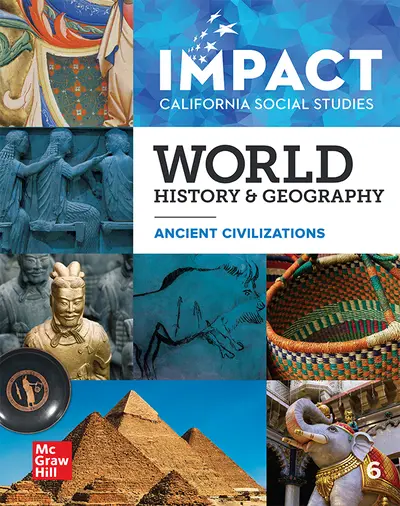
IMPACT California Social Studies, Grade 6
Grade 6History0 chapters, 0 lessons
IMPACT California Social Studies, Grade 6, published by McGraw-Hill, is a sixth-grade history textbook designed to meet California state standards for ancient world history. It guides students through the major civilizations of the ancient world, covering topics such as early humans and the Agricultural Revolution, Mesopotamia, Ancient Egypt and Kush, the Israelites, Ancient Greece, Ancient India, Early China, the Roman Republic and Empire, the rise of Christianity, and the pre-Columbian Americas. The course builds students' understanding of how early societies developed, interacted, and shaped the foundations of the modern world.
Chapters & Lessons
Frequently Asked Questions
- Is IMPACT California Social Studies Grade 6 right for my sixth grader?
- IMPACT California Social Studies Grade 6 is a McGraw-Hill program specifically designed for California's sixth-grade social studies standards, which focus on ancient world history. Its 11 chapters cover early humans, Mesopotamia, Egypt and Kush, the Israelites, Greece, Greek civilization, India, early China, Rome, Roman civilization, and the rise of Christianity—a comprehensive sweep of the ancient world. The IMPACT series uses primary sources, inquiry questions, and civic engagement activities throughout, making it more analytical than a traditional textbook. It is the right resource if your child's California school uses this edition. Compare it to History Alive! The Ancient World if your school uses that alternative for the same grade level content.
- Which chapters in IMPACT California Social Studies Grade 6 are hardest for students?
- Chapters 5 and 6 on the Ancient Greeks are consistently the most demanding—students must track democracy, philosophy, the Persian Wars, the Peloponnesian War, and Hellenistic culture across two full chapters with significant vocabulary and chronological complexity. Chapter 9 (Rome: Republic to Empire) requires students to understand the transformation from republic to empire—including the roles of Julius Caesar, Augustus, and the Senate—which is a dense political history lesson. Chapter 11 (The Rise of Christianity) covers religious history with nuance that requires careful reading. Chapter 4 (The Israelites) introduces religious and legal concepts from the Hebrew Bible that some students find unfamiliar and therefore challenging to analyze historically.
- My child struggles with ancient history—where should they start?
- Start with Chapter 1 (Early Humans and the Agricultural Revolution), which establishes the chronological and geographic framework the entire book depends on—how humans moved from hunter-gatherer bands to settled agricultural communities. Chapter 2 (Mesopotamia) is the ideal second stop: it is the most archetypal ancient civilization story and introduces concepts like city-states, writing, and law codes that reappear in every subsequent chapter. If your child is specifically confused about a later chapter like Chapter 7 (Ancient India) or Chapter 8 (Early China), reviewing the map at the start of that chapter and identifying the key river valley before reading the text typically resolves geographic confusion quickly.
- What should my child study after finishing IMPACT California Social Studies Grade 6?
- Seventh-grade social studies in California moves to medieval and early modern world history, typically using a program like History Alive! The Medieval World and Beyond, which picks up chronologically where this book's final chapters leave off. Students who have completed Chapter 11 (The Rise of Christianity) and the Rome chapters will find the medieval European chapters in seventh grade make much more sense, since they trace what happened to Rome after its fall. Students interested in deeper exploration of any civilization covered here—particularly Greece, Rome, or early China—can find supplemental resources on Pengi to extend their knowledge before starting seventh grade.
- How can Pengi help my child with IMPACT California Social Studies Grade 6?
- Pengi can strengthen your child's performance on the inquiry-based tasks that are central to the IMPACT curriculum. For the primary source analysis exercises—examining Hammurabi's Code in Chapter 2, Pericles' Funeral Oration in Chapter 5, or excerpts from the Roman Republic's legal documents in Chapter 9—Pengi can explain the historical context, help decode archaic language, and guide your child through the analytical questions the textbook poses. For civic engagement projects and writing assignments, Pengi can help organize arguments and verify historical accuracy. When your child has a chapter test on dense content like the Greek chapters, Pengi can run a focused review session targeting the specific terms and events the test will cover.
Ready to start learning?
Jump into your first lesson for IMPACT California Social Studies, Grade 6. Free, no account required.
Start Learning