
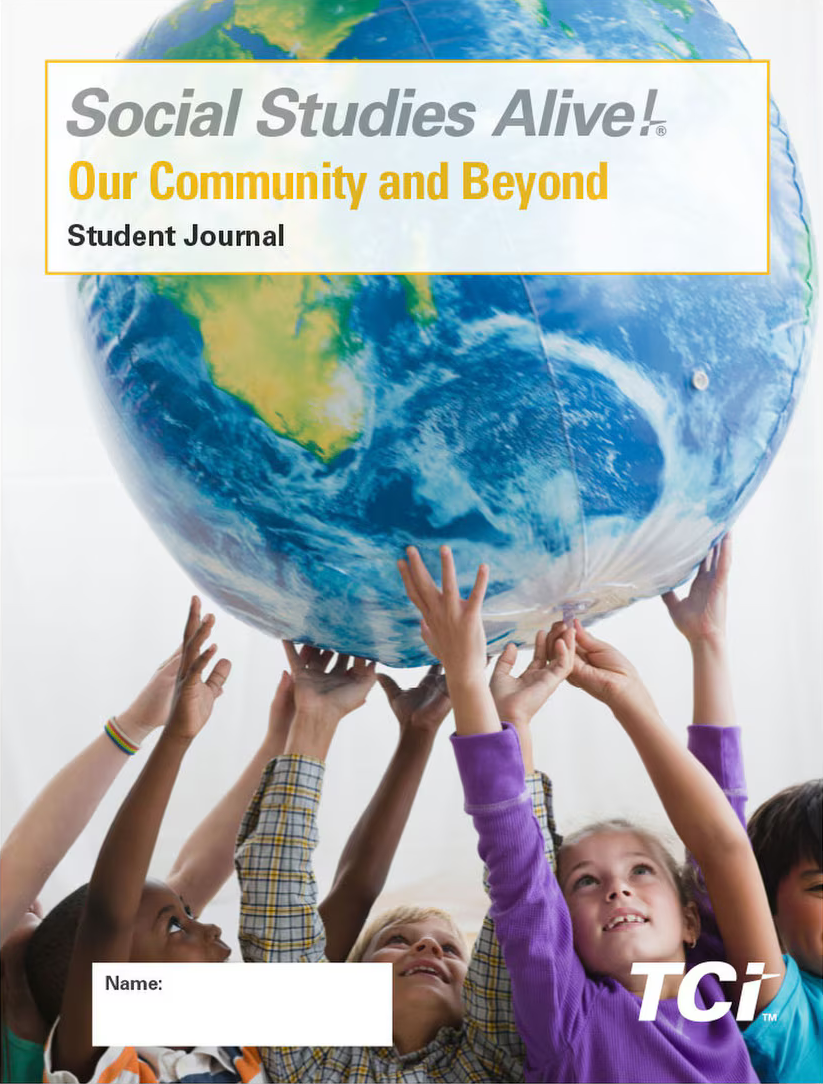
Social Studies Alive! Our Community and Beyond
Social Studies Alive! Our Community and Beyond, published by Teachers' Curriculum Institute (TCI), is a Grade 3 social studies textbook that introduces young learners to the world around them through four core areas: geography, history, economics, and civics. Students explore how communities are shaped by their physical environments, learn about local and regional history, develop foundational economic concepts such as goods, services, and trade, and discover how civic participation and government work at the community level. The program uses active, inquiry-based learning to help third graders connect classroom concepts to their everyday lives and the wider world beyond their neighborhoods.
Chapters & Lessons
Frequently Asked Questions
- Is Social Studies Alive! Our Community and Beyond right for my third grader?
- If your child is in third grade and their class uses this TCI textbook, it is a great program. It covers four core areas - geography, history, economics, and civics - through hands-on activities and inquiry-based learning, which works well for 8-9 year olds. It is strong for introducing goods and services, community government, and how physical geography shapes where people live. If you are a homeschooling parent looking for a structured Grade 3 social studies curriculum, this is one of the most widely adopted options available.
- Which topics in this textbook are hardest for third graders?
- The economics chapters tend to be the trickiest. Concepts like supply and demand, scarcity, and the difference between wants and needs are abstract for 8-year-olds. The civics lessons on how local government works - mayors, city councils, laws - also challenge students because most kids have no direct frame of reference. Geography Lesson 2 on map scales and latitude and longitude trips up students who have not developed spatial reasoning yet. Expect to spend extra time on any lesson requiring chart or map interpretation.
- My child struggles with economics concepts like goods and services. Where should they start?
- Start at the very beginning of the economics chapter - the lesson introducing the difference between goods and services. Make sure your child can give three examples of each from their own life before moving forward. Then work through lessons on needs vs. wants and spending vs. saving. Real-world examples from your family - grocery shopping, paying for a haircut - make these abstract ideas concrete. Avoid jumping to supply and demand until needs and wants feel solid.
- My child just finished this textbook. What social studies topics should they tackle next?
- Fourth grade social studies typically shifts to state history. In California that means California geography, Native American history, the mission era, the Gold Rush, and state government. TCI Social Studies Alive! California Promise is the Grade 4 companion to this book. For kids who loved the geography unit, learning all 50 states and capitals is great enrichment. The civics foundation from this book also sets them up well for deeper government content in grades 4 and 5.
- How can Pengi help my child with Social Studies Alive! Our Community and Beyond?
- Pengi can make abstract social studies concepts tangible for third graders. If your child is confused about scarcity or why communities have rules, Pengi explains it with simple examples drawn from the textbook content. Pengi is also great for test review - it can quiz your child on geography terms from Chapter 1 like hemispheres and continents, or economics vocabulary, and give immediate feedback. For the civics chapters on local government, Pengi can answer follow-up questions in plain language that a static textbook page cannot.
Ready to start learning?
Jump into your first lesson for Social Studies Alive! Our Community and Beyond. Free, no account required.
Start Learning