
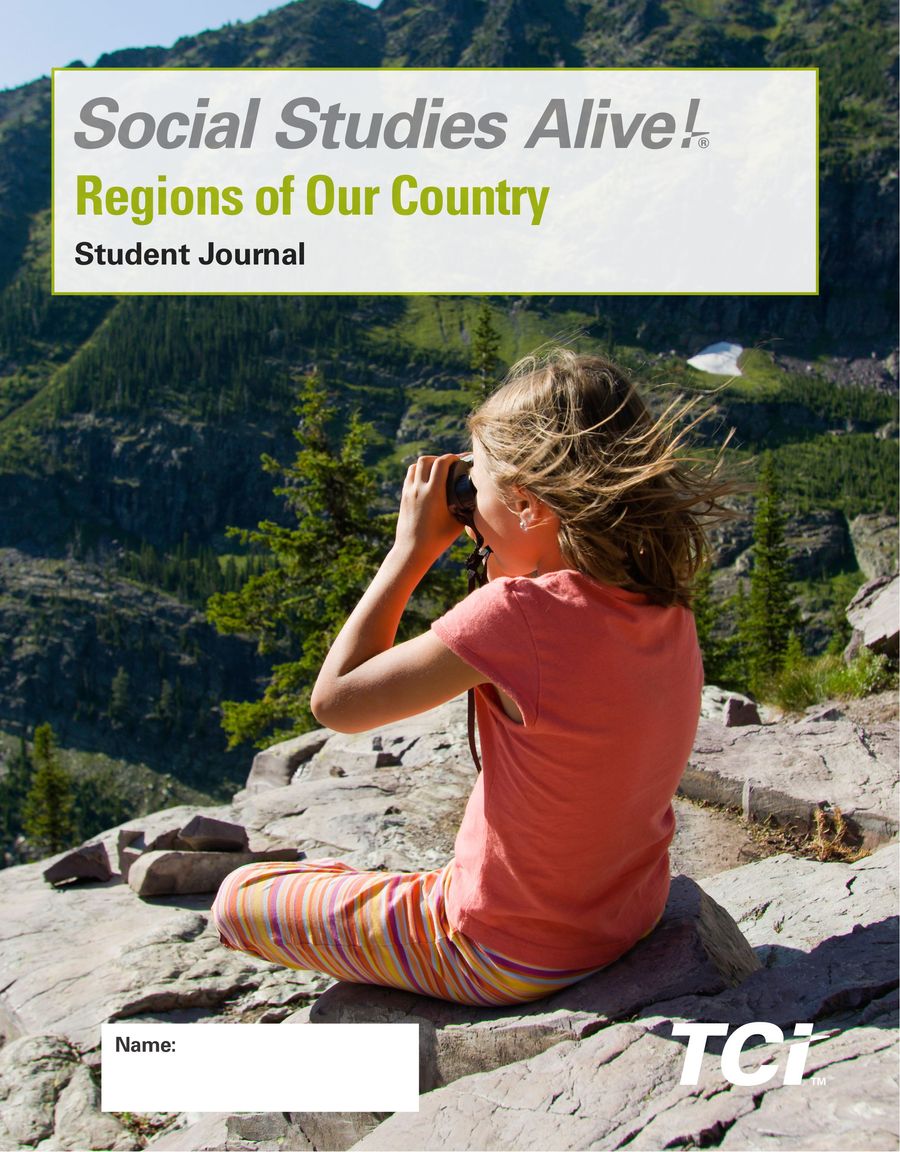
Social Studies Alive! Regions of Our Country
Grade 4History0 chapters, 0 lessons
Social Studies Alive! Regions of Our Country, published by TCI (Teachers' Curriculum Institute) for Grade 4, is a history and social studies textbook that introduces students to the five major regions of the United States: the Northeast, Southeast, Midwest, Southwest, and West. Each regional unit explores the geography, culture, economy, and people that make each area unique, grounding lessons in the broader social sciences framework introduced in the opening chapter. The program also guides students through an inquiry-based project focused on their own state, helping them apply regional thinking to their local community.
Chapters & Lessons
Frequently Asked Questions
- Is Social Studies Alive! Regions of Our Country right for my 4th grader?
- Social Studies Alive! Regions of Our Country is a well-structured Grade 4 social studies curriculum by TCI, widely used across the US. It takes an inquiry-based approach to the five US regions - Northeast, Southeast, Midwest, Southwest, and West - covering geography, economics, culture, and history in each. Chapter 7's state inquiry project helps kids connect the content to where they actually live. If your child learns through maps, visuals, and projects, this program is an excellent fit for building geographic and civic thinking before Grade 5 history.
- Which chapters are hardest for 4th graders in Social Studies Alive! Regions of Our Country?
- Chapter 2 (The Northeast) challenges students with population density maps and the megalopolis concept. Chapter 5 (The Southwest) involves abstract ideas like water rights and the Colorado River basin that many 9-year-olds find difficult. Chapter 7 (Inquiry: Studying Your State) requires distinguishing primary from secondary sources, which is new territory for most 4th graders. The vocabulary load is also heavy throughout - words like segregation, agribusiness, and aqueduct appear without much scaffolding, so intentional vocabulary review is important.
- My child is weak in geography skills - where should they start in this book?
- Start with Chapter 1, Lesson 2: Exploring Regions of the United States, which explicitly teaches the five themes of geography and foundational map skills including latitude, longitude, scale, and special-purpose maps. This lesson is the geographic toolkit for the entire book, so building fluency here pays off in every chapter that follows. If map reading stays difficult after Lesson 2, spend extra time on those activities before moving into the regional chapters. Pengi can walk your child through map interpretation with guided practice questions tied directly to this textbook.
- What should my child study after completing Social Studies Alive! Regions of Our Country?
- After finishing this book, students are ready for Grade 5 social studies, which typically covers US history from Native Americans through the colonial era and American Revolution. The geographic and regional thinking built here - especially the five themes of geography from Chapter 1 - carries forward into 5th and 6th grade history. If your child enjoyed the economics angle in Chapter 7, consider supplementing with introductory economics resources. Strong readers can also explore nonfiction books about specific US regions they found most interesting.
- How can Pengi help my child with Social Studies Alive! Regions of Our Country?
- Pengi can help your 4th grader understand concepts, vocabulary, and geographic thinking throughout this textbook. Whether your child is confused about how the Midwest became America's Breadbasket in Chapter 4, struggling with a population density map from Chapter 2, or unsure how to approach the state inquiry project in Chapter 7, Pengi gives patient, conversational explanations on demand. Pengi can also quiz your child on key vocabulary like delta, reservation, and plateau before a test, making review more effective than simply re-reading the textbook.
Ready to start learning?
Jump into your first lesson for Social Studies Alive! Regions of Our Country. Free, no account required.
Start Learning