Pengi Editor's Note
This article offers a detailed analysis of the 2016 Math Kangaroo exam across Levels 1–2 and 3–4, including topic breakdowns, module-to-question mapping, fully worked example problems, and a complete answer key for both levels. Pengi's editorial team selected this piece because it gives students and parents a clear picture of what Math Kangaroo tests at each grade band — the common-mistake sections are particularly useful for targeted practice.
Source: Think Academy Blog
2016 Math Kangaroo Real Questions and Analysis
In this article, you'll find:
- A topic distribution chart for the 2016 Math Kangaroo Levels 1–4
- Key concepts tested in each topic
- A question–module mapping table
- Several real 2016 questions with solutions and common mistakes
- Study tips and resources to prepare effectively for Math Kangaroo
2016 Math Kangaroo Overview
The Math Kangaroo competition consists of a single 75-minute multiple-choice test with five answer options per question. Students can participate either online or on paper.
Scoring Structure
- Grades 1–4: 24 questions, maximum score of 96 points
- Grades 5–12: 30 questions, maximum score of 120 points
Levels 1-2 Analysis
Topic Distribution
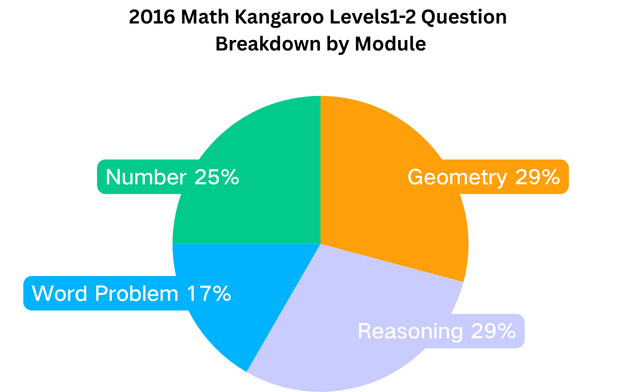
The 2016 Math Kangaroo Levels 1–2 exam emphasizes spatial and visual thinking (29%) as well as logical reasoning (29%), while also testing basic number sense (25%) and everyday word problems (17%).
Detailed Module Summary
| Module | Question Numbers | What It Tests (Brief) |
|---|---|---|
| Geometry | Q5, Q8, Q17, Q18, Q19, Q21, Q23 | Maze; building and counting blocks; puzzles; squares, arranging and dividing shapes; opposite faces |
| Reasoning | Q2, Q9, Q10, Q13, Q15, Q20, Q22 | Visual tracking; positional reasoning; rule-based logic; matching reasoning; sum–difference logic |
| Word Problem | Q4, Q11, Q14, Q16 | Basic addition & subtraction word problems; age and month problems; sum–difference problems |
| Number | Q1, Q3, Q6, Q7, Q12, Q24 | Counting; subtraction; grouping numbers |
Real Questions and Solutions Explained
Geometry Example – Problem 17
Question:
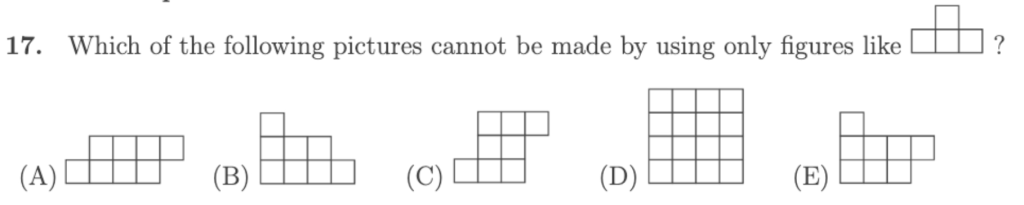
Solution:
Only (E) cannot be made from "T" shapes.

Answer: E
Common Mistakes:
- Thinking that shapes just need to match in size, not structure.
- Forgetting to rotate the "T" shape to test different fits.
Reasoning Example – Problem 20
Question:
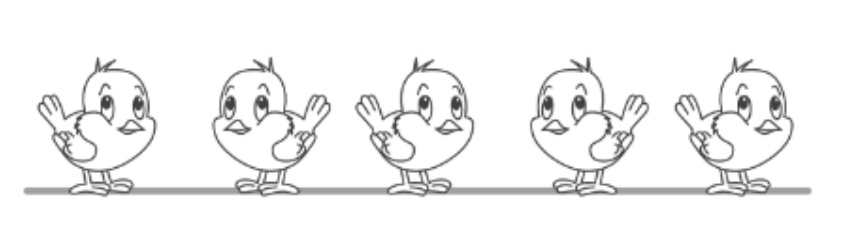
Five sparrows sat on a wire as shown in the picture. Each sparrow chirped only once to each bird it saw on the side it faced. For example, the second sparrow chirped one time. In total, how many times did they chirp?
(A) 6 (B) 8 (C) 9 (D) 10 (E) 12
Solution:
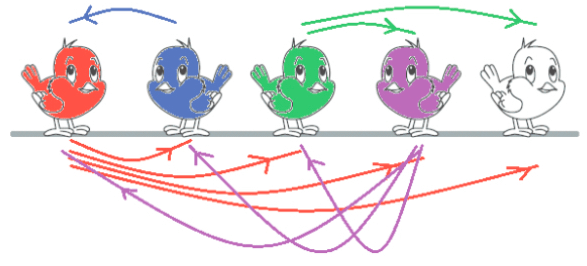
Look at each sparrow and count how many birds it can see (in the direction it's facing):
- The first sparrow (red) looks right → sees 4 birds → chirps 4 times
- The second sparrow (blue) looks left → sees 1 bird → chirps 1 time
- The third sparrow (green) looks right → sees 2 birds → chirps 2 times
- The fourth sparrow (purple) looks left → sees 3 birds → chirps 3 times
- The fifth sparrow looks right → sees no one → chirps 0 times
Add them up: 4 + 1 + 2 + 3 + 0 = 10
Answer: D
Common Mistakes:
- Forgetting which way the birds are facing and counting all the birds, not just the ones seen.
- Double-counting chirps or skipping a bird.
Word Problem Example – Problem 4
Question:
In a cave, there were only two seahorses, one starfish, and three turtles. Later, five seahorses, three starfish, and four turtles joined them. How many sea animals gathered in the cave?
(A) 6 (B) 9 (C) 12 (D) 15 (E) 18
Solution:
First, count the animals already in the cave: 2 + 1 + 3 = 6 animals. Next, count the animals that joined: 5 + 3 + 4 = 12 animals. Last, add both groups together: 6 + 12 = 18 animals.
Answer: E
Common Mistakes:
- Forgetting to add the animals that joined later
Number Example – Problem 6
Question:
Ten friends came to John's birthday party. Six of them were girls. How many boys were at the party?
(A) 4 (B) 5 (C) 6 (D) 7 (E) 8
Solution:
John had 10 friends at the party, and 6 of them were girls. That means 4 of the friends were boys: 10 − 6 = 4. But the question asks for how many boys were at the party, and John himself is a boy and is also at the party. So total boys = 4 boy friends + John = 5 boys.
Answer: B
Common Mistakes:
- Forgetting to include John in the total count
- Misreading the question as asking only about John's friends, not the total boys present
Levels 3-4 Analysis
Topic Distribution
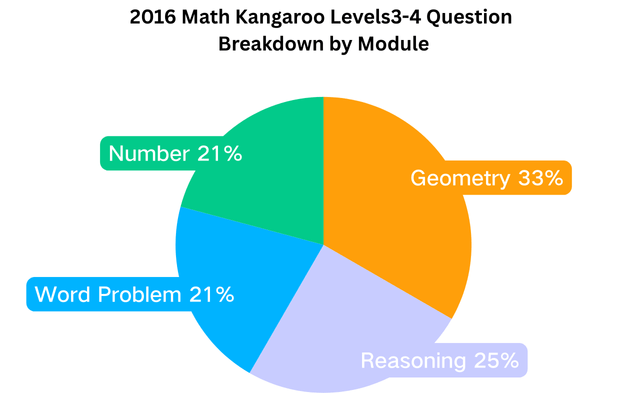
The 2016 Math Kangaroo Levels 3–4 exam places balanced emphasis on geometry (33%) and reasoning (25%), while also incorporating number problems (21%) and word problems (21%) to test well-rounded mathematical thinking.
Detailed Module Summary
| Module | Question Numbers | What It Tests (Brief) |
|---|---|---|
| Geometry | Q4, Q5, Q7, Q8, Q12, Q13, Q14, Q17 | Symmetry and mirror reflection; identifying 2D shapes; puzzles; direction & positions; forming shapes; rotations |
| Reasoning | Q10, Q15, Q16, Q21, Q23, Q24 | Reasoning with positions; logic rules; adjacency reasoning; equivalent substitution reasoning; patterns; rule-based logic |
| Word Problem | Q2, Q6, Q18, Q19, Q20 | Time problems; half word problems; age problems; multiples problems |
| Number | Q1, Q3, Q9, Q11, Q22 | Counting & comparing; addition & subtraction; digits; sums |
Real Questions and Solutions Explained
Geometry Example – Problem 8
Question:
Which one of the following sentences correctly describes the picture on the left?
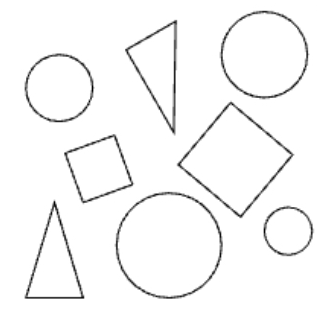
(A) There are as many circles as squares.
(B) There are fewer circles than triangles.
(C) There are twice as many circles as triangles.
(D) There are more squares than triangles.
(E) There are two triangles more than circles.
Solution:
First, count each shape in the picture: Circles: 4; Squares: 2; Triangles: 2. So the correct description is that there are twice as many circles as triangles.
Answer: C
Common Mistakes:
- Mixing up circles and squares
- Not checking all options carefully
Reasoning Example – Problem 21
Question:
Karin wants to place five bowls on a table in order of their weight. She already placed bowls Q, R, S, and T in order. Bowl T weighs the most. Where must she place bowl Z?
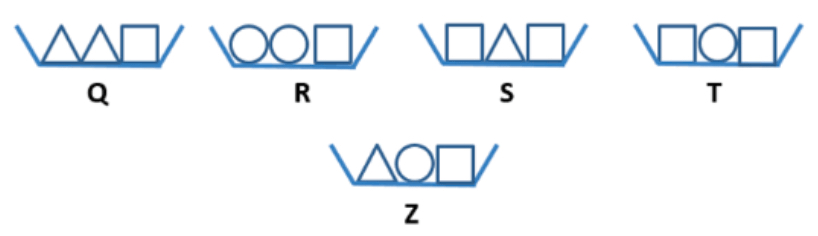
(A) to the left of bowl Q (B) between bowl Q and bowl R
(C) between bowl R and bowl S (D) between bowl S and bowl T (E) to the right of bowl T
Solution:
To find the correct position for bowl Z, compare the shapes inside each bowl:
Comparing Q and R: removing the same square from both shows that a triangle weighs less than a circle.
Now compare Z:
Bowl Z has one triangle, one circle, and one square — same as R.
Comparing Z and Q: both have a triangle and a square, but Z also has a circle, which makes Z heavier than Q.
Comparing Z and R: both have the same shapes, so Z weighs the same as R, but since the question asks for order, and R is already placed after Q, Z must be placed between Q and R.
Answer: B
Common Mistakes:
- Forgetting to compare only the extra shapes when both bowls share common ones.
Word Problem Example – Problem 18
Question:
Tim, Tom, and Jim are triplets (three brothers born on the same day). Their brother Paul is exactly 3 years older. Which of the following numbers can be the sum of the ages of the four brothers?
(A) 25 (B) 27 (C) 29 (D) 30 (E) 60
Solution:
Paul is 3 years older than the triplets. So, if each triplet is the same age, let's call that age X. Then the total age = X + X + X + (X + 3) = 4X + 3. We check which option gives a total that is 3 more than a multiple of 4. Only 27 works: 27 − 3 = 24, and 24 ÷ 4 = 6.
Answer: B
Common Mistakes:
- Adding random numbers without checking the age difference.
- Not checking if the remaining sum (after subtracting 3) is divisible by 4.
Number Example – Problem 11
Question:
Zoe has two cards. She wrote a number on each side of both cards. The sum of the two numbers on the first card is equal to the sum of the two numbers on the second card. The sum of the four numbers is 32. What could be the two numbers on the sides that we cannot see?
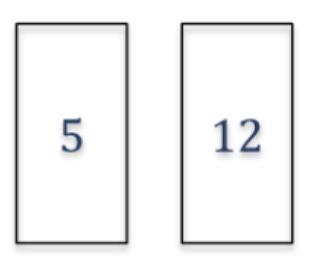
(A) 7 and 0 (B) 8 and 1 (C) 11 and 4 (D) 9 and 2 (E) 6 and 3
Solution:
We are told the two cards have equal sums on each side, and the total of all four numbers is 32. If both card sums are equal, that means each card adds up to 16 (because 32 ÷ 2 = 16). We can see one side of each card: 5 and 12. So the hidden sides must be 16 − 5 = 11 and 16 − 12 = 4.
Answer: C
Common Mistakes:
- Adding only the visible numbers without dividing total into two equal parts
- Not subtracting from the correct total (32 ÷ 2 = 16 for each card)
- Trying to guess without checking total sum logic
2016 Math Kangaroo Answer Key
| Question | Level 1 & 2 | Level 3 & 4 |
|---|---|---|
| 1 | D | E |
| 2 | B | E |
| 3 | D | A |
| 4 | E | A |
| 5 | C | D |
| 6 | B | B |
| 7 | C | A |
| 8 | A | C |
| 9 | D | B |
| 10 | C | B |
| 11 | E | C |
| 12 | C | B |
| 13 | B | D |
| 14 | B | A |
| 15 | A | C |
| 16 | E | D |
| 17 | E | D |
| 18 | A | B |
| 19 | D | D |
| 20 | D | C |
| 21 | A | B |
| 22 | E | C |
| 23 | A | E |
| 24 | C | B |
Best Resources to Prepare for Math Kangaroo
Free Download: MK Collection of Common Mistakes
Help your child avoid the mistakes most kids make on the hardest MK questions.
Download MK Level 1-2 Collection of Common Mistakes in 4 & 5 Point Questions
Download MK Level 3-4 Collection of Common Mistakes in 4 & 5 Point Questions
Try Pengi AI — Smarter Math Practice for Students
Pengi AI supports K–12 learners with personalized math practice, guided explanations, and feedback designed to help them build confidence and improve steadily.