Pengi Editor's Note
This article provides a complete breakdown of the 2019 Math Kangaroo competition for both Levels 1–2 and Levels 3–4, including topic distributions, worked example problems, and full answer keys. The Pengi editorial team recommends this resource for younger students and their parents who want to understand what Math Kangaroo tests and how to approach the most common problem types.
Source: Think Academy Blog
2019 Math Kangaroo Real Questions and Analysis
In this article, you'll find:
- A topic distribution chart for the 2019 Math Kangaroo Levels 1–4
- Key concepts tested in each topic
- A question–module mapping table
- Several real 2019 questions with solutions and common mistakes
- Study tips and resources to prepare effectively for Math Kangaroo
2019 Math Kangaroo Overview
The Math Kangaroo competition consists of a single 75-minute multiple-choice test with five answer options per question. Students can participate either online or on paper.
Scoring Structure
- Grades 1–4: 24 questions, maximum score of 96 points
- Grades 5–12: 30 questions, maximum score of 120 points
Levels 1-2 Analysis
Topic Distribution
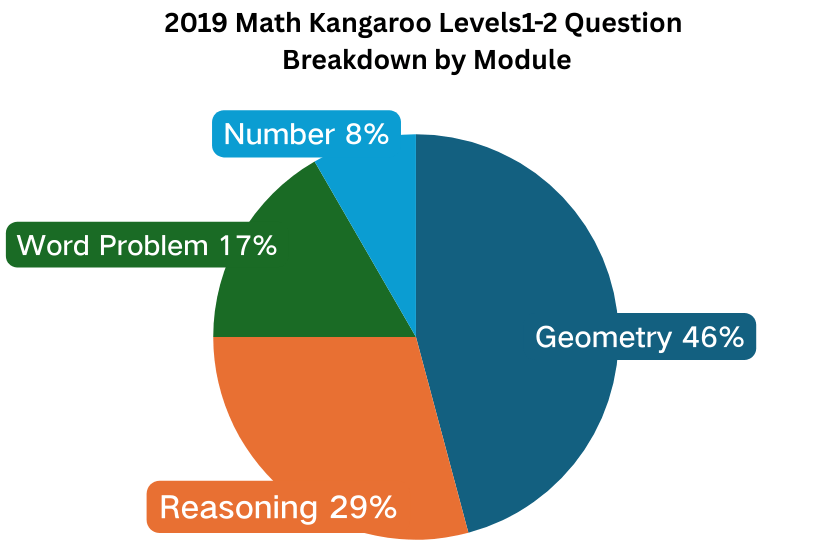
The 2019 Math Kangaroo Levels 1–2 exam emphasizes geometry (46%) and strong logical reasoning (29%), with word problems (17%) and number sense (8%) playing smaller supporting roles.
Detailed Module Summary
| Module | Question Numbers | What It Tests (Brief) |
|---|---|---|
| Geometry | Q2, Q4, Q5, Q7, Q9, Q10, Q13, Q14, Q15, Q18, Q21 | 2D shape composition, cube views & visible faces, perimeter, divide shapes, nets & folding, rotation, grid transformations |
| Reasoning | Q8, Q11, Q12, Q20, Q22, Q23, Q24 | Substitution, routes planning, pattern reasoning logic |
| Word Problem | Q3, Q16, Q17, Q19 | Basic comparison & difference, least amount, time; calendar, price problems |
| Number | Q1, Q6 | Counting & pairing |
Real Questions and Solutions Explained
Geometry Example – Problem 14
Question:
Each of the shapes shown is made by gluing together four cubes of the same size. The shapes will be painted. Which shape has the smallest area to be painted?
Solution:
Each cube has 6 faces, but when cubes are stuck together, some faces are hidden. To find the shape with the smallest painted area, count how many faces are still showing. Shape B has the fewest visible faces (only 16). That means it has the smallest painted area.
Answer: B
Common Mistakes:
- Thinking all shapes have the same area just because they use 4 cubes.
- Forgetting that touching sides are not painted.
Reasoning Example – Problem 12
Question:
A cat and a bowl of milk are in opposite corners of the board. The cat can only move as shown by the arrows. In how many ways can the cat reach the milk?
(A) 2 (B) 3 (C) 4 (D) 5 (E) 6
Solution:
To reach the milk, the cat must make 2 right moves and 2 down moves, no matter what path it takes. There are different orders the cat can do these 4 steps (like: right, down, right, down… or down, right, down, right…). By checking all possible paths or tracing them like in the picture, there are 6 different ways for the cat to reach the milk.
Answer: E
Common Mistakes:
- Forgetting the cat can only move right or down (not up or left)
- Repeating the same path or missing paths
- Thinking the cat can go diagonally or skip steps
Word Problem Example – Problem 3
Question:
Together, Mom Kangaroo and her son Jumper weigh 60 kilograms. Mom Kangaroo alone weighs 52 kilograms. How much does Jumper weigh?
(A) 2 kilograms (B) 4 kilograms (C) 8 kilograms
(D) 30 kilograms (E) 46 kilograms
Solution:
The total weight of Mom and Jumper is 60 kg. Mom by herself weighs 52 kg. To find how much Jumper weighs, subtract: 60 − 52 = 8 kilograms.
Answer: C
Common Mistakes:
- Adding instead of subtracting
Number Example – Problem 6
Question:
Jorge pairs his socks so that the numbers match. How many pairs can he make?
(A) 3 (B) 4 (C) 5 (D) 6 (E) 8
Solution:
The socks with numbers 1, 2, 3, 5, and 7 can be paired up. The socks with 4, 6, and 8 do not have matches.
Answer: C
Common Mistakes:
- Trying to pair socks with different numbers
Levels 3-4 Analysis
Topic Distribution
The 2019 Math Kangaroo Levels 3–4 exam prioritizes reasoning (38%) alongside substantial geometry (33%) and solid number work (29%), meaning many problems require clear step-by-step reasoning with basic number skills.
Detailed Module Summary
| Module | Question Numbers | What It Tests (Brief) |
|---|---|---|
| Geometry | Q4, Q6, Q5, Q7, Q10, Q11, Q18, Q20 | Transformations (translation/rotation/reflection), shape composition, cube/nets & surface painting, area/perimeter, 3D views & overlays |
| Reasoning | Q1, Q9, Q13, Q16, Q17, Q21, Q22, Q23, Q24 | Logic, ordering with rules, combinatorial selection, schedule |
| Number | Q2, Q3, Q8, Q12, Q14, Q15, Q19 | Arithmetic structures & expressions, digits, sums, counting by cases |
Real Questions and Solutions Explained
Geometry Example – Problem 18
Question:
Anna used 32 small white squares to frame a 7 by 7 picture. How many of these small white squares does she need to frame a 10 by 10 picture?
(A) 36 (B) 40 (C) 44 (D) 48 (E) 52
Solution:
For a 10×10 picture: Each side needs 10 squares. There are 4 sides: 10 (top) + 10 (bottom) + 10 (left) + 10 (right) = 40. And 4 corners: 40 + 4 = 44 squares.
Answer: C
Common Mistakes:
- Forgetting to add the 4 corner squares
Reasoning Example – Problem 21
Question:
In a park there are 15 animals: cows, cats, and kangaroos. We know that precisely 10 are not cows and precisely 8 are not cats. How many kangaroos are there in the park?
(A) 2 (B) 3 (C) 4 (D) 8 (E) 10
Solution:
There are 15 animals in the park: cows, cats, and kangaroos.
- 10 animals are not cows → Cows = 15 − 10 = 5
- 8 animals are not cats → Cats = 15 − 8 = 7
- Kangaroos = 15 − 5 − 7 = 3
Answer: B
Common Mistakes:
- Confusing "not cows" or "not cats" as the number of cows or cats.
- Forgetting that the total includes cows, cats, and kangaroos altogether.
Number Example – Problem 12
Question:
The weight of a dog toy is a whole number. How much does one dog toy weigh?
(A) 7 kg (B) 8 kg (C) 9 kg (D) 10 kg (E) 11 kg
Solution:
From the first scale, one dog is lighter than 12 kg. From the second scale, two dogs together weigh more than 20 kg, so each must be heavier than 10 kg. The only whole number that is more than 10 and less than 12 is 11.
Answer: E
Common Mistakes:
- Missing the clue that 2 dogs > 20 kg means each is over 10 kg.
- Choosing 10 kg, forgetting it must be more than 10 and less than 12.
2019 Math Kangaroo Answer Key
| Question | Level 1 & 2 | Level 3 & 4 |
|---|---|---|
| 1 | D | E |
| 2 | C | C |
| 3 | C | A |
| 4 | E | D |
| 5 | B | A |
| 6 | C | A |
| 7 | A | D |
| 8 | C | B |
| 9 | E | B |
| 10 | B | C |
| 11 | A | C |
| 12 | E | E |
| 13 | B | B |
| 14 | B | A |
| 15 | E | D |
| 16 | D | D |
| 17 | D | E |
| 18 | A | C |
| 19 | D | B |
| 20 | B | E |
| 21 | C | B |
| 22 | D | E |
| 23 | A | B |
| 24 | C | D |
Try Pengi AI — Smarter Math Practice for Students
Pengi AI supports K–12 learners with personalized math practice, guided explanations, and feedback designed to help them build confidence and improve steadily.