Pengi Editor's Note: This article was originally published by Think Academy. We're sharing it here for educational value. Think Academy is a leading K-12 math education provider.
Distributive Property: Formulas, School and AMC 8 Examples
The distributive property is one of the most fundamental tools in mathematics. It appears in basic arithmetic, algebra, and even competition math problems on exams like the AMC 8.
What Is the Distributive Property?
The distributive property states:
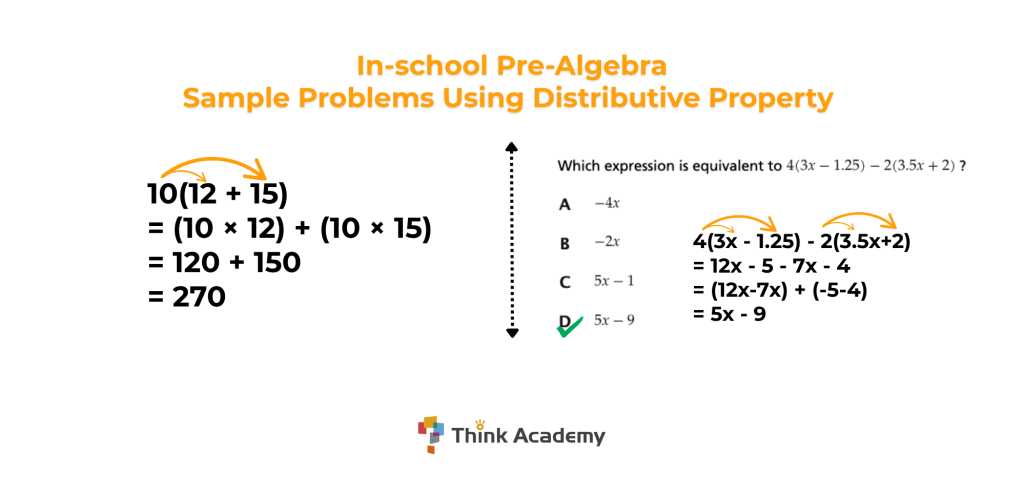
a(b + c) = ab + ac
In words: multiplying a number by a sum is the same as multiplying that number by each term in the sum and then adding the results.
This works for subtraction too:
a(b − c) = ab − ac
Why Does the Distributive Property Work?
Think of it visually. If you have 3 groups of (4 + 5):
3 × (4 + 5) = 3 × 4 + 3 × 5 = 12 + 15 = 27
You could also compute it directly: 3 × 9 = 27. The distributive property just gives you another (often more useful) path to the same answer.
School-Level Examples
Example 1 — Basic Arithmetic
Simplify: 6 × (10 + 3)
Solution:
6 × 10 + 6 × 3 = 60 + 18 = 78
Example 2 — Algebraic Expressions
Expand: 5(2x + 7)
Solution:
5 × 2x + 5 × 7 = 10x + 35
Example 3 — With Negative Numbers
Expand: −3(x − 4)
Solution:
−3 × x + (−3) × (−4) = −3x + 12
Example 4 — Combining Like Terms After Distribution
Simplify: 2(3x + 5) + 4(x − 1)
Solution:
6x + 10 + 4x − 4 = 10x + 6
AMC 8 Application Examples
The distributive property appears frequently in AMC 8 problems, often in slightly disguised forms.
AMC-Style Example 1
Compute: 99 × 101
Solution:
Rewrite as (100 − 1)(100 + 1) = 100² − 1² = 10000 − 1 = 9999
This uses the difference of squares pattern, which is derived from the distributive property.
AMC-Style Example 2
What is 37 × 8 + 37 × 12?
Solution:
Factor out 37: 37(8 + 12) = 37 × 20 = 740
This is the distributive property in reverse — factoring before multiplying saves significant time.
AMC-Style Example 3
If x = 49, compute: x² − 2x + 1
Solution:
Recognize: x² − 2x + 1 = (x − 1)²
(49 − 1)² = 48² = 2304
Common Mistakes to Avoid
- Forgetting to distribute to all terms: 3(x + 4) ≠ 3x + 4. You must write 3x + 12.
- Sign errors: −2(x − 5) = −2x + 10 (not −2x − 10).
- Stopping too early: Always check if terms can be combined after distributing.
Practice Problems
- Expand: 7(3x − 2)
- Simplify: 4(2x + 3) − 3(x − 5)
- Compute: 102 × 98 using the distributive property.
Want more printable practice?
Explore the K–12 Worksheets Hub
Related Articles
Try Pengi AI — Smarter Math Practice for Students
Pengi AI supports K–12 learners with personalized math practice, guided explanations, and feedback designed to help them build confidence and improve steadily.