
Pengi Editor's Note: This article was originally published by Think Academy. We're sharing it here for educational value. Think Academy is a leading K-12 math education provider.
How to Divide Polynomials in 4 Simple Steps
Polynomial long division is an essential algebra skill that extends the concept of numerical long division to algebraic expressions. It's used to divide a polynomial by another polynomial of equal or lesser degree.
When to Use Polynomial Long Division
Use polynomial long division when dividing a polynomial by a binomial (or higher degree polynomial). For division by a monomial, simply divide each term separately.
Example of when you need long division:
- (x³ + 2x² − x − 6) ÷ (x − 2) ← use long division
- (6x² + 4x) ÷ 2x ← divide each term (no long division needed)
The 4-Step Process
Repeat these steps until the degree of the remainder is less than the degree of the divisor:
Step 1: Divide — Divide the leading term of the dividend by the leading term of the divisor.
Step 2: Multiply — Multiply the result by the entire divisor.
Step 3: Subtract — Subtract from the current dividend.
Step 4: Bring Down — Bring down the next term and repeat.
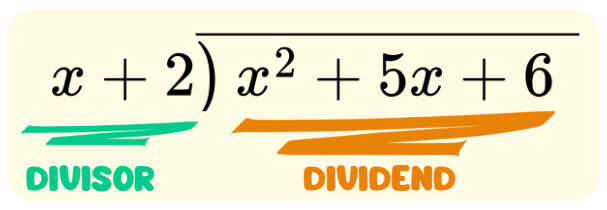
Example 1: (x² + 5x + 6) ÷ (x + 2)
Set up the long division:
         ________
(x + 2) | x² + 5x + 6
Step 1: Divide x² ÷ x = x
Write x above the division bar.
Step 2: Multiply x × (x + 2) = x² + 2x
Step 3: Subtract
(x² + 5x + 6) − (x² + 2x) = 3x + 6
Step 4: Bring down (already done)
Repeat with 3x + 6:
Step 1: Divide 3x ÷ x = 3
Write +3 next to the x.
Step 2: Multiply 3 × (x + 2) = 3x + 6
Step 3: Subtract
(3x + 6) − (3x + 6) = 0
Answer: x + 3 (no remainder)
Check: (x + 3)(x + 2) = x² + 2x + 3x + 6 = x² + 5x + 6 ✓
Example 2: (2x³ − 3x² + x − 2) ÷ (x − 1)
Step 1: 2x³ ÷ x = 2x²
2x² × (x − 1) = 2x³ − 2x²
Subtract: (2x³ − 3x² + x − 2) − (2x³ − 2x²) = −x² + x − 2
Step 2: −x² ÷ x = −x
−x × (x − 1) = −x² + x
Subtract: (−x² + x − 2) − (−x² + x) = −2
Step 3: −2 ÷ x — degree of −2 (degree 0) < degree of x (degree 1)
Remainder = −2
Answer: 2x² − x with remainder −2
Written as: 2x² − x + (−2)/(x − 1) or 2x² − x − 2/(x − 1)
Example 3: Missing Terms — (x³ − 8) ÷ (x − 2)
When the polynomial has missing terms, insert placeholders with coefficient 0:
(x³ + 0x² + 0x − 8) ÷ (x − 2)
Step 1: x³ ÷ x = x²
x² × (x − 2) = x³ − 2x²
Subtract: x³ + 0x² − (x³ − 2x²) = 2x²
Bring down 0x: 2x² + 0x
Step 2: 2x² ÷ x = 2x
2x × (x − 2) = 2x² − 4x
Subtract: 2x² + 0x − (2x² − 4x) = 4x
Bring down −8: 4x − 8
Step 3: 4x ÷ x = 4
4 × (x − 2) = 4x − 8
Subtract: (4x − 8) − (4x − 8) = 0
Answer: x² + 2x + 4
(Note: This is the factored form of the difference of cubes: x³ − 8 = (x − 2)(x² + 2x + 4))
Common Mistakes
- Forgetting to write placeholder terms: If the polynomial has gaps (e.g., x³ + 1 with no x² or x term), insert 0 coefficients.
- Sign errors in subtraction: After multiplying, you subtract the entire product — change all signs before adding.
- Stopping too early: Continue dividing until the degree of the remainder is less than the degree of the divisor.
Practice Problems
- (x² + 7x + 12) ÷ (x + 3)
- (2x² + 5x − 3) ÷ (x + 3)
- (x³ − 27) ÷ (x − 3)
- (3x³ + 2x² − x + 5) ÷ (x + 2)
Want more printable practice?
Explore the K–12 Worksheets Hub
Try Pengi AI — Smarter Math Practice for Students
Pengi AI supports K–12 learners with personalized math practice, guided explanations, and feedback designed to help them build confidence and improve steadily.