Pengi Editor's Note: This article was originally published by Think Academy. We're sharing it here for educational value. Think Academy is a leading K-12 math education provider.
How to Excel at AMC 10: Reaching AIME and USAJMO
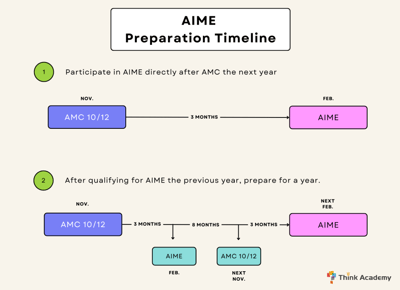
The AMC 10 is not just a math competition — it's a gateway to AIME, USAJMO, and ultimately USA(J)MO. Students who want to reach these levels need more than good grades; they need a systematic, multi-year preparation strategy.
Understanding the Competition Pathway
The AMC competition pathway for AMC 10 students:
- AMC 10A or 10B → Top scorers qualify for AIME
- AIME → Top scorers qualify for USAJMO (via AMC 10) or USAMO (via AMC 12)
- USAJMO/USAMO → Top performers selected for IMO Team
Key score thresholds (approximate):
- AMC 10 → AIME: score ~96–105+ (varies by year)
- AIME (score out of 15): need ~8–10 for USAJMO qualification
- USAJMO qualification index (AMC 10 + 10×AIME): approximately 215+
Phase 1: AMC 10 Foundation (12–18 months before first attempt)
Core Content to Master
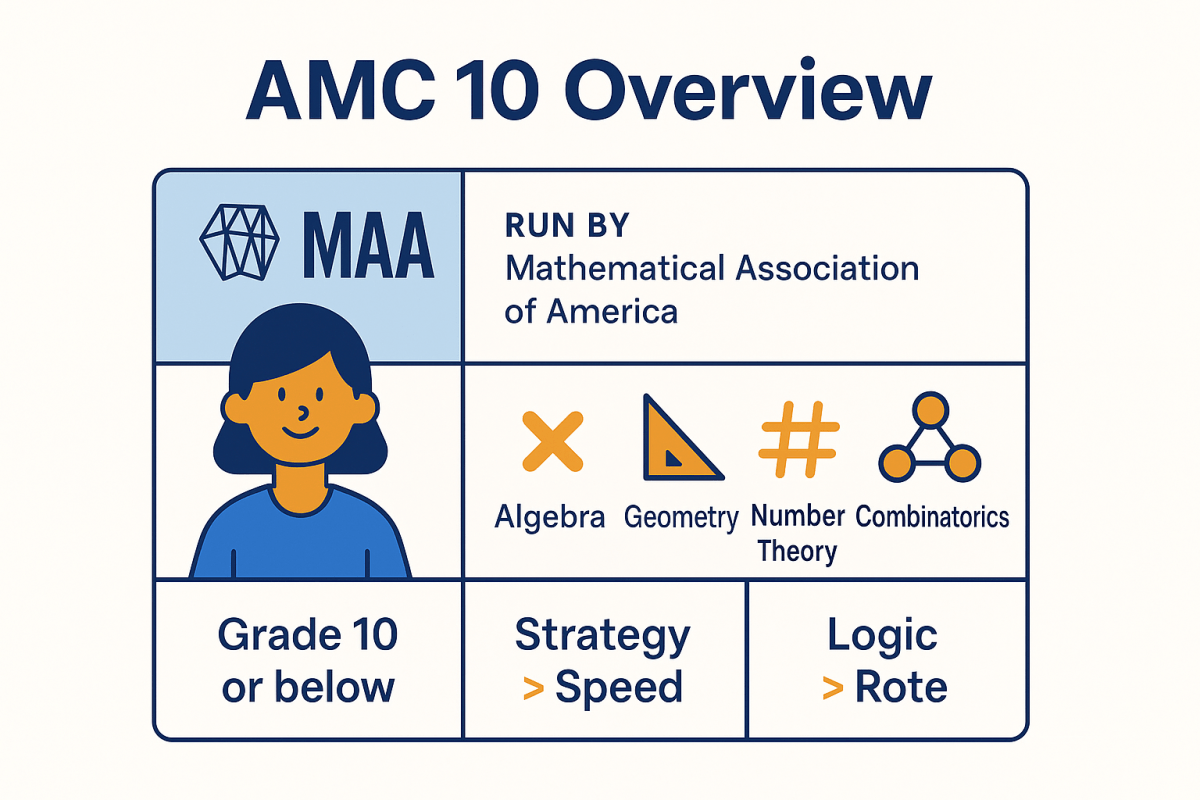
The AMC 10 tests content beyond standard high school math:
Algebra:
- Quadratic equations and Vieta's formulas
- Systems of equations (linear and non-linear)
- Polynomial roots and factoring
- Sequences and series (arithmetic, geometric)
- Logarithms and exponentials
Geometry:
- Similar triangles and ratios
- Circle theorems (inscribed angles, power of a point, radical axis)
- Area of irregular shapes (shoelace formula, Pick's theorem)
- 3D geometry (volumes, surface areas)
- Coordinate geometry
Number Theory:
- Modular arithmetic and congruences
- Integer factoring and GCD/LCM
- Diophantine equations (linear)
- Prime factorization applications
Combinatorics:
- Counting principles (multiplication, addition)
- Permutations and combinations
- Pigeonhole principle
- Basic probability
Recommended Study Resources
- AoPS Introduction Series: Complete all four books (Algebra, Counting & Probability, Number Theory, Geometry). This is non-negotiable.
- Past AMC 10 Problems: Work through the last 10 years systematically.
- AoPS Online Courses: AMC 10 Prep courses structure the preparation effectively.
Target Score at This Stage
After Phase 1 preparation, a dedicated student should be scoring 70–90 on AMC 10 practice tests consistently.
Phase 2: AIME Qualification (6–12 months)
What Changes at the AIME Level
To reach AIME qualification (~96–105+), the content gaps are less important than:
- Problem synthesis: AIME-level problems on AMC 10 (questions 20–30) require combining multiple concepts in a single problem.
- Precision: With 6 points per correct and 0 for wrong, every mistake is costly. No more guessing.
- Time management: Spending 10+ minutes on a hard problem you can't solve wastes time that could earn points on medium problems.
Strategic Approach
The 15-15-20 strategy:
- Questions 1–15: Target 100% accuracy. These should take ≤ 30 minutes total.
- Questions 16–20: Target 60–70% accuracy. Apply all strategies; skip and return.
- Questions 21–30: Attempt any that look approachable; skip those that seem intractable.
Error categorization practice: After every practice test, categorize every wrong answer:
- Conceptual (didn't know the technique)
- Execution (knew the approach, made an arithmetic/algebraic error)
- Strategic (chose wrong approach or wasted time)
Each category requires different remediation.
Advanced Resources
- AoPS Volume 1 and 2: The bridge between AMC 10 and AIME-level thinking.
- The Art and Craft of Problem Solving (Paul Zeitz): Builds mathematical maturity for hard problems.
- AoPS AIME Problem Series: Systematic exposure to AIME problem types.
Phase 3: AIME → USAJMO (12–24 months)
What USAJMO Demands
USAJMO is proof-based. Students move from multiple-choice to open-ended proofs requiring:
- Precise mathematical writing
- Constructive proofs and proofs by contradiction
- Number theory (often the most accessible USAJMO topics)
- Combinatorics with elegance
- Advanced geometry (often the most challenging)
Building Proof-Writing Skills
This is where most AMC/AIME-strong students struggle. The shift from computation to proof requires:
- Reading and writing mathematical proofs regularly
- Practicing proof-writing on USAJMO/USAMO past problems with feedback
- Studying written solutions to understand proof structure, not just problem-solving
Resources:
- Evan Chen: Olympiad Handouts (free online) — exceptional quality
- USAMO/USAJMO Past Problems and Solutions (AoPS wiki)
- Mathematical Olympiad in China series
- Problems in Combinatorics (Lovász)
A Realistic Timeline
| Timeframe | Typical Milestone |
|---|---|
| Years 1–2 | AMC 8 → AMC 10 proficiency (score 60–90) |
| Years 2–3 | AMC 10 AIME qualification |
| Years 3–4 | AIME score 8–10 |
| Years 4–5 | USAJMO qualification |
These timelines assume starting competition prep seriously in grades 6–8. Students who start earlier can move faster; students who start in 10th grade should focus on maximizing AMC 10/12 and AIME performance rather than targeting USAJMO.
Common Mistakes That Prevent Progress
- Prioritizing quantity over quality in practice: Doing 100 easy problems poorly teaches less than carefully analyzing 20 hard problems.
- Skipping proof writing: Even AMC students benefit from writing out full solutions (not just circling answers) to build precision.
- Neglecting weak subjects: Most students have one particularly weak area. Avoiding it slows overall progress.
- Isolated study: Competition math improves faster with peers, mentors, and structured feedback. Online communities (AoPS forums) and in-person programs provide this.
Try Pengi AI — Smarter Math Practice for Students
Pengi AI supports K–12 learners with personalized math practice, guided explanations, and feedback designed to help them build confidence and improve steadily.