
Pengi Editor's Note: This article was originally published by Think Academy. We're sharing it here for educational value. Think Academy is a leading K-12 math education provider.
High School GPA Planning for Rising 9th Graders: Summer Academic Planning
The summer before 9th grade is one of the most consequential planning windows in a student's academic career. The decisions made now — about course selection, summer preparation, and academic habits — set the trajectory for four years of high school, college applications, and beyond.
Why 9th Grade GPA Matters More Than You Think
Many families assume that 9th grade is a warm-up year — that poor early performance can be easily overcome. Research and college admissions data tell a different story:
- GPA resets are hard: Recovering from a poor 9th grade GPA requires multiple years of exceptional grades. A 2.8 GPA in 9th grade cannot be "fixed" by getting 4.0s in 11th and 12th — the cumulative damage is mathematical.
- Selective colleges see every grade: Elite universities receive full transcripts, including 9th grade. They notice when performance dips in early high school.
- Habits form in 9th grade: The study habits, time management, and academic self-discipline developed (or neglected) in 9th grade persist through high school.
Understanding How High School GPA Is Calculated
Different schools use different GPA scales, but the most common approaches are:
Unweighted GPA (4.0 scale):
- A = 4.0, B = 3.0, C = 2.0, D = 1.0
Weighted GPA (accounts for course difficulty):
- Honors courses: +0.5 bonus
- AP/IB courses: +1.0 bonus
Most colleges recalculate GPA on their own scale when evaluating applications, so understanding your school's system — and how colleges will interpret it — is important.
Course Selection Strategy for 9th Grade
The Balance Principle
Rising 9th graders face a critical trade-off: taking enough challenging courses to build a strong academic profile vs. overloading and undermining both GPA and well-being.
Conservative approach: Take the standard honors track in your strongest subjects; use standard-level courses in areas needing development. Build confidence and strong study habits in 9th grade, then increase rigor in 10th–12th.
Aggressive approach: Take multiple honors and one or two AP courses if your academic preparation is genuinely strong. This builds a stronger transcript but requires exceptional time management.
Red flag to avoid: Taking maximum rigor without preparation and getting Bs and Cs across the board is worse than taking slightly less rigor and earning As.
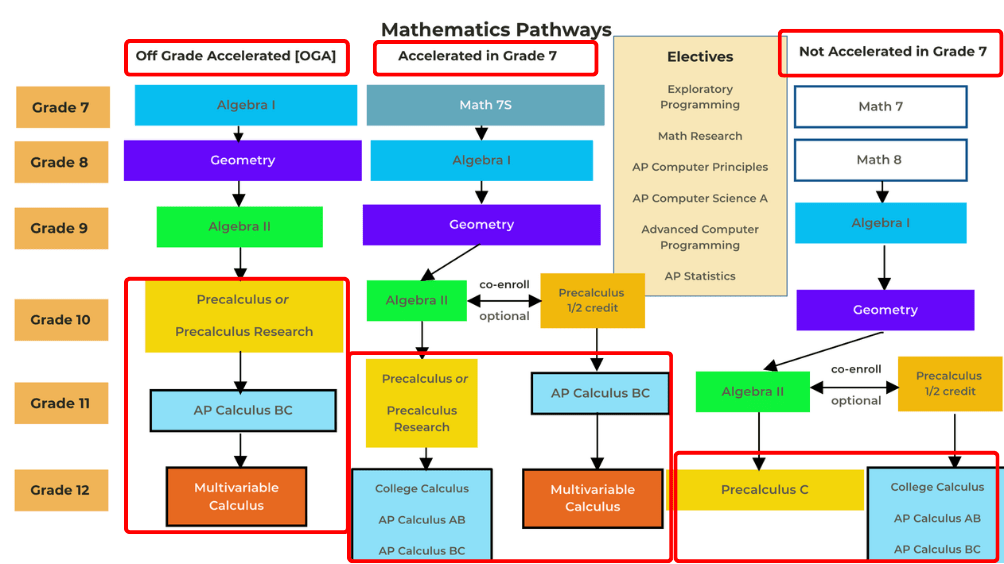
Math Placement: The Most Important Course Decision
Math is the single most consequential course selection in high school. Consider:
- What math level will you enter 9th grade at?
- What is the 4-year math trajectory you're aiming for?
- Is your current math foundation strong enough for the level you're entering?
Common trajectories:
| Entry Level | 9th | 10th | 11th | 12th |
|---|---|---|---|---|
| Standard | Algebra 1 | Geometry | Algebra 2 | Pre-Calc |
| Accelerated | Geometry | Algebra 2 | Pre-Calc/Trig | AP Calc AB |
| Advanced | Algebra 2 | Pre-Calc | AP Calc AB | AP Calc BC |
| Competition-ready | Pre-Calc/Trig | AP Calc | AP Calc BC | Multivariable/Linear Alg |
Summer Academic Planning: What to Do
1. Review and Shore Up Foundations
Use the summer to ensure your child has genuinely mastered prerequisite material — especially in math. Gaps left unaddressed before 9th grade will compound through high school.
Focus areas:
- Algebra 1 mastery (if entering Geometry or higher)
- Geometry and proof skills (if entering Algebra 2)
- Pre-calculus concepts (if entering AP Calculus)
2. Build Study Systems Before School Starts
Developing good study habits before the school year begins is far easier than trying to change habits mid-semester.
Summer practice habits to build:
- Daily focused work sessions (30–45 minutes)
- Review material the same day it's encountered
- Spaced practice across multiple days rather than cramming
3. Explore Academic Interests
Summer is an opportunity to discover genuine academic interests that might inform extracurricular focus and college essays in later years.
Options:
- Summer math programs (AMC prep, math enrichment)
- Science research programs
- Writing or humanities workshops
- Community college dual enrollment (in some states)
4. Prepare for Standardized Testing
While PSAT and SAT are still years away, students who enter 9th grade with awareness of the testing timeline are better positioned:
- PSAT 8/9: often taken in 9th grade as practice
- PSAT 10: 10th grade
- PSAT/NMSQT: 11th grade (National Merit qualifying exam)
- SAT: 11th–12th grade
Strong math preparation in 9th grade builds the foundation for strong SAT Math scores in later years.
Goal-Setting: The 4-Year Plan
Rising 9th graders who think ahead — even loosely — about where they want to be by senior year make better decisions year-by-year.
Sample 4-year planning framework:
- 9th grade: Establish strong GPA (3.8+), identify 1–2 extracurricular interests, build study habits
- 10th grade: Increase rigor, deepen extracurricular involvement, take PSAT 10
- 11th grade: Take most challenging courses, pursue significant extracurricular achievement, take PSAT/NMSQT and SAT
- 12th grade: AP exams, college applications, senior thesis/projects
Common Mistakes Rising 9th Graders Make
- Treating 9th grade as casual: Every grade counts. Start with full effort.
- Taking too many honors/AP courses unprepared: A 3.2 in five honors courses is worse than a 3.8 in three honors courses.
- Neglecting math: Math is cumulative; falling behind in 9th grade has lasting consequences.
- Underestimating time management demands: High school workload exceeds middle school expectations significantly.
- Not building study habits proactively: Reactive studying (cramming before tests) creates stress and poor retention.
Try Pengi AI — Smarter Math Practice for Students
Pengi AI supports K–12 learners with personalized math practice, guided explanations, and feedback designed to help them build confidence and improve steadily.