Pengi Editor's Note: This article was originally published by Think Academy. We're sharing it here for educational value. Think Academy is a leading K-12 math education provider.
All-in-One Guide: How to Get Into a Private Elementary School
Applying to private elementary school takes planning and preparation. From setting goals to understanding interviews and assessments, this guide breaks down the process into 6 clear steps—so you can find the right fit for your child and apply with confidence.
TL;DR
6 Key Steps in the Private School Application Process:
- Have a family discussion: Talk about your goals, values, and what kind of school fits your child best.
- Research schools online: Make a shortlist of 5–10 schools based on location, curriculum, and philosophy. Pay special attention to tuition and financial aids.
- Plan for campus visits: Learn about each school's community and admission requirements. Most families apply to 3–5 schools.
- Submit your online application: Create an account, pay the application fee, and track deadlines.
- Complete supporting materials and required tests: This may include documents, test results, and scheduling interviews.
- Review admission results: If accepted, you'll confirm with a deposit and review the tuition plan. If waitlisted, send regular updates to show continued interest.
We'll go into detail for each step in the sections below—so you feel fully prepared for your child's private school journey.
Step 1: Ask These 3 Questions Before You Apply
Before you begin the application process, take time to reflect as a family. Private schools are not just looking at test scores. They want to know if your values, goals, and learning style match their mission.
Ask yourself these three key questions:
- What do private schools value—and how does that align with our family? (Think about academic readiness, curiosity, or parent-school partnership.)
- What is our long-term education goal? Do you want a rigorous academic path, a nurturing environment, or a balance?
- What are my child's strengths and personality traits? Is your child creative, logical, social, or independent?
Writing down your answers will help you choose schools that fit—and prepare a stronger, more authentic application.
Step 2: Build Your School List Through Online Research
Choosing the right private school starts with good research. Every school has its own values, curriculum, and admissions process. Your goal is to narrow your list to about 5–10 schools—and apply to 3–5.
Here are some factors to consider:
- School type: academic, religious, bilingual, or gifted
- Grade span: Pre-K–5, K–8, or K–12
- Teaching style: Montessori, inquiry-based, traditional, or project-based
- Tuition and financial aid: what's the cost, and are scholarships available?
- Commute: is it realistic for your daily schedule?
Understanding Tuition and Affordability
Affordability is one of the most important factors families consider when looking at private schools.
Tuition can vary widely—from just a few thousand dollars to over $60,000 per year—depending on the school's location, reputation, and grade level.
Most private schools offer ways to make tuition more manageable:
- Need-based financial aid – Based on your family's income and financial situation
- Merit scholarships – Often available in upper grades for academic or talent-based achievements
- Sibling discounts – Reduced tuition for families with multiple children enrolled
- Flexible payment plans – Monthly, quarterly, or semi-annual options to spread out the cost
The table below compares tuition rates at well-known private schools in New York, California, and Texas:
| Schools | Kindergarten | Grade 1 | Grade 5 |
|---|---|---|---|
| Trinity -NY | $69,000 | $69,000 | $69,000 |
| Horace Mann -NY | $65,370 | $65,370 | $65,370 |
| Riverdale – NY | $59,412 | $59,412 | $59,412 |
| Nueva -CA | $46,910 | $46,910 | $62,560 |
| Harker -CA | $49,900 | $49,900 | $49,900 |
| Basis -CA | $34,650 | $34,650 | $39,795 |
| Challenger – CA | $25,840 | $26,610 | $26,610 |
| Challenger – TX | $16,930 | $18,600 | $18,600 |
Step 3: Schedule School Visits
Visiting a school in person is one of the best ways to learn what it's really like. Most private schools offer two types of visits: official and informal.
Official Visits
- Open House: Families meet school leaders, explore the campus, and ask questions.
- School Tour: Walk through classrooms and common spaces with an admissions officer.
- Shadow Day: Some schools allow younger applicants to join a short classroom activity.
Informal Visits
- Walk or drive around the school during recess or pickup time
- Observe how students interact
- Talk to parents near the school gates for honest feedback
After your visits, narrow down your list to 3–5 schools—places where both you and your child feel comfortable and excited to apply.
Step 4: Create an Account and Complete Your Application
Be aware of each school's timeline. Most private schools manage their admissions through an online portal such as Ravenna, SAO (Standard Application Online), or a school-specific platform.
Once registered, you'll use this portal to:
- Submit the application form and pay the application fee
- Track important deadlines and task checklists
- Upload required documents
- Schedule interviews or assessment sessions
- Receive admissions decisions
Step 5: Collect and Submit All Supporting Materials
Most private elementary school applications include:
- Application Form and Fee
- Parent/Guardian Questionnaire or Statement
- Teacher Recommendation Letters or Forms
- Report Cards or Student Records (Past 1–2 Years)
- Transcripts
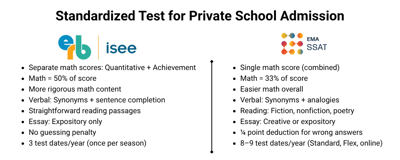
- Standard Test (Required or Optional) – ISEE, SSAT, or IQ tests depending on the school
- Interviews – Both parent and student interviews are common at top-tier schools
Step 6: Review Admission Results and Next Steps
Admission results are typically released in late February or early March. If your child receives an offer, you'll usually have 1–2 weeks to confirm your spot by paying a non-refundable deposit.
What If You're Waitlisted?
Don't give up. Many families are accepted off the waitlist—but you need to be proactive:
- Send polite follow-up emails every week
- Reaffirm your interest in the school
- Visit again if possible to show commitment
- Be responsive and positive in all communication
Conclusion
Navigating private school admissions can feel overwhelming, but with the right plan, your family can move forward with clarity and confidence. Start early, stay organized, and focus on finding the best fit for your child.
Appendix: Math Curriculum Comparison: Public School vs. Academic Private School (PreK–G12)
In the U.S., math curriculum pacing varies widely depending on school type. Public schools typically follow Common Core standards, while academically rigorous private schools often accelerate 1–2 years ahead.
| Grade | Public School Curriculum | Academic Private School Curriculum | Recommended Competitions |
|---|---|---|---|
| PreK | Number recognition up to 100 | Simple addition and subtraction | N/A |
| K | Basic addition, shape identification | Word problems, multi-digit addition/subtraction | N/A |
| G1 | Subtraction, simple word problems | 1–2 years ahead; early multiplication | Math Kangaroo |
| G2 | Multi-digit addition/subtraction | Multi-digit multiplication, fractions | Math Kangaroo / Noetic |
| G3 | Multiplication, division, fractions | Advanced fractions, graphs | Math Kangaroo / Noetic |
| G4 | Multi-digit multiplication | Pre-Algebra preparation | Math Kangaroo / AMC 8 |
| G5 | Fractions and decimals | Early Algebra topics | Math League / AMC 8 |
Try Pengi AI — Smarter Math Practice for Students
Pengi AI supports K–12 learners with personalized math practice, guided explanations, and feedback designed to help them build confidence and improve steadily.