
Pengi Editor's Note: This article was originally published by Think Academy. We're sharing it here for educational value. Think Academy is a leading K-12 math education provider.
ISEE vs SSAT: Complete Guide for Private School Admissions
The ISEE and SSAT are admissions tests used by private schools to evaluate students from elementary through high school. While not always required, strong scores can improve a student’s chances of admission, placement, and scholarships.
In this guide, you’ll learn how the two tests differ, what each one includes, what counts as a good score, how they compare to school math—and how Think Academy can help your child prepare.
TL;DR – Quick Summary for Busy Parents
- ISEE and SSAT are standardized tests used by private schools for admissions and placement. Most schools accept either test.
- ISEE is often preferred by day schools; SSAT is common in boarding school admissions.
- ISEE math is more rigorous, with two separate math sections making up 50% of the score. SSAT math is slightly easier and counts for one-third of the total score.
- Verbal and reading on the SSAT require a broader vocabulary and stronger reading intuition, including analogies and poetry. ISEE verbal is simpler, focusing on synonyms and sentence completions.
- ISEE allows 3 test dates per year (once per season); SSAT offers more flexibility, up to 9 times per year.
- Think Academy helps students close the gap between school math and admissions test expectations—especially in algebra, geometry, and logic-based reasoning.
What Are the ISEE and SSAT?
The ISEE (Independent School Entrance Exam)
The ISEE is a standardized test accepted by over 1,200 private and independent schools worldwide. It’s used for students applying to Grades 2–12 and assesses academic readiness across verbal, math, and reading areas. For registration, check ERB.
ISEE Test Levels
- Primary Level: Students Applying to Grades 2–4
- Lower Level: Students Applying to Grades 5–6
- Middle Level: Students Applying to Grades 7–8
- Upper Level: Students Applying to Grades 9–12
What’s on the ISEE
- Verbal Reasoning:
- Synonyms and sentence completion
- Quantitative Reasoning
- Word problems and quantitative comparisons (Middle/Upper only)
- Topics include numbers, algebra, geometry, measurement, and data
- Mathematics Achievement
- Multi-step, grade-level math problems
- Includes fractions, decimals, geometry, and algebra
- Reading Comprehension
- Passage-based questions covering main ideas, vocabulary, tone, and inference
- Lower: 5 passages; Middle/Upper: 6 passages
- Essay
- Unscored writing sample submitted to schools
Format and Scheduling
- Available in paper or online format
- Can be taken at schools, Prometric centers, or at home (Grades 5–12)
- Students may take the ISEE up to three times per academic year—once per testing season (Fall, Winter, Spring/Summer)
ISEE Scoring Overview
- Scaled Score (760–940 per section): Adjusted for test version
- Percentile Rank (1–99): Compares performance to other applicants
- Stanine Score (1–9): Simplifies percentiles into 9 bands; 5 is average, 7–9 is strong
- No penalty for incorrect answers
| Stanine | Percentile Range | Performance Level |
|---|---|---|
| 1 | 1–3 | Very Low |
| 2 | 4–10 | Low |
| 3 | 11–22 | Below Average |
| 4 | 23–39 | Slightly Below Average |
| 5 | 40–59 | Average |
| 6 | 60–76 | Above Average |
| 7 | 77–88 | High |
| 8 | 89–95 | Very High |
| 9 | 96–99 | Exceptional |
When to Take the ISEE
The ISEE can be taken once per testing season, up to three times per academic year:
| Season | Months |
|---|---|
| Fall | August, September, October, November |
| Winter | December, January, February, March |
| Spring/Summer | April, May, June, July |
Most families take the test once in Fall and again in Winter, depending on school deadlines.
The SSAT (Secondary School Admission Test)
The SSAT is a standardized test used for admission to private middle and high schools in the U.S. and abroad. It evaluates verbal, reading, and math skills, and includes an unscored writing sample.
SSAT Test Levels
- Elementary Level: Students Applying to Grades 4–5
- Middle Level: Students Applying to Grades 6–8
- Upper Level: Students Applying to Grades 9–12
What’s on the SSAT
- Verbal Reasoning
- Synonyms and analogies
- Quantitative (Math)
- Arithmetic, algebra, geometry, and data interpretation
- Two sections for Middle/Upper Levels; one for Elementary
- Reading Comprehension
- Passages from fiction, nonfiction, and poetry
- Writing Sample
- Middle: historically, only a creative prompt, but now two prompt options
- Upper: choice of creative or expository prompt
- Experimental Section (Middle/Upper only)
- Unscored; used to pilot new questions
Format and Scheduling
- Available as:
- Paper test
- SSAT at Home (U.S. and Canada only)
- Prometric test center (international availability)
- Can be taken more frequently than the ISEE (6 standard + 1 Flex test/year for Middle/Upper + 1–2 computer-based)
SSAT Scoring Overview
- Scaled Scores vary by level (e.g., 500–800 per section for Upper Level)
- Percentile Rank compares your child’s performance to other first-time test-takers in the same grade and gender
- Guessing Penalty: -¼ point for incorrect answers
- Score reports include scaled scores, percentiles, and a writing sample
Scoring Ranges by Level
| Section | Upper Level | Middle Level | Elementary Level |
|---|---|---|---|
| Quantitative | 500–800 | 440–704 | 300–600 |
| Reading Comprehension | 500–800 | 440–710 | 300–600 |
| Verbal Reasoning | 500–800 | 410–710 | 300–600 |
| Essay | Unscored | Unscored | Unscored |
Why unscored essay?
The essay is unscored because it’s not intended to generate a numerical result. Instead, it serves as a qualitative writing sample for admissions officers to evaluate a student’s writing ability, reasoning skills, and voice. It also helps schools verify that the student’s application essays are authentic and consistent with their in-test writing.
What’s a Good Score on the ISEE or SSAT?
ISEE: Focus on Stanines
Stanines (1–9) are the most important score for admissions teams. They offer a simplified view of performance compared to other applicants.
- 7–9: Strong for top-tier schools
- 5–6: Average to above average; acceptable for many schools
- 4: Often acceptable but may need support from other strong application elements
- 1–3: Considered below average
Many students score lower than expected. The ISEE is rigorous, and the testing pool is highly competitive. For example, a student accustomed to scoring in the 80th percentile on state tests might land around the 50th percentile on the ISEE.
SSAT: Focus on Percentiles
Percentiles are key to interpreting SSAT results.
- 80th–90th+ percentile: Strong for selective schools
- 60th–79th percentile: Competitive for many day and boarding schools
- Below 50th percentile: May raise concerns unless offset by strong academics
SSAT scores are scaled across years and cohorts. The test penalizes incorrect answers, so students must balance speed with accuracy. You can retake the SSAT and choose which score reports to send.
Summary: Interpreting Your Child’s Score
| Test | Strong Score | Competitive Score | Acceptable Score |
|---|---|---|---|
| ISEE (Stanine) | 8–9 | 6–7 | 4–5 |
| SSAT (Percentile) | 90th+ | 75th–89th | 60th–74th |
ISEE vs SSAT: Which Test Should Your Child Take?
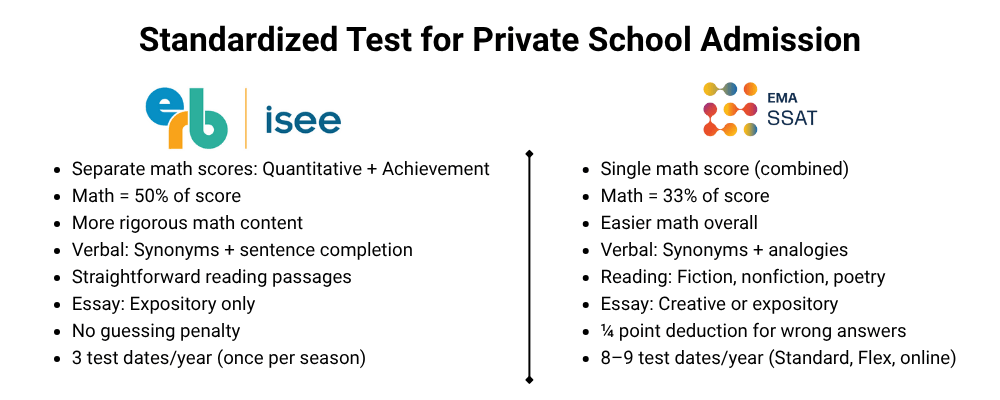
While many schools accept both the ISEE and SSAT, one may be a better fit depending on your child’s academic strengths, test-taking style, and preparation timeline. Below are the 7 key differences to help you decide.
1. Score Reporting
- ISEE reports each math section separately (Quantitative Reasoning and Math Achievement), which can better highlight strong math performance.
- SSAT combines both math sections into a single quantitative score, making it harder to spotlight advanced math ability.
2. Math Weight and Difficulty
- ISEE math accounts for 50% of the total score, with two distinct sections focused on both logic and grade-level knowledge.
- SSAT math accounts for about 33%, and is generally considered less difficult than ISEE math.
- For strong math students, ISEE may offer a clearer advantage.
3. Verbal Section Format and Vocabulary Load
- Both tests assess vocabulary through synonyms, but they differ in format and difficulty:
- ISEE includes sentence completion—typically easier and more familiar to students.
- SSAT includes analogies, which require more abstract reasoning and a broader vocabulary.
- SSAT places a much higher demand on vocabulary, and is better suited for students who read widely and have strong language intuition.
4. Reading Comprehension
- ISEE reading passages tend to be more straightforward.
- SSAT reading includes a wider variety of genres (including poetry) and requires stronger inference, tone analysis, and critical reading skills.
- Students who regularly read and analyze diverse texts may find SSAT reading more manageable.
5. Writing Sample Prompts
- Both tests include an unscored essay that is sent to schools.
- ISEE uses only expository prompts, requiring a clear explanation or opinion.
- SSAT offers more variety: choice between creative and expository
- Students who enjoy storytelling may prefer the SSAT format.
6. Guessing Penalty
- ISEE has no penalty for incorrect answers, encouraging students to answer every question.
- SSAT deducts ¼ point for wrong answers, so students need to guess strategically.
7. Frequency and Flexibility
- ISEE can be taken only three times per year (once per season: Fall, Winter, Spring/Summer).
- SSAT offers more flexibility, students can take the SSAT up to 8–9 times per year (6 Standard + 1 Flex + 1–2 computer-based), offering far more flexibility than the ISEE’s 3-test limit.
Choosing the Right Test
Ask yourself:
- Do your target schools have a preference? – Go to the school website and check the admission requirements.
- For more details on ISEE and SSAT policies at private high schools, check the appendix table 1.
- Does your child do better with analogies or sentence completions?
- Does your child need the flexibility to retest?
- Would a strong math performance be better showcased on the ISEE?
Popular Platforms to Prepare for ISEE and SSAT
- Test Innovators – Official ISEE partner with full-length practice tests, diagnostics, and analytics.
- The Tutorverse – Offers prep books, small group classes, and tutoring for both ISEE and SSAT.
- SSAT.org Test Prep – Official SSAT platform with practice tools and scoring insights.
- PrivateSchoolExam.com – Targeted practice questions, essay prompts, and score breakdowns.
The Math Gap: Why These Tests Feel Harder Than School
ISEE and SSAT math often exceeds Common Core standards, especially in:
- Early algebra (variables in Grade 4–5)
- Geometry (area, volume, and coordinate grids)
- Logic-based problem solving
- Multi-step word problems under time pressure
Even strong students may struggle—because the tests assess reasoning, not just knowledge.
Check Appendix Table 2 to learn about the ISEE math focus by level.
How Think Academy Helps Close the Gap
Our programs are designed to:
- Identify knowledge gaps through diagnostic assessments
- Align test prep with ISEE/SSAT levels and question styles
- Strengthen problem-solving and reasoning skills
- Build confidence with timed practice and coaching
We don’t just teach for the test—we build a lasting foundation for academic success.
Recommended Readings
If you are planning for applying private schools, check these great articles that help you with your application:
- Private School Interview: How to Prepare and Question Checklist
- All-in-One Guide: How to Get Into a Private Elementary School
- Types of Private Schools and How to Choose the Right One
- 5 Big Findings About 10 Top Private High Schools
Appendix
Table 1: ISEE and SSAT Policies at the Top 20 U.S. Private High Schools
| School | Standard Test | Required or Optional | Notes |
|---|---|---|---|
| Groton School (MA) | ISEE & SSAT | Required | Accepts either ISEE or SSAT. The November or December test dates are preferable; the January date is acceptable. |
| Phillips Academy Andover (MA) | ISEE & SSAT | Required | Requires one standardized test: ISEE, SSAT, PSAT, SAT, or ACT depending on entry grade. |
| Phillips Exeter Academy (NH) | ISEE & SSAT | Required | Requires ISEE or SSAT for 9th-grade entry. 10th–12th may submit ISEE, SSAT, PSAT, SAT, or ACT. Tests must be taken within one year of the application deadline. |
| Choate Rosemary Hall (CT) | ISEE & SSAT | Optional | Test-optional. Accepts ISEE/SSAT (post-June); 10th–11th may submit PSAT/SAT/ACT instead. |
| Commonwealth School (MA) | ISEE & SSAT | Required | Requires either SSAT or ISEE. Deadline: Jan 15. |
| The Hotchkiss School (CT) | ISEE & SSAT | Required | 9th–10th: SSAT or ISEE required. 11th–12th may submit PSAT/SAT/ACT. |
| College Prep (CA) | ISEE & SSAT | Required (9th only) | Requires ISEE/SSAT for 9th grade. PSAT/SAT/ACT allowed for transfer grades. |
| Riverdale Country School (NY) | ISEE & SSAT | Required (Grades 5–12) | Requires ISEE or SSAT for Grades 5–12. No testing for lower grades. |
| St. Paul’s School (NH) | ISEE & SSAT | Required | Accepts SSAT, ISEE, PSAT, SAT, PreACT, or ACT. TOEFL/IELTS/Duolingo for non-native English speakers. |
| Stanford Online High School (CA) | ISEE & SSAT | Optional | Test-optional. Accepts ISEE/SSAT or PSAT/SAT/ACT. Not submitting scores will not disadvantage applicants. |
| Harvard-Westlake (CA) | ISEE | Required | Requires ISEE only (Upper Level). SSAT not accepted. One score submission recommended. |
| The Pingry School (NJ) | ISEE & SSAT | Required | Accepts ISEE or SSAT (Sept–Dec). Transfer applicants may submit PSAT/SAT/ACT. |
| The Brearley School (NY) | ISEE & SSAT | Required | Requires ISEE or SSAT, plus internal math/English assessments. |
| The Nueva School (CA) | Test-blind | Test-blind | Does not accept or consider ISEE/SSAT scores. Uses internal assessments. |
| St. John’s School (TX) | ISEE | Required | Accepts ISEE only. Only one official score report reviewed. |
| The Lawrenceville School (NJ) | ISEE & SSAT | Required | Accepts ISEE/SSAT for 9th–10th. PSAT/SAT/ACT allowed for older applicants. |
| Regis High School (NY) | HSPT | Required | Uses its own Regis Scholarship HSPT exam. SSAT/ISEE not accepted. |
| The Chapin School (NY) | Test-blind | Test-blind | Does not accept ISEE/SSAT. Uses in-house assessments and Character Snapshot. |
| Dwight Global Online School (NY) | ISEE & SSAT | Optional | Accepts ISEE/SSAT or PSAT/SAT/ACT. Testing is not mandatory. |
| The Bishop’s School (CA) | ISEE & SSAT | Required | Requires ISEE or SSAT. PSAT/SAT/ACT allowed for Grades 10–12. Deadline: Feb 1. |
Selected from: 2025 Niche Rankings – Top 20 Private High Schools in the U.S.
Table 2: ISEE Math Focus by Level
| Level | Module | Target Grade | Number of Questions | Duration | Focus (Number of questions) |
|---|---|---|---|---|---|
| Primary 2 | Math | Entering Grade 2 | 24 | 26min | Number sense, operations, early algebra, data analysis, geometry, probability, measurement |
| Primary 3 | Math | Entering Grade 3 | 24 | 26min | Same as Primary 2; includes basic reasoning and visual content |
| Primary 4 | Math | Entering Grade 4 | 28 | 30min | Builds on Primary 3; introduces more abstraction and complexity |
| Lower Level | Quantitative Reasoning | EntergingGrades 5–6 | 38 (35 scored + 3 unscored) | 35min | Problem-solving and critical reasoning |
| Math Achievement | 30 (25 scored + 5 unscored) | 30min | Algebra (4-7), Data/Statistics (4-7), Geometry (2–5), Measurement (2–5), Fractions/Decimals (4-7)Integers (4-7) | ||
| Middle Level | Quantitative Reasoning | Entering Grades 7–8 | 37 (32 scored + 5 unscored) | 35min | Problem-solving and critical thinking; Word problems (18–21), Quantitative comparisons (14–17) |
| Math Achievement | 47 (42 scored + 5 unscored) | 40min | Algebra (9–13), Data/Statistics (5–9), Fractions/Decimals (7–10), Geometry (4–6), Measurement (4–6), Integers (7–11) | ||
| Upper Level | Quantitative Reasoning | EnteringGrades 9–12 | 37 (32 scored + 5 unscored) | 35min | Same structure as Middle Level; logic-based comparisons and word problems |
| Math Achievement | 47 (42 scored + 5 unscored) | 40min | Same structure as Middle Level; slightly higher difficulty across all categories |
Try Pengi AI — Smarter Math Practice for Students
Pengi AI supports K–12 learners with personalized math practice, guided explanations, and feedback designed to help them build confidence and improve steadily.