Pengi Editor's Note: This article was originally published by Think Academy. We're sharing it here for educational value. Think Academy is a leading K-12 math education provider.
How to Teach Kids Critical Thinking: Daily Examples & Age Group Guide
What Is Critical Thinking for Kids?
Critical thinking is the essential ability to analyze information, ask questions, and solve problems independently rather than accepting things at face value.
Critical thinking is the difference between simply absorbing what others say and actively engaging with the world. It empowers children to pause and evaluate situations before reacting.
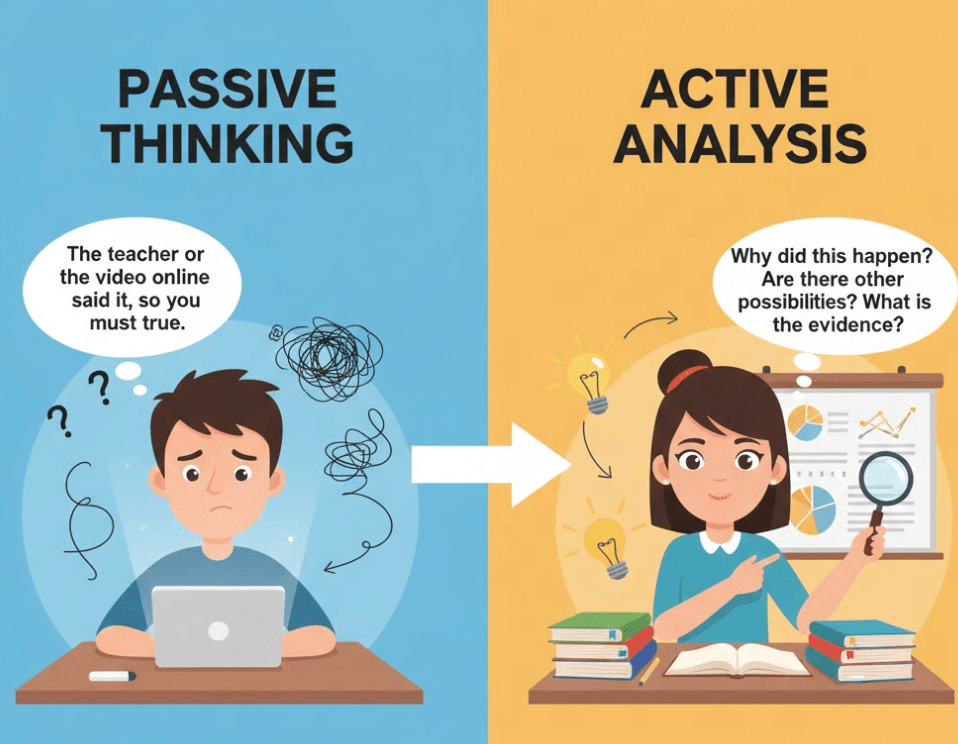
To put it simply, consider the difference between passive and active learning:
- Passive Thinking: “The teacher or the video online said it, so it must be true.”
- Active Analysis: “Why did this happen? Are there other possibilities? What is the evidence?”
And critical thinking is such a crucial life skill, it shouldn’t be left to chance. It needs to be intentionally nurtured from a young age. At Think Academy, we believe that early math education isn’t just about memorizing numbers—it is about building a complete, well-rounded cognitive foundation. That is why Critical Thinking is a core pillar of the “Seven Abilities” framework taught in our Early Childhood programs.

When children develop all seven of these abilities, they don’t just become good at math—they become unstoppable problem solvers in every area of life.
Why Developing Critical Thinking Skills is Crucial
You might wonder why you should focus on this specific ability. The benefits extend far beyond textbooks, shaping how your child navigates life.
Here is why developing this skill is the most valuable investment you can make for your child’s future:
1. The Key to Success in the Math & STEM Classroom
In traditional schooling, it is easy for kids to fall into the trap of just memorizing formulas or repeating procedures to pass a test. However, as math and science become more advanced, memorization stops working. Critical thinking is what allows a child to look at a complex word problem, break it down into logical steps, and figure out which formula to use. It turns them from passive rule-followers into active problem solvers.
2. A Foundational Engine for All Academics
It is important to note that this is not just for STEM subjects! Critical thinking is the underlying engine that powers all learning. It is equally crucial for reading comprehension (understanding a character’s hidden motives), historical analysis (evaluating why an event happened), and writing persuasive essays. A child who knows how to think critically will excel across the entire curriculum.
3. Life Skills and Emotional Regulation
This is perhaps the most surprising benefit for parents. Building independence and emotional resilience is a massive part of growing up. When children possess analytical skills, they can logically evaluate their own setbacks. Instead of having an emotional meltdown and thinking, “I’m just not smart enough,” a critical thinker can calmly assess the situation and realize, “I just haven’t found the right method yet.” It replaces panic with logic.
4. The Ultimate Moat in the AI Era
We are raising kids in a digital age where Artificial Intelligence can instantly provide a standard answer to almost any question. Because of this, the most important ability for the next generation is no longer just “remembering the answer.” Instead, true value lies in knowing how to ask good questions, how to evaluate different perspectives, and how to distinguish the authenticity of information. Independent thought is your child’s best defense and greatest asset in the AI era.
The 4 Core Pillars of Critical Thinking
To effectively teach critical thinking, we must first break it down into actionable skills. When we talk about raising an independent thinker, we are actually developing four core abilities:
- Analytical Reasoning (The “Why” Skill): The ability to break down complex problems, identify root causes, and understand cause-and-effect relationships rather than just looking at surface-level symptoms.
- Information Evaluation (The “Skepticism” Skill): The capacity to question sources, distinguish objective facts from subjective opinions, and identify underlying motives or biases.
- Perspective-Taking (The “Empathy” Skill): The willingness to step outside one’s own viewpoint, consider alternative angles, and evaluate situations objectively without emotional bias.
- Adaptive Problem Solving (The “Flexibility” Skill): The courage to test hypotheses, recognize logical flaws, and revise one’s own beliefs or strategies when presented with new evidence.
Real-World Cases: Guiding Critical Analysis in Daily Challenges
When children face obstacles, it’s tempting to just solve the problem for them. However, these moments are prime opportunities to practice the four core pillars. Here are common cases and solutions designed to shift their mindset from emotional reaction to logical analysis.
Scenario 1: Siblings Arguing
- Target Skill: Perspective-Taking (The “Empathy” Skill)
- Child says: “My sister ate up all my candy!”
- Parent script: Instead of just separating them, ask: “Can each of you explain what happened from your perspective, and what you think a fair solution would be?”
- The Critical Thinking Lesson: This forces them to step outside their own bias and evaluate the situation objectively.
Scenario 2: Emotional Meltdown During Homework
- Target Skill: Analytical Reasoning (The “Why” Skill)
- Child says: “I can’t do this! It’s too hard!”
- Parent script: “It looks like you are feeling really frustrated right now. Let’s not look at the whole problem yet. Can you tell me the very first thing you already know about this?”
- The Critical Thinking Lesson: This teaches them to reason wisely, and break down a complex, overwhelming problem into manageable, logical steps.
Scenario 3: Facing Suspicious Information Online
- Target Skill: Information Evaluation (The “Skepticism” Skill)
- Child says: “The internet says eating this will make you super strong!”
- Parent script: “That sounds amazing! But let’s think like detectives. Who wrote that article, and what might they be trying to sell us?”
- The Critical Thinking Lesson: This directly trains their media literacy, teaching them to question the source and underlying motives of information.
Scenario 4: A Failed Science Project
- Target Skill: Adaptive Problem Solving (The “Flexibility” Skill)
- Child says: “This isn’t working! I give up, it’s impossible!”
- Parent script: “It’s frustrating when the plan doesn’t work the first time! But instead of starting over or quitting, let’s look at the ‘evidence.’ Why do you think it collapsed/failed? If we changed just one thing in our strategy, what would it be? Let’s run a quick ‘test’ to see if that works better.”
- The Critical Thinking Lesson: This shifts the child’s mindset from seeing failure as a dead end to seeing it as a puzzle. It rewards the process of revising a strategy based on new evidence, which is the hallmark of a flexible, resilient thinker.
5 Simple Daily Habits to Enhance Critical Thinking Skills
You don’t need a formal curriculum to teach critical thinking. You can weave these four pillars into your everyday routines with these eight habits.
- Be a “Curious Detective”
People who lack deep reasoning only look at surface phenomena. When your child throws a tantrum, peel back the layers by asking “why” three times. This teaches children to use objective logic to find the “real variables” that led to the result, rather than being carried away by superficial emotions.
- The “What Happens Next?”
Critical thinkers deduce cause and effect before taking action. Ask questions like, “If we eat all the chips today, what problem will we have for movie night tomorrow?” This trains their “what-if thinking” to evaluate the long-term consequences of their actions.
- “Spot the Trick” in Everyday Ads
This is core training for the AI era. When watching videos or looking at posters, ask: “What do you think the person who made this wants us to do?” Making “questioning the source” an instinct means they will be less likely to be brainwashed by fake news.
- The “Prove It” Rule
Deep reasoning requires separating subjective emotions from objective facts. When your child says food tastes terrible, guide them to provide evidence like a food critic. This helps them understand that opinions need specific facts and reasons to support them.
- Allow (Respectful) Rule Negotiation
Daring to question authority is the ultimate manifestation of independent thought. Tell your child that rules can be changed if they “submit an application” with reasonable arguments. Children who dare to persuade their parents through reasoning will not blindly follow bad advice from peers.
How to Promote Critical Thinking by Age Group
Critical thinking is not a “one big lesson.” It’s a set of habits that grows over years—just like reading or sports. The key is to choose tools that match your child’s development stage, so they feel curious (not pressured). Below are age-based ideas you can use right away, plus a short list of books and games that naturally train Critical Thinking .
Ages 4–6: Curiosity First (Build the “Why” Habit)
At this age, children learn through play, stories, and daily routines. Your goal isn’t long explanations—it’s helping them form the habit of asking simple “why” and noticing cause-and-effect.
What to focus on
- Cause and effect: “If we do this, what happens next?”
- Naming feelings + reasons: “I feel ___ because ___.”
- Sorting and patterns: group objects by one rule, then try a second rule
Good books
- Picture books that highlight choices and consequences (any favorites work well)
Good games
Ages 7–9: Teach “Evidence + Explanation”
Kids in this range can start explaining their thinking. This is when critical thinking becomes visible: not just the answer, but the reason behind it.
What to focus on
- Giving reasons: “I think ___ because ___.”
- Rule thinking: understanding rules, exceptions, and “always/sometimes/never”
- Comparing explanations: “Which reason fits the facts better?”
Good books
- The Number Devil (great for curiosity and logical math thinking)
- The Way Things Work (excellent cause-and-effect reading)
Good games
- SET (pattern recognition and logical speed)
- Rush Hour (planning and debugging strategies)
- Mastermind (deduction from clues)
Ages 10–12: Practice “Analyze, Evaluate, Revise”
This is the sweet spot for building real independent thinking: kids can hold multiple conditions in mind and adjust strategy when they hit a dead end.
What to focus on
- Breaking problems into parts: identify what is known vs. unknown
- Source awareness: “Who wrote this and why?”
- Learning from mistakes: treat errors as information, not shame
Good books
- How to Think Like a Detective (any kid-friendly logic/deduction title works)
- Age-appropriate science experiment books (emphasis on “test and revise”)
Good games
- Logic grid puzzles (deduction and constraints)
- Chess (or Chess puzzles) (planning and consequence thinking)
- Codenames (precision in language, inference)
Ages 13+: Strengthen “Independent Judgment”
Teens are ready for deeper reasoning: bias, credibility, trade-offs, and long-term planning.
What to focus on
- Argument quality: spotting weak logic and unsupported claims
- Evidence-based opinions: building a viewpoint with facts, not vibes
- Updating beliefs: changing your mind when new evidence appears
Good books
- Teen-friendly logic, media literacy, or decision-making books (match their interests)
Good games
- Debate prompts (family “topic of the week”), strategy games (e.g., Settlers of Catan)
How Think Academy Classes Develop Critical Thinking
Critical thinking isn’t built by telling kids to “think harder.” It’s built through the right kind of practice, repeated over time—where children learn to stay curious, ask smart questions, test ideas, and revise their thinking.
That’s exactly what we aim to do in Think Academy classes.
Think Academy is a top-rated EdTech platform specializing in systematic math enrichment and competition training for Grades PreK–12. Rather than offering random, band-aid tutoring, we provide an interactive online math class known for energetic teachers and a complete, proven learning cycle. We excel at preparing students for math competitions (like Math Kangaroo and AMC 8) while building a rock-solid foundation for long-term academic success.
And most importantly:
We don’t just teach math. We teach students how to think critically.
1) We Activate Curiosity (Especially in Early Elementary)
In PreK and lower elementary grades, curiosity is the engine. If you can spark it, learning becomes self-driven.
In class, we use clear visuals and diagrams, short stories and relatable contexts, “notice-and-wonder” moments that naturally lead to a math question
Teachers don’t rush to explain. We guide. We help students discover the math—so children build the habit of exploring, not just following instructions.
2) We Teach Reasoning Skills, Not Just Answers
A big part of critical thinking is learning how to analyze information before jumping to a solution.
In Think Academy lessons, students practice working with different kinds of information, such as: word problems (text), diagrams and geometric figures (visual reasoning), tables and charts (data thinking).
Instead of simply telling students what to do, our teachers use open-ended questions to guide step-by-step reasoning:
- “What do you know for sure?”
- “What is the question really asking?”
- “What strategy could work here—and why?”
This trains students to build logic from evidence, not memorize procedures.
3) We Make Thinking Visible Through Discussion
Critical thinking isn’t only about being “right.” It’s also about understanding different approaches—and learning to evaluate them.
Our classrooms are open and welcoming:
- Students are encouraged to explain their own ideas.
- They hear different viewpoints from classmates.
- Teachers model how to compare methods and check reasoning.
This kind of discussion supports perspective-taking and thoughtful evaluation—skills that matter in math and in life.
4) We Build Independent Thinkers Through Long-Term Growth
Critical thinking is not a one-week skill. It’s something children develop through consistent, meaningful challenge.
Through long-term math enrichment—steady effort, feedback, and reflection—students naturally become more:
- resilient when problems get hard
- confident in their reasoning
- independent in learning and decision-making
Ready to Support Your Child’s Critical Thinking Journey?
If you’re interested in math enrichment that strengthens both skills and thinking habits, we recommend starting with an evaluation first.
How It Works: The Think Academy Approach
At the heart of Think Academy is a cohesive, immersive learning cycle driven by cutting-edge technology and expert teaching. The entire experience challenges advanced learners while keeping them engaged and supported every step of the way.
- Step 1: Evaluate & Personalize
It starts with a Free 1-on-1 Evaluation. We pinpoint your child’s exact math level and map out a customized learning pathway just for them. - Step 2: Interactive, Live Teaching
No boring, passive videos! Our expert teachers use game-based, scenario-driven lessons to help kids discover the “why” behind the math. - Step 3: Collaborative Peer Learning
Students learn in a live virtual classroom where they can raise hands, discuss ideas, and solve problems alongside motivated peers. - Step 4: The Complete Learning Loop
Mastery takes practice. We combine pre-class prep, engaging homework, step-by-step video solutions, and 1-on-1 Office Hours so no question goes unanswered. - Step 5: Total Parent Visibility
You are never left in the dark. Our parent app provides detailed post-class performance reports and data, so you always know exactly how your child is growing.
Take Action: Not sure where your child currently stands? Let us help you find out.
Try Pengi AI — Smarter Math Practice for Students
Pengi AI supports K–12 learners with personalized math practice, guided explanations, and feedback designed to help them build confidence and improve steadily.