Pengi Editor's Note
The Pengi editorial team curated this Think Academy private middle school admissions guide. Middle school admissions often surprises families with how competitive and early-starting it can be — this comprehensive guide helps families understand and prepare for every stage.
Source: Think Academy Blog
All-in-One Guide: How to Get Into a Private Middle School
Private middle schools in the U.S. rarely exist as grades 6–8 only. Instead, most are part of a broader structure:
- Elementary + Middle (K–8 or PK–8): Students enter in early grades and stay through 8th grade. Families then apply again for high school. This model is especially common among parochial and independent day schools.
- Middle + High (6–12 or 7–12): These schools begin in middle school and continue through high school. Entering in 6th or 7th often secures a pathway into the upper school without needing to reapply.
- Full Continuum (K–12 or PK–12): Large independent schools span all grades, usually with distinct lower, middle, and upper school divisions. Families benefit from long-term continuity and community.
Standalone 6–8 private middle schools are very rare. For most families, applying means either joining a K–8 program with a transition to high school, or entering a 6–12 school that continues through graduation.
This makes private middle school admissions a strategic decision point:
- Apply now for smaller class sizes, a supportive environment, and earlier academic challenge.
- Or wait until high school, when many schools admit a larger new cohort at 9th grade.
With this context in mind, let’s walk through the seven steps to applying for private middle schools so you can make the right choice for your child.
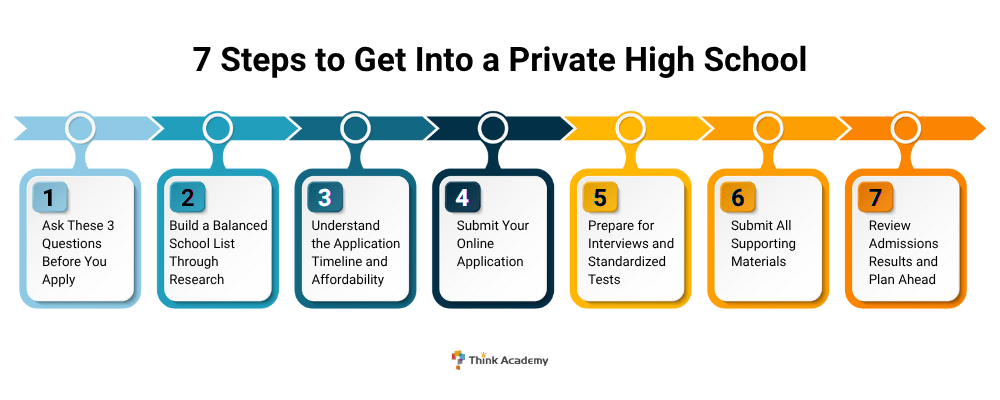
TL;DR – The 7 Steps
- Have a family discussion about goals, values, and school fit
- Research schools and create a shortlist of 3–5 balanced options
- Understand the application timeline, requirements, and affordability
- Complete the online application and attend admission events
- Prepare for entrance exams (ISEE or SSAT) and interviews
- Submit supporting materials: essays, recommendations, transcripts
- Review results, manage waitlists, and plan tuition commitments
Step 1: Start with Honest Family Reflection
Before you begin the application process, ask three key questions as a family:
- Why now? Are you looking for more academic challenge, smaller classes, or a new social environment? Or would waiting until high school be better?
- What type of school fits my child? Consider curriculum style (traditional vs. progressive), coed vs. single-sex, day vs. boarding, or religious vs. secular.
- Is my child ready? Schools value curiosity, enthusiasm, and growth mindset more than polished resumes.
Tip: Writing down your answers will help guide both your school search and your application essays.
Step 2: Build a Balanced School List
Once a family decides to apply for private middle school, the process becomes a project. For newcomers, it can feel almost as complex as college admissions. Starting early is essential.
Applications for the following fall usually open around Labor Day (early September) of the year before entry. Many families begin researching schools a year in advance. A strong strategy is to:
- Tour schools and attend open houses in spring or fall of 5th grade (for 6th entry) or 6th grade (for 7th entry).
- Create a shortlist of 8–10 schools initially, then narrow to 3–5 for applications. Include a mix of reach, match, and safety schools.
- Cast a wide net. In competitive cities, parents report “hundreds of applications for just a few dozen spots.”
When evaluating schools, consider:
- Curriculum and academic style (STEM-heavy, arts-focused, or liberal arts)
- Entry grade: 6th grade offers the most openings; 7th and 8th are more limited
- Class size and teacher support
- School culture, diversity, and extracurricular options
- Location and daily logistics
- Tuition and financial aid availability
Tip: Focus on schools where your child will thrive—not just those with the biggest names.
Step 3: Know the Timeline and Financial Commitment
Private middle school admissions follow a predictable schedule:
- Applications open: August–October (the year before entry)
- Deadlines: November–January
- Testing & interviews: October–February
- Decisions released: March
- Deposits due: March–April
Affordability and Financial Aid
Private middle school tuition in the U.S. varies widely depending on school type and location.
- National averages: The typical private K–8 school costs about $9,000–$12,500 per year. Independent day schools (non-religious, college-prep) are much higher, with a median tuition around $30,000.
- Major metro areas: Families in large cities face the highest costs. In the Bay Area and Los Angeles, strong independent middle schools often run $30,000–$45,000, while New York City schools average $40,000–$60,000+. A few elite Manhattan schools now approach $70,000 per year.
- Boarding schools: Less common for middle grades, but tuition plus room/board can exceed $60,000 annually.
Financial Aid and Accessibility
- Roughly 25–30% of students at independent schools receive need-based financial aid.
- The average award nationally is about $20,000 per student, and in high-cost regions, packages can cover half or more of tuition.
- Many schools now offer sliding-scale tuition, sibling discounts, and monthly payment plans to broaden access.
Tip: Financial aid deadlines often differ from admissions deadlines.
The table below compares 2025–26 tuition rates for grade 6-8 at 20 prominent U.S. private K-12 schools.
| School (Location) | Tuition (Grades 6–8) |
|---|---|
| Riverdale Country School (NY) | $69,300 (2025–26; includes books, lunch, activities) |
| The Pingry School (NJ) | $52,736 (grades 6–8, 2025–26) |
| The Brearley School (NY) | $66,800 (2025–26, K–XII tuition, all-inclusive, free plans available based on family income) |
| The Nueva School (CA) | $65,760 (2025–26, grades 5–8 incl. $3,200 trips) |
| St. John’s School (TX) | $34,970 (Middle School grades 6–8, 2025–26) |
| The Chapin School (NY) | $68,250 (2025–26; plus $2,000 tech fee grades 6–12) |
| Rye Country Day School (NY) | $53,400 (2025–26, grades 5–8; lunch included) |
| Horace Mann School (NY) | ~$66,000–68,000 (est. 2025–26; was $64,070 base in 2024–25 + fees) |
| Trinity School (NY) | $69,000 (2025–26 tuition, K–12) |
| St. Mark’s School of Texas (TX) | $36,345 (grade 6); $38,444 (grades 7–8) |
| Sidwell Friends School (DC) | $59,440 (2025–26, Middle School grades 5–8) |
| American Heritage – Broward Campus (FL) | $40,200 (grades 6–8, annual tuition) |
| The Dalton School (NY) | $67,480 (2025–26 tuition) |
| The Spence School (NY) | $68,480 (2025–26 tuition) |
| The Quarry Lane School (CA) | $41,940 (2025–26, grades 6–8 tuition + fees) |
| Ethical Culture Fieldston School (NY) | $68,162 (2025–26 tuition, PreK–12) |
| BASIS Independent McLean (VA) | $39,000 (2025–26 tuition) |
| Avenues: The World School (NY) | $72,300 (2025–26, nursery–12 tuition) |
| The Village School (TX) | Day: $32,300 (2025–26, grades 6–8)Boarding: ~$82,675 (7-day boarding, upper school) |
| BASIS Independent Brooklyn (NY) | $43,000 (2025–26 tuition, grades 1–12) |
*Tuition rates are based on the most recently published information from the school websites. Families should always check each school’s official website for the latest updates and details.
Step 4: Submit Applications and Engage with Schools
Applications are submitted through platforms like Ravenna, Gateway, or school-specific portals. Beyond paperwork, admissions teams expect families to show genuine interest in the school.
Key admission events:
- Open Houses: Large introductions with tours and presentations
- Campus Tours: Smaller visits to see daily life in action
- Info Sessions: Focused sessions, often virtual
- Shadow Days: A day in the life with a current student (when offered)
Tip: Attendance shows commitment. Schools notice when families engage actively in the process.
Step 5: Prepare for Tests and Interviews
Entrance Exams
Most private middle schools require one of the following:
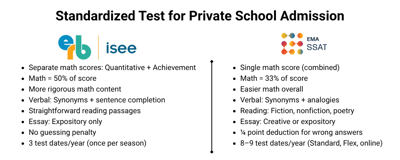
- ISEE Lower and Middle Level: The Independent School Entrance Exam is accepted by many day and independent schools. The “Lower Level” is for students applying to grades 5-6, and “Middle Level” for students applying to grades 7-8.
- SSAT Middle Level: The Secondary School Admission Test is widely accepted and common among boarding schools. The “Middle Level” is for students applying to grades 6-8.
- Some schools add Character Skills Snapshot, short school-based tests, or cognitive assessments.
- Always check each school’s admissions page, since testing policies can vary.
Some schools are now test-optional, but a strong score still helps. To prepare:
- Take a diagnostic test in late summer or early fall
- Follow a two- to three-month study plan
- Complete at least one full-length, timed practice exam
For more information about standardized tests, visit this page: ISEE vs SSAT: Complete Guide for Private School Admissions
Student Interviews
Interviews vary by grade level:
- 6th grade: Conversational—curiosity and enthusiasm matter most
- 7th/8th grade: More reflective—focus on academic interests, challenges, and goals
Common interview questions:
- What’s your favorite subject and why?
- How do you spend your free time?
- Describe a challenge you’ve faced.
- Why are you interested in this school?
Tip: Practice can help, but authentic answers are best.
For more interview tips, read this article: Private School Interview: How to Prepare and Question Checklist
Step 6: Submit Supporting Materials
Private middle school applications aim to present the whole child. Families should expect to submit:
- Student essays: authentic, age-appropriate writing
- Parent statement: balanced reflection on strengths and needs
- Teacher recommendations: usually Math and English teachers
- Transcripts: last two years of report cards
- Optional extras: art portfolio, athletic resume, or learning support documentation
Admissions are highly competitive, especially in urban areas. With more families applying—and some schools dropping test requirements—the applicant pool has only grown.
To strengthen your application:
- Apply to a balanced range of schools, including at least one realistic “safe but solid” option.
- Submit optional extras only if they add real value.
- Give teachers plenty of notice for recommendations; strong recs matter.
Tip: Stay organized and calm. One school acceptance or rejection will not define your child’s future.
Step 7: Review Results and Plan Ahead
Most schools release decisions in March. Families usually face three possible outcomes:
- Accepted: Celebrate, attend welcome events, and pay the deposit.
- Waitlisted: Write a letter of continued interest and share new updates.
- Denied: Explore other options and consider reapplying for high school entry.
Tip: Applying to at least one “safe but solid” school ensures you always have a secure outcome.
Not Sure If You’re on the Right Track?
If you’re planning for private school admissions but unsure whether your current math placement and pacing are competitive, a Think Academy Free Math Evaluation can help.
You’ll receive:
- a diagnostic assessment of your current level
- clear feedback on acceleration readiness
- a personalized 1-on-1 learning path aligned with private school expectations
Prefer to Start with Practice?
If you’d like to assess and strengthen fundamentals independently, access Think Academy’s free math worksheets for PreK through Grade 10. Worksheets are organized by grade and topic to help identify gaps and build confidence.
Recommended Articles
- Types of Private Schools and How to Choose the Right One
- Chadwick vs Sage Hill: California’s Established Icon vs Rising Star in Private Education
- Harker vs. Nueva: An In-depth Comparison of Top Private Schools
Applying to private middle schools requires more than checking deadlines. Families must balance academic readiness, emotional maturity, financial planning, and long-term goals. By following these seven steps—reflecting as a family, researching carefully, preparing for exams and interviews, and submitting thoughtful applications—you can help your child take this next step with confidence.
Appendix: Math Curriculum Comparison: Public School vs. Academic Private School
In the U.S., math curriculum pacing varies widely depending on school type. Public schools typically follow Common Core standards, while academically rigorous private schools often accelerate 1–2 years ahead, even outside of Gifted & Talented (GT) or Honors programs.
The chart below compares:
- Public School Standard Track
- Typical Academic Private School Track
- Math Competition Recommendations
Table: By-Grade Math Progression and Recommended Competitions
| Grade | Public School Curriculum | Academic Private School Curriculum | Recommended Math Competitions |
|---|---|---|---|
| G6 | Pre-Algebra (starting) | Pre-Algebra / Algebra 1 | AMC 8 / AMC 10 |
| G7 | Math 7 (Pre-Algebra) | Algebra 1 / Geometry | AMC 8 / AMC 10 |
| G8 | Math 8 (Pre-Algebra) | Geometry / Algebra 2 | AMC 8 / AMC 10 / AIME |
| G9 | Algebra 1 | Algebra 2 / Pre-Calculus | AMC 10 / AIME |
| G10 | Geometry / Algebra 2 | Pre-Calculus / Calculus AB / SAT Math | AMC 10 / AIME / USA(J)MO |
| G11 | Algebra 2 / Pre-Calc / SAT | Calculus BC / Stats / SAT Math | AMC 12 / AIME / USAMO |
| G12 | Calculus / Stats | Multivariable Calculus / Stats | AMC 12 / USAMO |
Notes:
- Curriculum terms are aligned with Common Core and competitive private school pacing.
- Private school curriculum is often 1–2 years accelerated, especially by Grade 3–5.
- Competition recommendations are based on content alignment and grade-level eligibility.
Try Pengi AI — Smarter Math Practice for Students
Pengi AI supports K–12 learners with personalized math practice, guided explanations, and feedback designed to help them build confidence and improve steadily.