Pengi Editor's Note: This article was originally published by Think Academy. We're sharing it here for educational value. Think Academy is a leading K-12 math education provider.
Public School vs. Private School: What’s the Best Fit?
Choosing between public and private school is one of the biggest decisions families face. Both systems offer unique benefits and challenges, and the best choice often depends on your child’s personality, your family’s values, and your financial situation. Below, we break down the main differences, share real parent perspectives, and highlight the key factors to consider.
Main Differences Between Public and Private Schools
1. School Funding & Tuition
- Public schools: Funded by state and local taxes. Usually free, though families may pay small fees for supplies, sports, field trips, or extracurriculars.
- Private schools: Funded primarily by tuition, which can range from $10,000 to $80,000+ annually. Other costs often include application fees, books, technology fees, extracurriculars, and fundraising contributions.
As one parent noted after years in both systems: “It is an enormous expense over a kid’s lifetime and unless you have a solid plan for college and retirement, I would really think twice before going private.”
2. Admission
- Public schools: Assigned by home address, district zoning, or (in some areas) lottery systems. Magnet and charter schools may require separate applications.
- Private schools: Families must apply about one year before the expected entry year. Admission often includes placement testing, student interviews, parent statements, and teacher recommendations.
3. Curriculum
- Public schools: Follow state standards like Common Core. Offer accelerated tracks or placement-based classes in middle and high school. Curriculum can be more test-driven, with emphasis on meeting benchmarks.
- Private schools: Offer greater flexibility and often move faster. Some schools use AP/IB programs, while others create their own advanced seminars. Project-based or inquiry learning is common.
A mom who switched to private explained: “The curriculum is so much richer and presented with excitement and even joy. My child is back to loving school and feeling safe so he can focus on learning.”
4. Advanced Classes
- Public schools: Larger schools may offer a wide range of AP/IB courses; smaller schools often have fewer options.
- Private schools: Many still offer AP or IB, though more are replacing them with custom advanced classes to better prepare students for college.
5. Class Size & Student-to-Teacher Ratio
- Public schools: National average is about 24 students per class (ratios vary widely by state and funding).
- Private schools: Typically smaller, 12–18 students per class. Student-to-teacher ratios often fall between 6:1 and 12:1, allowing more personalized attention.
6. Arts & Sports Resources
- Public schools: Limited by budget. Families often rely on outside lessons or club sports. Larger high schools may still have strong programs depending on community support.
- Private schools: Richer offerings built into the school day. Some schools specialize in arts, athletics, or STEM depending on staff expertise and tuition support.
7. Teacher Qualifications
- Public schools: Teachers must hold state credentials and are paid according to district salary scales. More consistency in training.
- Private schools: Requirements vary; some hire subject-matter experts without formal teaching credentials. Pay is often lower, which can lead to turnover but also attracts teachers seeking flexibility.
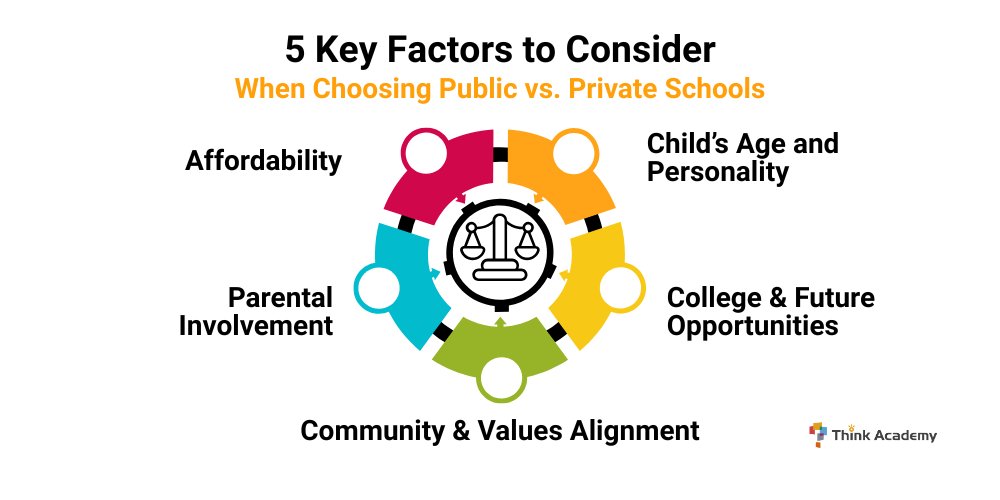
5 Key Factors to Consider When Choosing
1. Affordability
Private tuition is a long-term commitment. Consider whether it affects your ability to save for college or maintain financial security. Public schools are free but may require additional spending on tutoring, arts, or sports.
2. Child’s Age and Personality
- Younger children: May benefit from close attention possible in small private school classes.
- Active or high-need personalities: Some thrive when teachers can provide more one-on-one support. Others may do well in the larger, diverse environment of public schools.
- Discipline and structure: Private schools often set higher behavioral expectations, which can help some kids but feel restrictive to others.
One parent summed it up: “If the kid loves the teacher, they will love the class. But honestly, that’s not possible to guarantee every year, neither at public nor private.”
3. Parental Involvement
- Public schools: Families often organize afterschool activities and contribute heavily to fundraising.
- Private schools: Offer more in-house programs, saving parents’ time. However, volunteer and fundraising commitments are still common.
4. College & Future Opportunities
- Public schools: Larger student bodies often mean broader AP/IB options, electives, and extracurricular clubs. Some parents felt public schools taught resilience and independence—valuable skills for college and beyond.
- Private schools: Typically provide strong college counseling and personalized guidance. Some carry reputations or alumni networks that can help in selective admissions, though outcomes still depend on the student’s motivation.
One parent observed: “Our kids did public elementary until middle school, then one chose private and one stayed public—both ended up in colleges that fit them well. The bigger difference was personality, not the school name.”
5. Community & Values Alignment
- Public schools: Reflect the local community—diverse in background, parenting styles, and values. This can help children learn how to work with a wide mix of peers.
- Private schools: Each has its own culture—academic, faith-based, arts-focused, or progressive. Parents emphasized the importance of matching a school’s culture to the child’s needs and family values.
A private school parent shared: “The gift with private schools is being able to find one that fits your child’s personality. Look at the culture—academic, arts, sports—and choose the best fit, not just the ‘best school.’”
Public vs. Private Schools at a Glance
| Category | Public Schools | Private Schools |
|---|---|---|
| Funding & Tuition | Free; small fees for supplies, field trips, sports | Tuition $15K–$60K+ per year; extra fees (books, application, extracurriculars, fundraising) |
| Admission | Assigned by home address, district, or lottery; some magnet/charters by application | Apply about one year before entry; testing, interviews, recommendations |
| Curriculum | State standards (e.g. Common Core); accelerated tracks by placement; often test-driven | More flexible; often faster paced; project-based or advanced custom courses |
| Advanced Courses | AP/IB availability depends on school size and resources | Some offer AP/IB, others use self-designed advanced seminars |
| Class Size | Avg. ~24 students per class; ratio ~16:1 nationally | Smaller: 12–18 students per class; ratio 6:1–12:1 |
| Arts & Sports | Limited by funding; families often seek outside classes or clubs | Typically broader offerings during school day; quality depends on school focus and resources |
| Teacher Qualifications | Must be state-credentialed; salaries tied to district scale | Vary; some hire experts without credentials; lower pay, higher turnover |
| Social Environment | Greater diversity (race, income, background); “real world” mix | Often less socioeconomically diverse; close-knit communities |
| Special Needs Support | Legally required (IEPs, specialists) | Varies; many lack resources for special education |
| Parental Involvement | Heavy role in enrichment, volunteering, and fundraising | More built-in programs, but volunteering and fundraising still expected |
| School Day Length | Often shorter in elementary; aftercare needed | Longer day with enrichment (music, art, foreign language, PE) built in |
| College Prep | Broad electives, AP/IB, public resilience builds independence | Strong college counseling, alumni networks, selective admissions edge |
| Values & Culture | Reflects local diversity and community values | Distinct school cultures (academic, arts, faith-based, progressive) |
Big Picture Takeaways
- Public schools: Best for families who value diversity, community, and affordability. Academics can be excellent, but enrichment may depend on the teacher and parent involvement.
- Private schools: Best for families who want smaller classes, individualized attention, and specialized programs—and can manage the financial cost. They provide consistency in enrichment but often less socioeconomic diversity.
Ultimately, the right choice is less about public vs. private and more about finding the right fit for your child’s needs and personality. Many families switch paths at different stages—public for elementary, private for middle or high school, or the reverse.
Bottom line: The best school is the one where your child feels safe, supported, and motivated to learn.
Choosing between public and private school doesn’t have to be an all-or-nothing decision. The right fit depends on your child’s needs, your family’s values, and your long-term goals. Whether you prioritize diversity, affordability, small class sizes, or advanced enrichment, the most important thing is finding an environment where your child feels safe, supported, and motivated to learn.
Ready to See If Your Child Can Thrive in a More Rigorous Track?
Academic readiness is just as important as school choice. A structured evaluation can show whether your child is prepared for an accelerated program or a more demanding learning environment. Think Academy’s leveled curriculum helps students build the foundation they need for top schools and STEM-focused majors.
Take our free readiness test based on your child’s grade, and get personalized 1-on-1 feedback plus a custom study plan from our math experts. It’s the first step toward helping your child gain confidence, close skill gaps, and excel in any school setting.
Start the Readiness Test Today
Recommended readings:
Public school vs. private school:
Public schools:
- A Step-to-Step Guide to Public School Registration
- California Edu: Bay Area Top Public High School Districts
- New York Edu: Long Island Top Public High School Districts
Private schools:
- Types of Private Schools and How to Choose the Right One
- 20 Best Private High Schools in the U.S. for 2025–26
- 20 Best Private K-12 Schools in the U.S. for 2025–26
Pengi AI — AI-powered personalized math tutoring platform that adapts to each student's level, offering 24/7 practice and instant feedback.
Try Pengi AI — Smarter Math Practice for Students
Pengi AI supports K–12 learners with personalized math practice, guided explanations, and feedback designed to help them build confidence and improve steadily.