Pengi Editor's Note: This article was originally published by Think Academy. We're sharing it here for educational value. Think Academy is a leading K-12 math education provider.
Rising 9th Grader Parent Guide: Top 50 College Prep with Real Student Cases
Your child is becoming a rising 9th grader, and high school suddenly feels more structured—grades, course rigor, and activities all start to add up. This Rising 9th Grader Parent Guide explains top 50 college prep in practical terms: what selective colleges typically look for, what matters most in 9th grade, and how to build a sustainable plan. You’ll also see real student cases that show how academic planning and long-term choices can work in different school contexts—without overloading your child.
College Prep in 9th Grade
A Sustainable Approach
College preparation in 9th grade isn’t about piling on activities. It’s about establishing a sustainable plan for the next four years.
In 9th grade, your child should focus on adjusting to the high school curriculum while laying the foundation for a future application. Regardless of which colleges they are aiming for, it’s important to understand the standards they will be evaluated on.
What Colleges Really Look For
Understanding college expectations early allows you to help your child plan effectively for their high school years. While every school is different, the core elements colleges look for can be broken down into key areas:
1) Proactivity: Choose and Plan Early
- Start Early: Early planning is essential. This includes choosing the right courses, understanding PSAT/SAT/ACT preparation, and identifying whether your child will need tutoring or support.
- Academic Path: Discuss long-term academic goals with your child starting in 9th grade. Identify key milestones and prepare for standardized testing well ahead of 11th or 12th grade. This helps avoid last-minute stress.
2) Academic Strength: Grades + Rigor
One of the most critical elements of a college application is the academic record. The advice here is clear: take the most rigorous courses your child can handle while aiming for top grades.
- Focus on Core Subjects: Major-related courses, such as math, science, and English, should take priority. Don’t overload on electives or AP classes at the expense of core subjects.
- Quality Over Quantity: Strong grades in rigorous subjects are more important than simply taking every AP class available. Colleges appreciate depth and consistent performance.
3) Depth & Consistency: Long-Term Commitments Matter
Colleges value consistency and depth in extracurricular activities. Your child’s involvement in long-term activities demonstrates commitment, passion, and growth.
- Sustained Activities: Focus on one or two key activities your child is genuinely interested in, such as volunteering or sports. A long-term commitment (e.g., 14+ hours/week in swimming) is much more valuable than short-term “checklist” activities.
- Progression Over Time: Ensure your child’s involvement grows over the years, showing both dedication and personal development.
4) Authentic Impact
Real Contribution Over “Passion Projects”
Many parents encourage their children to take on passion projects that are designed to impress college admissions teams. However, the most valuable contributions come from real-world impact, not overly planned projects.
- Meaningful Volunteering: Helping at a local science museum, tutoring younger students, or assisting in community-based projects offers more authentic contributions than creating a high-effort but shallow project.
- Sincerity Counts: Focus on areas where your child can truly make a difference. Colleges appreciate sincerity, and impact isn’t always about the scale but the meaningfulness of the work.
Summer Before 9th Grade: What Actually Helps?
The summer before 9th grade is the last opportunity for students to prepare for high school in a relaxed environment. This period can be used to, for example:
- Explore personal interests
- Start learning about time management
- Take an academic enrichment course to get ahead in a subject of interest
Though this summer doesn’t need to be packed with activities, it’s an important time to lay the groundwork for high school success.
High School Planning: Start with College Priorities
Target College Profiles
When it comes to planning your child’s high school trajectory, it’s important to understand what top colleges prioritize. To do this effectively, you can utilize Common Data Sets (CDS) for each target college. These documents provide clear insights into the weight given to different components of a college application, including academic performance and extracurricular activities.
Common Holistic Review Process for U.S. Colleges
Top U.S. colleges generally use a holistic review process, considering both academic and non-academic factors in evaluating applicants. Here’s a breakdown of the major factors considered in the admissions process:
Academic factors:
- Rigor of secondary school record
- Class rank
- Academic GPA
- Standardized test scores
- Application essay
- Letters of recommendation
Non-academic factors:
- Interview (if required)
- Extracurricular activities
- Talent/ability
- Character/personal qualities
- Volunteer work and work experience
Understanding how each university prioritizes these factors can help guide your child’s high school choices and application preparation.
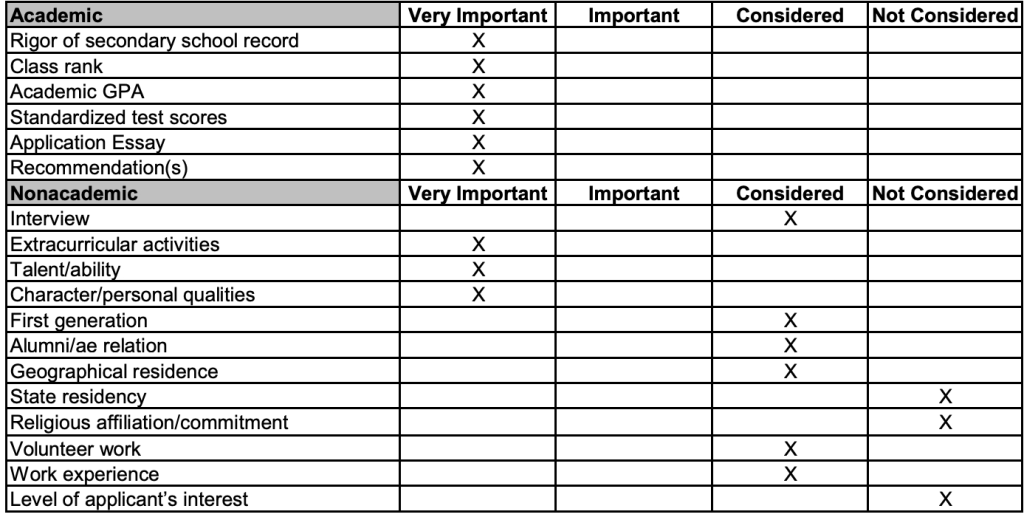
Princeton University Common Data Set report in 2024-2025
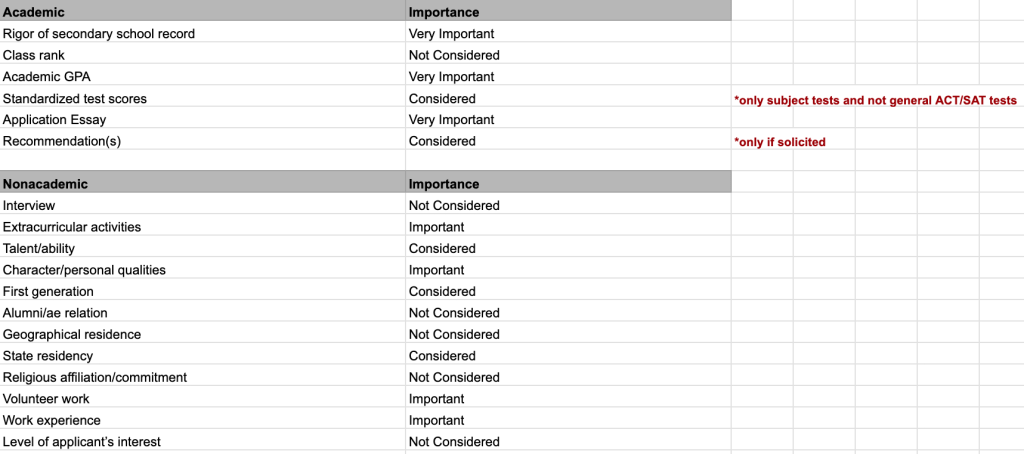
UC Berkeley Common Data Set report in 2024-2025
For parents: You can easily access the common data set for your kid’s target school by searching for its name followed by “Common Data Set”.
Want to know more info about top 50 colleges check this: 2026 U.S. News Top 50 Colleges
Academic Planning: Customize for Your Child
When you review Common Data Sets (CDS) for target schools, a pattern shows up quickly: academic factors—course rigor and GPA—are typically rated “Very Important.” The practical implication is simple. You don’t need a perfect résumé in 9th grade, but you do need an academic plan that builds strength and momentum over time.
Through the examples above—such as Princeton and UC Berkeley’s Common Data Set priorities—it’s clear that academic preparation is one of the most important components of a competitive college application. Top colleges place significant weight on rigorous coursework, GPA, and demonstrated academic growth.
This makes Academic Planning essential: mapping courses that support your child’s strengths, adding challenge at the right pace, and balancing rigor with well-being.
Avoid Overloading with AP Classes
AP courses can be valuable when they align with your child’s strengths and interests. However, piling on APs without solid foundations often results in burnout and weaker performance. The goal is quality and balance rather than quantity.
Plan Courses That Support Your Child’s Strengths
Academic planning should reflect your child’s interests and strengths. A strong foundation in core subjects paired with thoughtful progression into advanced coursework provides the best combination of confidence and competitiveness.
Recommend reading:
- AP Science Planning: Biology, Chemistry, and Pre-AP Guide
- AP Physics 1 vs 2 vs C: Difficulty, Prereqs, and Planning
Student Cases
Case Study 1
Admission Result: Stanford University (also admitted to Duke University, Pomona College, University of California, Los Angeles, University of California, Berkeley)
Academics (quantifiable + AP count + notable point)
- SAT: 1550+
- TOEFL: 115+
- AP courses: 4
- Notable point: The differentiator described is not AP volume, but a clear narrative of fit + values + impact supported by sustained execution.
Non-Academic
- Theme: humanities + storytelling + disability community advocacy
- 3-year volunteering at a Brain Injury Service Center (art projects → 1:1 work)
- Founded a student-led NGO focused on brain trauma stories; reported reach 100,000+; expanded into online magazine/webinars and related initiatives
- Activities: Model UN, speech club, philosophy club, NGO internship, visual arts journal, self-published coloring book, Stanford Humanities camp
- Awards: Zonta International Young Women in Public Affairs Award; Scholastic Art & Writing Award
- Fit-building: targeted school research + alignment in essays; submitted a Letter of Continued Interest after deferral
Case Study 2
Admission Result: Yale University
Academics (quantifiable + program + notable point)
- Curriculum: IB
- Academic standing: top 5% (within school cohort, as described)
- IGCSE: A*
- SAT: 1500+
- Notable point: Academics were already top-tier; the strategy focused on differentiating via personal qualities and a sharper narrative angle rather than adding more credentials.
Non-Academic
- Captain of school table tennis team; won multiple competitions representing the school
- Programs: Yale Young Global Scholars (YYGS), Model United Nations
- Community impact: charity/community service; collaborated with local government to improve educational resources in Hong Kong (as described)
- Essay angle: sports → reflections on social inequality → Hong Kong current affairs + historical parallels → personal project exploring family history (kept focus on the student)
Case Study 3
Admission Result: University of Southern California; University of California, Los Angeles; University of Michigan
Academics (quantifiable + program + notable point)
- GPA: 3.9 unweighted
- Curriculum: IB
- ACT: 32 (English 35, Math 33, Reading 32, Science 29)
- Notable point: Consulting began in September of senior year, leaving no time to change course selection or materially raise scores; improvements focused on positioning and narrative clarity.
Non-Academic
- Baseline: sports (swim, golf, football), National Honor Society, limited community service, summer college program (10th grade)
- Repositioned academic direction: Anthropology + Spanish minor (instead of broadly “premed/econ”), based on travel and interest in religious studies
- Evidence-building actions (late-stage, feasible): reading list; American Anthropological Association webinars/literature; started a blog; independent research via IB Theory of Knowledge
- Narrative anchor: cultural exploration + religious studies perspective tied to lived context
Case Study 4
Admission Result: University of Pennsylvania Huntsman Program (dual-degree international studies + business)
Academics (quantifiable + AP count + notable point)
- GPA: 4.0 unweighted / 4.29 weighted
- SAT: 1530
- Course rigor: AP-heavy coursework
- Notable point: Grades and rigor were already strong; the main gap was a clear fit story plus higher-signal experiences aligned with a very competitive program.
Non-Academic
- Background: Vietnamese-American male at a private high school
- Baseline: Scouts of America, orchestra, former class VP (10th grade), some sports/volunteering
- Built narrative: global outlook + service/leadership
- Year abroad in Italy as central theme
- Scouts leadership positioned as sustained service
- Added higher-signal experiences: internship with a U.S. Senator; started the largest club at school
- Added research: engineering research program at a local university
- Essays: adversity → global perspective → leadership growth
- Major strategy: flexible intended majors (history/philosophy/international business/global studies) depending on school/program fit
Overall Parent Takeaway
Across these four cases, the consistent lesson is that academic planning is most effective when it combines strong academics with a coherent direction. High course rigor helps, but only if it’s sustainable; in several cases, the differentiator was not “more APs,” but a clear narrative supported by credible evidence (long-term service, leadership, research, or structured intellectual exploration).
Focus on STEM – Think Academy
If your child is interested in STEM, focusing on math courses early will set them up for success. Enroll in advanced classes where appropriate and ensure they are challenged without being overwhelmed. The goal is to build a strong foundation for future college applications.
For parents whose children are looking to go beyond the basics and engage in advanced learning, especially with competition-style practice, Think Academy’s middle school math program is specifically designed to foster these skills.
What We Build in Our Students
- Mastery of Advanced Topics: Topics like Algebra 1, Geometry, and Algebra 2 — all covered ahead of school curricula (1–2 years in advance).
- Real Competition Preparation: Targeted math competition training for AMC 8, AMC 10, and Olympiad-style problems, giving your child a head start in competitions.
- STEM-Ready Profiles: Helping students build strong math records, setting them up for advanced high school math tracks, gifted programs, and selective private schools.
The Results Speak for Themselves
- 🏆 90%+ of Think Academy students scored above the 90th percentile.
- 🏆 94% of students placed into the fastest middle school math track.
- 🏆 Over 1,000 national competition awards in 2024 and 2025 each.
To help your child start strong, we offer a free personalized evaluation to identify their math strengths and gaps, while providing expert recommendations for long-term growth.
Your free evaluation includes:
- Peer comparison & ranking across key domains
- Skill-by-skill breakdown: number sense, algebra, geometry, and more
- Concept-level insights: where your child excels or needs support
- A clear next-step plan — personalized by our expert instructors
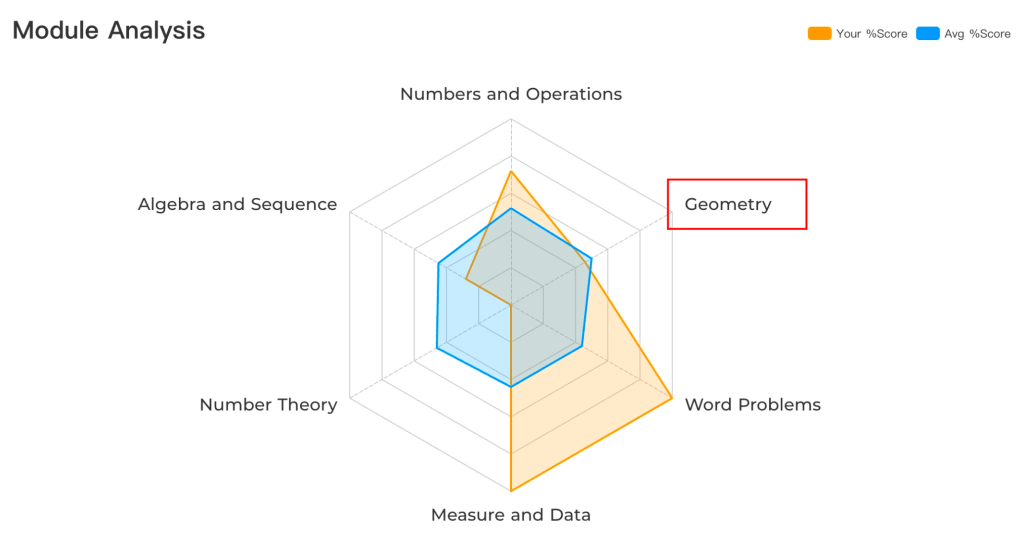
Think Academy Evaluation – Module Result
Recommend Reading:
- High School GPA Planning for Rising 9th Graders: Summer Academic Planning
- Summer Planning for Rising 9th Graders: Academics, Interests, and Summer Programs
Try Pengi AI — Smarter Math Practice for Students
Pengi AI supports K–12 learners with personalized math practice, guided explanations, and feedback designed to help them build confidence and improve steadily.