Pengi Editor's Note: This article was originally published by Think Academy. We're sharing it here for educational value. Think Academy is a leading K-12 math education provider.
Types of Private Schools and How to Choose the Right One
Choosing a private school for your child is one of the most personal—and strategic—decisions a family can make. From the type of school to the grade-level structure, educational values, tuition, and extracurricular offerings, every option has its trade-offs.
This guide walks you through the most common types of private schools in the U.S., typical entry points, and the key factors parents should consider when choosing the best fit for their child.
Key Takeaways for Parents
- The right school is the one that fits your child best—not necessarily the most prestigious.
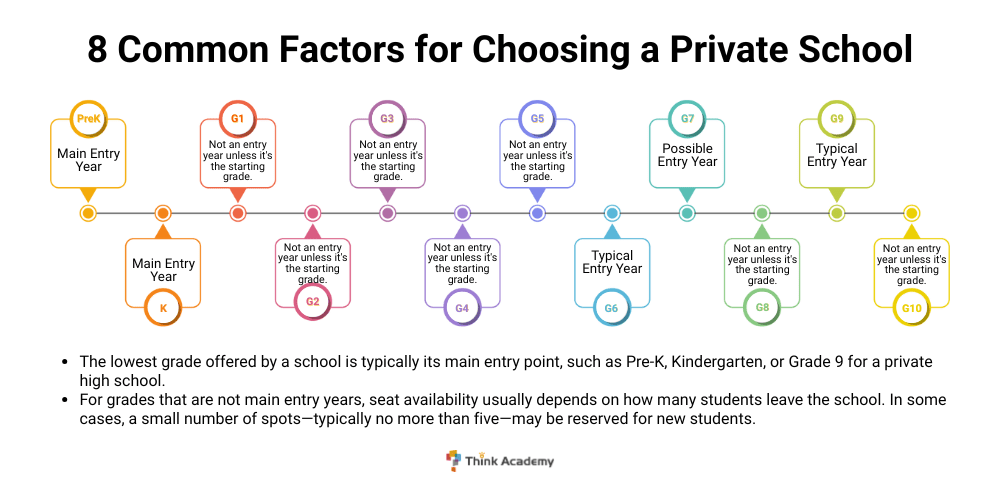
- Pre-K, Kindergarten, Grade 6, and Grade 9 are the most common private school entry years.
- Tuition, class size, and academic approach vary significantly between schools.
- Private schools differ in values and teaching philosophies—understanding these is key to finding the right fit.
- The school website, campus visits, and conversations with students, parents—your best tools for researching a private school.
Private School Types
Based on Grade Span
Private schools come in different structural formats. Some serve all grades, while others specialize in certain age groups.
- K (or PreK) –12: Full-spectrum schools that provide continuity from early childhood through high school
- K (or PreK) –5: Elementary-only schools that focus on foundational skills
- K (or PreK) –8: Extend through middle school for stability in the early years
- Grade 6–12 or 7–12: Secondary schools with more academic rigor
- Grade 9–12: High school only, often college preparatory
- Other models (for example 4-12) are designed to ease transitions between school stages
Entry Years
The lowest grade offered by a school is typically its main entry point, such as Pre-K, Kindergarten, or Grade 9 for a private high school. However, some other grades also tend to have more available seats, including:
- Grade 6: A common entry year due to the start of middle school
- Grade 7: Added availability, often tied to academic re-leveling
- Grade 9: Major intake year for high schools, especially college prep programs
For grades that are not main entry years, seat availability usually depends on how many students leave the school. In some cases, a small number of spots—typically no more than five—may be reserved for new students.
Based on Educational Philosophy
1. Traditional Independent Schools
These are non-religious schools governed independently, typically by a board of trustees. They emphasize academics, leadership, and enrichment opportunities and often have strong records in college preparation.
2. Religious Schools
Private religious schools include Catholic, Christian, Jewish, and Islamic institutions. These schools integrate academic learning with moral and faith-based education. Many offer lower tuition due to religious sponsorship.
3. Language Immersion Schools
Language immersion schools deliver instruction in two languages, such as Mandarin-English or Spanish-English. They are ideal for bilingual families or those focused on global education goals.
4. Montessori and Waldorf Schools
Montessori schools emphasize hands-on, self-directed learning. Waldorf schools prioritize creativity and holistic development. Both are more common in the preschool and elementary years and differ from traditional academic structures.
Gender-Based Models
Private schools may be coeducational or single-sex.
- Coeducational: Boys and girls learn together
- Single-sex: Focus on minimizing distractions and building confidence, depending on the philosophy of the school
Day vs. Boarding Schools
- Day schools: Students commute daily; more common for younger grades
- Boarding schools: Residential programs beginning in grades 7–9; known for immersive academics and extracurricular experiences
How to Find the Best-Fit School for Your Child
Every school has a unique mission, structure, and culture. Choosing the right fit requires aligning your child’s learning style and goals with the school’s strengths.
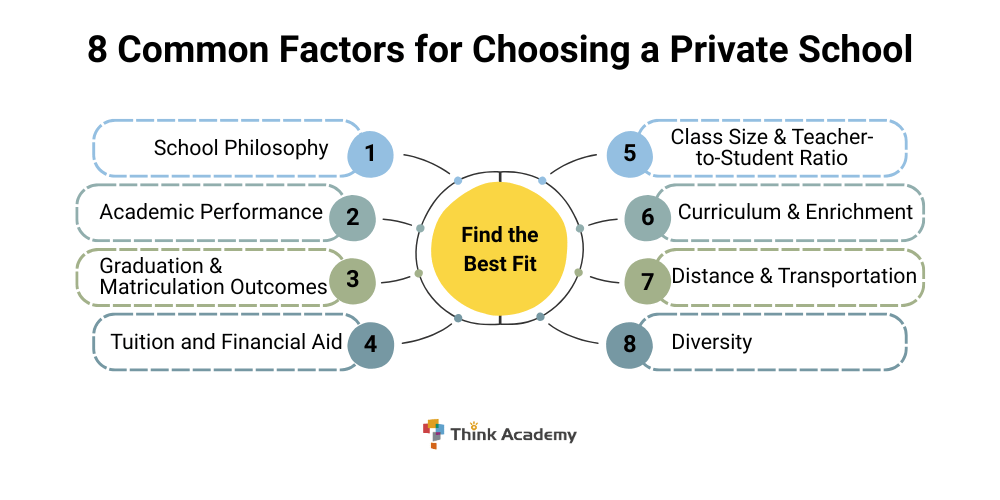
Common Factors to Consider
1. School Philosophy
Understand what the school values most—academics, creativity, character development, diversity, or discipline—and whether that aligns with your child’s personality and your family values.
2. Academic Performance
Review test score averages, competition results, and standardized assessment benchmarks. For high schools, look at college acceptance rates and academic distinctions.
3. Graduation and Matriculation Outcomes
Where do students go after graduating? For middle and elementary schools, this may include high school placement. For high schools, consider college matriculation trends.
4. Tuition and Financial Aid
Private school tuition can vary widely, ranging from several thousand to tens of thousands of dollars per year. Be sure to consider the total cost and what it includes—such as tuition, textbooks, and extracurricular activities—as well as whether the school offers need-based or merit-based financial aid. Many private schools also offer sibling discounts and flexible payment plans.
5. Class Size and Teacher-to-Student Ratio
Smaller class sizes often lead to more personalized instruction and stronger teacher-student relationships. In elementary schools, class sizes typically range from 6 to 16 students, while in middle and high schools, they can range from 12 to 25. Teacher-student ratios usually fall between 1:6 and 1:16, depending on the school’s structure and resources.
6. Curriculum and Enrichment
Look into whether the school offers accelerated tracks, electives, or special programs such as STEM, arts, or foreign languages. Review the structure of math tracks and advanced coursework like AP or IB.
7. Distance and Transportation
Evaluate how far the school is from home and whether bus or carpool options are available. Commute time can significantly impact both your and your child’s daily routine, especially for working parents. Based on feedback from Think Academy parents, a manageable commute is typically within 25 minutes.
8. Diversity
Consider how the school supports cultural, racial, and socioeconomic diversity among students and faculty. Ask how inclusion is practiced and supported.
Grade-Level Specific Considerations
Elementary School (PreK–5)
- Quality of playground and physical activity areas
- Focus on foundational skills in literacy and math
- Afterschool options for working parents
- Language program options for multilingual families
Middle School (Grades 6–8)
- Availability of advanced math tracks or accelerated programs
- Arts and sports teams, including quality of coaching and participation
- Support for social-emotional growth and executive function, as academics become more challenging in middle school.
High School (Grades 9–12)
- Access to advanced coursework such as AP, IB, or dual enrollment
- Performance and coaching in arts and athletics
- Opportunities for leadership, clubs, and community service
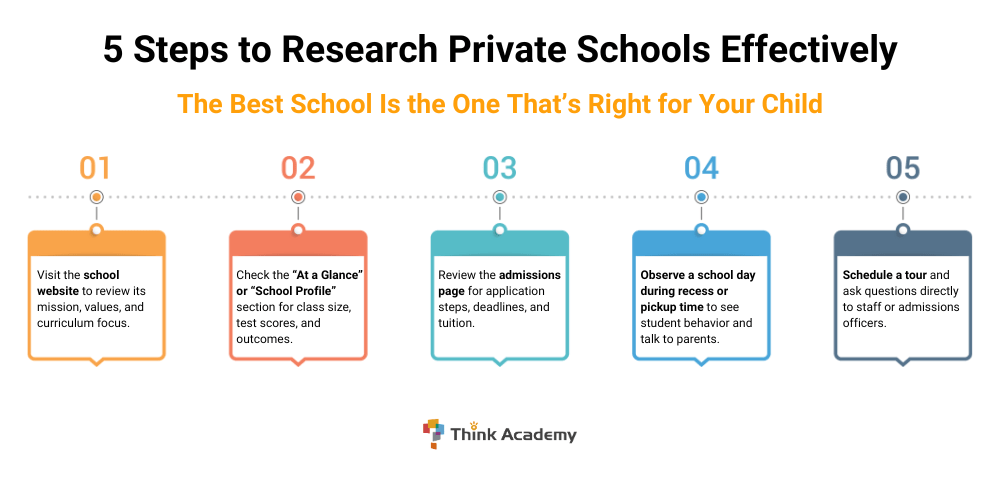
5 Steps to Research Private Schools Effectively
To gather this information effectively, here are some key tips to help you with your research:
- Explore the school website to understand its mission, values, and educational approach.
- Look for sections like “At a Glance” or “School Profile”, where many schools share key metrics such as class size, academic performance, faculty credentials, and graduation outcomes.
- Check the “Admissions” page for application requirements, deadlines, and tuition details.
- Visit the campus during a regular school day, preferably around recess, to observe student interactions and talk to parents during drop-off or pick-up.
- Schedule a campus tour and speak directly with school staff to ask specific questions and get a feel for the school culture.
Turning School Research into an Academic Plan
Understanding private school types, entry years, and educational philosophies helps families narrow down options—but choosing the right school also requires knowing whether your child is academically prepared for the pace and expectations of that environment.
Across many private schools, especially academically rigorous programs, math placement is a key factor that influences:
- admissions competitiveness
- access to accelerated or honors tracks
- long-term readiness for advanced coursework in middle and high school
For families who are new to the U.S. education system—or weighing different private school models for the first time—this step is often the hardest: translating school research into a clear academic path for their child.
A Think Academy Free Math Evaluation helps bridge that gap by offering:
- a clear diagnosis of your child’s current math level
- insight into which private school tracks and pacing levels are realistic targets
- personalized 1-on-1 guidance on how to prepare early for the academic expectations of your chosen school type
Whether you are considering traditional independent schools, language immersion programs, or academically accelerated private schools, understanding math readiness early allows families to plan with confidence—before admissions decisions and placement tests come into play.
Prefer to Start with Practice?
If you’d like to assess and strengthen fundamentals independently, access Think Academy’s free math worksheets for PreK through Grade 10. Worksheets are organized by grade and topic to help identify gaps and build confidence.
Try Pengi AI — Smarter Math Practice for Students
Pengi AI supports K–12 learners with personalized math practice, guided explanations, and feedback designed to help them build confidence and improve steadily.