Pengi Editor's Note
The Pengi editorial team selected this Think Academy private high school admissions guide. The all-in-one format — from entrance exams to financial aid — gives families a complete picture of a process that can otherwise feel opaque and overwhelming.
Source: Think Academy Blog
All-in-One Guide: How to Get Into a Private High School
Applying to a top-tier private high school takes preparation and planning. From setting academic goals to managing interviews and financial aid, this guide breaks the process into seven clear steps—so you can help your child apply with confidence.
TL;DR – Key Steps
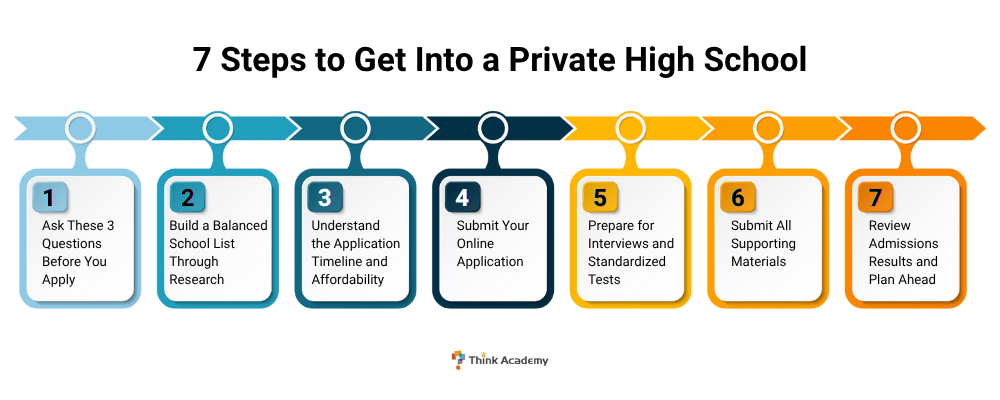
7 Key Steps to Apply for Private High School:
- Have a family discussion about goals, values, and school fit
- Research schools and build a shortlist of 3–5 balanced options
- Understand the application timeline and affordability
- Submit your online application and track deadlines
- Prepare for standardized tests and interviews
- Submit all supporting materials: essays, test scores, recs, transcripts
- Review decision results, enroll or manage waitlists, and plan tuition payments
We’ll walk through each step below—so you’re fully prepared for your child’s next chapter.
Step 1: Ask These 3 Questions Before You Apply
Before you start applications, take time to reflect as a family. High schools want to admit students who are not only academically capable but aligned with the school’s values.
Ask yourself:
- What’s our long-term goal? Do you want an Ivy League–feeder? A balanced program with arts and sports? A nurturing, project-based environment?
- What type of school will help my child grow? Think beyond rankings. Consider day vs. boarding, size, culture, and academic strengths.
- Is my child ready and motivated? High school admissions focus more on the student than the parent. Their interests, attitude, and voice matter most.
Writing down these answers will help you build a school list—and prepare a more authentic application later on.
Step 2: Build a Balanced School List Through Research
Once your goals are clear, start researching schools. Focus on building a shortlist of 5–10, and plan to apply to 3–5.
Here’s what to consider:
- School model: Day or boarding, coed or single-gender, secular or religious
- Curriculum: AP, IB, Harkness, STEM-intensive, or liberal arts
- Location and lifestyle: Commute time, housing, or boarding readiness
- Culture fit: Look at class size, diversity, clubs, advisory system
- Affordability: Tuition ranges from $30K to over $75K; aid policies vary
- Test policy: Most schools require SSAT or ISEE—but some are test-optional or test-blind
Tip: Choose schools where your child would genuinely thrive—not just where they can “get in.”
Step 3: Understand the Application Timeline and Affordability
Private high school admissions are detailed and time-sensitive. Here’s what you need to know.
Typical Timeline for Fall 2026 Entry:
- Applications open: August to October 2025 (Most popular schools are now open for applications.)
- Application deadlines: November 2025 to January 2026
- Testing and interviews: October 2025 to February 2026
- Decisions released: March 2026
- Deposits due: March to April 2026
Most schools require:
- Online application (Ravenna, Gateway, SAO, or school portal)
- Application fee (typically $50 to $150; waivers available)
- Student essays (1 to 3 prompts)
- Parent questionnaire
- Transcripts (last 2 to 3 years)
- Recommendations (English and Math teachers; sometimes a counselor or coach)
- SSAT or ISEE scores (required or optional)
- Interview (student—and often parent)
Tip: Use a checklist or spreadsheet to track each school’s requirements and due dates.
Tuition and Affordability
Affordability is one of the most important factors families consider when looking at private schools.
Tuition can vary widely—from just a few thousand dollars to over $75,000 per year—depending on the school’s location, reputation, and grade level.
While cost is a major concern for many families, most private schools offer ways to make tuition more manageable, such as:
- Need-based financial aid: Based on your family’s income and financial situation
- Merit scholarships: Often available in upper grades for academic or talent-based achievements
- Sibling discounts: Reduced tuition for families with multiple children enrolled
- Flexible payment plans: Monthly, quarterly, or semi-annual options to spread out the cost
Education loans are also an option for families seeking financial support beyond what schools offer.
Tip: Financial aid deadlines often differ from general application deadlines. Be sure to check the latest information on each school’s website.
The table below compares 2025–26 tuition rates at 20 prominent U.S. private high schools. Here are three key takeaways:
- Tuition varies widely—from $0 at Regis High School (NY) to over $80,000 per year for Lawrenceville’s boarding program. Among day-only schools, the range spans from $37,050 at St. John’s School (TX) to more than $68,000 at The Chapin School (NY).
- Boarding programs command the highest prices, with several New England boarding schools (Andover, Exeter, Hotchkiss, Choate) charging $69,000–$77,000 annually, compared to their day-student rates of $54,000–$66,000.
- State and location strongly influence tuition. New York and New Jersey schools generally have higher day tuition than California or Texas counterparts, while online options like Stanford OHS and Dwight Global offer lower rates than most brick-and-mortar programs.
| School | State | Tuition (2025–26) |
|---|---|---|
| Groton School | MA | $61,810 (boarding); $48,135 (day) |
| Phillips Academy Andover | MA | $76,731 (boarding); $59,478 (day) |
| Phillips Exeter Academy | NH | $69,537 (boarding); $54,312 (day) |
| Choate Rosemary Hall | CT | $72,420 (boarding); $55,990 (day) |
| Commonwealth School | MA | $60,075 |
| The Hotchkiss School | CT | $75,790 (boarding); $64,420 (day) |
| The College Preparatory School | CA | $60,050 |
| Riverdale Country School | NY | $59,412 |
| St. Paul’s School | NH | $71,800 |
| Stanford Online High School | CA (Online) | $30,970 |
| Harvard-Westlake School | CA | $52,500 |
| The Pingry School | NJ | $54,795 |
| The Brearley School | NY | $66,800 |
| The Nueva School | CA | $62,560 |
| St. John’s School | TX | $37,050 |
| The Lawrenceville School | NJ | $80,690 (boarding); $66,400 (day) |
| Regis High School | NY | $0 (tuition-free) |
| The Chapin School | NY | $68,250 |
| Dwight Global Online School | NY (Online) | $42,750 |
| The Bishop’s School | CA | $49,600 |
Step 4: Submit Your Online Application
Submit an Inquiry
Most schools now require an additional step before you can open an application account—called submitting an inquiry. This step may happen even before you schedule a visit or start your application. It helps the school learn about your interest and background, and allows them to send you updates on the application process and upcoming events as you decide whether to apply.
Application Account
Most private schools manage their admissions through an online portal, such as Ravenna, SAO (Standard Application Online), or a school-specific platform. Creating an account on these portals is often the first formal step in the application process.
Once registered, you’ll use this portal to:
- Submit the application form and pay the application fee
- Track important deadlines and task checklists
- Upload required documents (e.g., report cards, recommendations)
- Schedule interviews or assessment sessions
- Receive admissions decisions
Tip: Set up your account early so you can monitor updates and avoid last-minute technical issues. Some schools also use the portal to send reminders about upcoming events or missing materials.
Admission Events & School Visits
With your application account set up, it’s time to attend admission events and school visits. These events are crucial for demonstrating your interest and helping your child decide if a school is a good fit.
What to Expect:
- Open Houses: Large group events, often on weekends, that include presentations, student-led tours, and opportunities to meet teachers and coaches.
- Info Sessions: More intimate presentations, often virtual, that focus on specific aspects of the school, like academics or arts.
- Campus Tours: A great way to see the school in action on a typical school day and get a feel for the culture.
- Student Shadow Days: Some schools offer the chance for your child to spend a day attending classes with a current student. This is one of the best ways to experience a school’s culture firsthand.
Tip: Attending these events shows demonstrated interest, which can be a factor in competitive admissions. Be sure to register through the online portal and sign in at each event.
Step 5: Prepare for Interviews and Standardized Tests
Schedule an Interview
High school interviews focus more on the students. Nearly all schools require a student interview, and sometimes a parent interview as well.
What to prepare for:
- Academic Interests and Goals: Discuss in-school projects, competitions, and long-term college and career aspirations.
- Extracurricular Activities: Highlight sports, arts, leadership achievements, and other hobbies.
- Personal Fit: Be ready to talk about your personality, how you handle challenges, and why you believe this school is the right fit for you.
More tips for interview preparation: Private School Interview: How to Prepare and Question Checklist
Standardized Tests
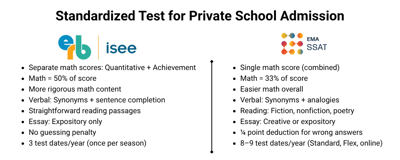
- ISEE: The Independent School Entrance Exam is accepted by many day and independent schools. The “Upper Level” is for students applying to grades 9-12.
- SSAT: The Secondary School Admission Test is widely accepted and common among boarding schools. The “Upper Level” is for students applying to grades 9-12.
- PSAT, SAT, and ACT: For high grades, typically Grade 10 or 11, many schools will accept PSAT, SAT, or ACT scores in addition to, or in lieu of, the SSAT or ISEE.
- Others: Some schools have their own exams, like Regis High, while others are “test-blind,” meaning they don’t use test scores at all. Nueva or Chapin are examples of schools with these policies.
Good prep includes:
- A diagnostic test in the summer or early fall to establish a baseline.
- A two- to three-month study plan.
- Targeted review for math, vocabulary, and reading speed.
- Full-length practice tests under timed conditions.
A strong score helps—but remember, it’s just one part of a holistic review.
To learn more about ISEE and SSAT, read this: ISEE vs SSAT: Complete Guide for Private School Admissions
Step 6: Submit All Supporting Materials
The application isn’t just about grades or test scores. Schools want to know your child as a whole person.
You’ll typically submit:
- Essays: Authentic, reflective responses written by the student
- Teacher recommendations: Usually English and Math teachers
- Transcript: From Grades 6–8 or 7–9 depending on entry point
- Parent statement: About your child’s strengths and school fit
- Activity list: Highlight depth, leadership, and personal interests
- Interview: Required by most schools; may be in-person or online
- Optional extras: Art portfolio, athletic resume, or video essay if allowed
Tip: Start essays and request recommendations in early fall—don’t wait until the deadline.
Step 7: Review Admissions Results and Plan Ahead
Most decisions come out in March 2026. Here’s what to expect—and how to respond.
If accepted:
- Celebrate the good news
- Attend revisit days or welcome events
- Confirm enrollment and pay deposit (typically due within 1–2 weeks)
If waitlisted:
- Send a follow-up letter reaffirming interest
- Update the school with new achievements
- Accept an offer elsewhere in the meantime
- Stay positive and responsive—waitlists often move in April or May
If denied:
- Be proud of the effort your child made
- Revisit other strong options
- Consider schools with rolling admissions
- Possibly reapply for 10th grade later
Tip: Apply to at least one “safe but solid” school your child would be happy to attend.
Not Sure If You’re on the Right Track?
If you’re planning for private school admissions but unsure whether your current math placement and pacing are competitive, a Think Academy Free Math Evaluation can help.
You’ll receive:
- a diagnostic assessment of your current level
- clear feedback on acceleration readiness
- a personalized 1-on-1 learning path aligned with private school expectations
Prefer to Start with Practice?
If you’d like to assess and strengthen fundamentals independently, access Think Academy’s free math worksheets for PreK through Grade 10. Worksheets are organized by grade and topic to help identify gaps and build confidence.
Recommended Articles
- Types of Private Schools and How to Choose the Right One
- Top High Schools in LA: Harvard-Westlake vs. Whitney High School
Applying to a top private high school is a multi-step process, but with clear goals, careful school research, and early preparation for testing, essays, and interviews, your family can navigate it with confidence. Use this guide as your roadmap—so when decision day arrives, you’ll have strong options that fit your child’s strengths, ambitions, and personality.
Appendix: Math Curriculum Comparison: Public School vs. Academic Private School
In the U.S., math curriculum pacing varies widely depending on school type. Public schools typically follow Common Core standards, while academically rigorous private schools often accelerate 1–2 years ahead, even outside of Gifted & Talented (GT) or Honors programs.
The chart below compares:
- Public School Standard Track
- Typical Academic Private School Track
- Math Competition Recommendations
Table: By-Grade Math Progression and Recommended Competitions
| Grade | Public School Curriculum | Academic Private School Curriculum | Recommended Math Competitions |
|---|---|---|---|
| G6 | Pre-Algebra (starting) | Pre-Algebra / Algebra 1 | AMC 8 / AMC 10 |
| G7 | Math 7 (Pre-Algebra) | Algebra 1 / Geometry | AMC 8 / AMC 10 |
| G8 | Math 8 (Pre-Algebra) | Geometry / Algebra 2 | AMC 8 / AMC 10 / AIME |
| G9 | Algebra 1 | Algebra 2 / Pre-Calculus | AMC 10 / AIME |
| G10 | Geometry / Algebra 2 | Pre-Calculus / Calculus AB / SAT Math | AMC 10 / AIME / USA(J)MO |
| G11 | Algebra 2 / Pre-Calc / SAT | Calculus BC / Stats / SAT Math | AMC 12 / AIME / USAMO |
| G12 | Calculus / Stats | Multivariable Calculus / Stats | AMC 12 / USAMO |
Notes:
- Curriculum terms are aligned with Common Core and competitive private school pacing.
- Private school curriculum is often 1–2 years accelerated, especially by Grade 3–5.
- Competition recommendations are based on content alignment and grade-level eligibility.
Try Pengi AI — Smarter Math Practice for Students
Pengi AI supports K–12 learners with personalized math practice, guided explanations, and feedback designed to help them build confidence and improve steadily.