Pengi Editor's Note: This article was originally published by Think Academy. We're sharing it here for educational value. Think Academy is a leading K-12 math education provider.
What Is a Good i-Ready Diagnostic Score? 2026 Chart by Grade Explained
When a student completes the i-Ready Diagnostic, the natural next question is: What do these scores mean?
The Diagnostic provides much more than a single number. It highlights:
- Current performance compared to grade-level expectations
- Growth over time, from Beginning of Year (BOY) to Middle (MOY) and End of Year (EOY)
- Readiness for future learning, including enrichment or additional support
This article explains how to access i-Ready results, what scale scores and percentiles mean, and how families can turn reports into an improvement plan.
What is i-Ready?
i-Ready is an adaptive online assessment and instructional program created by Curriculum Associates. It is used in more than 25,000 schools across the U.S. to measure student learning in Math and Reading/Literacy.
The program includes:
- i-Ready Diagnostic – an adaptive test that identifies each student’s current skill level
- i-Ready Personalized Instruction – lessons tailored to their needs, based on results
How to access i-Ready scores
Results are available as soon as the Diagnostic is complete.
- Teachers can view full reports immediately.
- Students usually move straight into personalized lessons, rather than raw scores.
- Families receive results through district channels—some schools share them right after testing, others after the window closes.
Ways to access:
- i-Ready Login Portal – sign in with school credentials
- i-Ready Connect for Students (App) – shows lessons, progress, sometimes scores
- Clever Login – single sign-on; click the i-Ready logo
- School Platforms – portals like PowerSchool, Aeries, or Infinite Campus
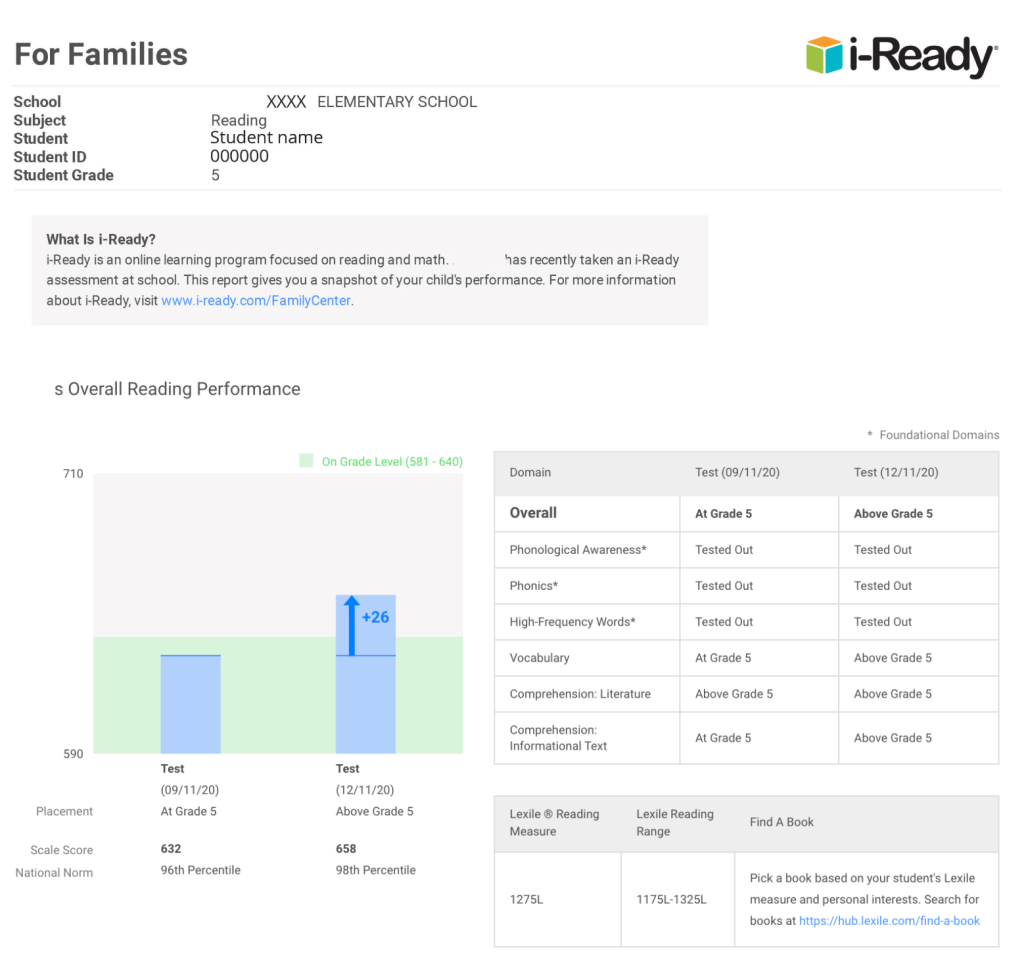
- For Families Report (PDF) – simplified, parent-friendly report sent home or emailed
For the full official guide, see_:_ How to Interpret i-Ready Report
A Quick Guide to Understanding i-Ready Score
1. Scale Score (100–800)
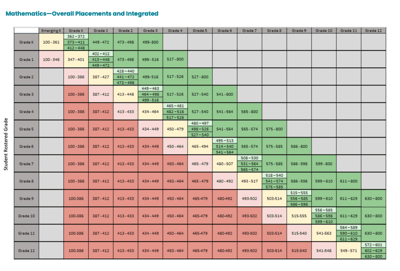
The scale score is the main numerical indicator of performance. Each grade has its own “on-level” range, meaning the same number may indicate different placement depending on grade.
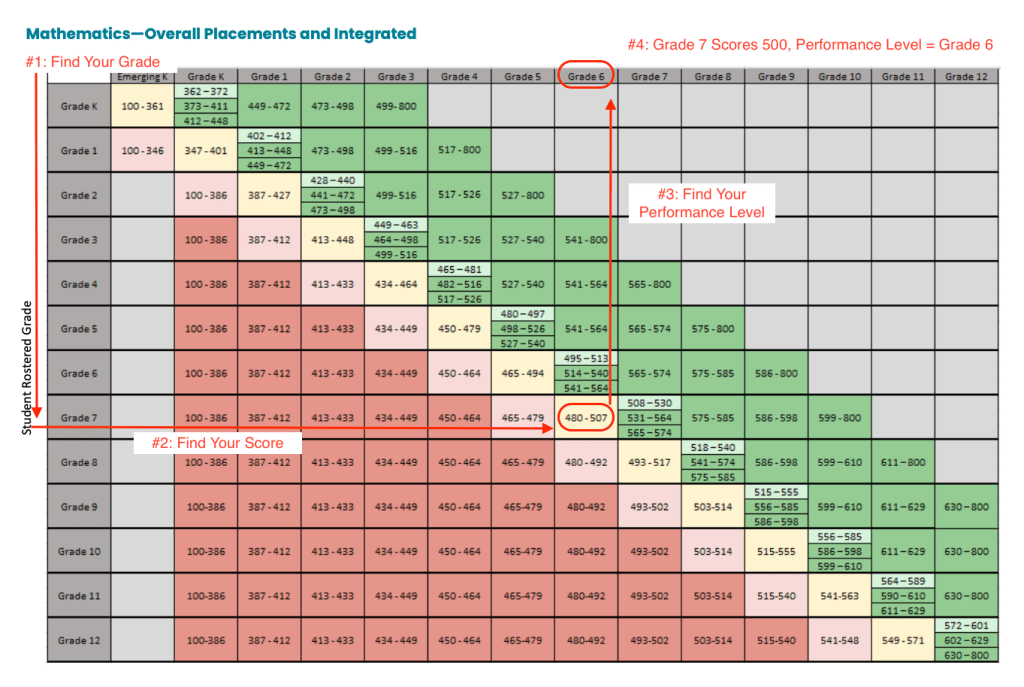
3 Steps to Understand Your i-Ready Diagnostic Score (Example: Grade 7 scored 500)
- Start with your enrolled grade: Look at the left-hand column and find the row for Grade 7.
- Move across the Grade 7 row to locate your score range: A score of 500 falls between 480–507, which is shown in the light yellow cell.
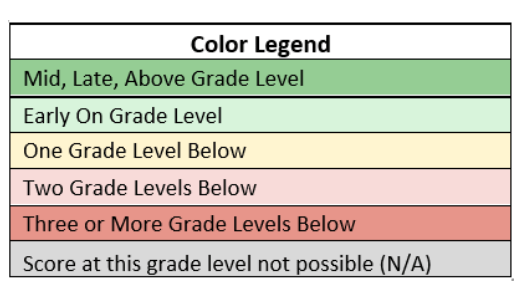
- Look upward to see the grade level that matches this color band: The light yellow cell aligns with Grade 6, and the color legend confirms that light yellow represents one grade level below.
This means that although the student is in Grade 7, their current i-Ready performance is closer to a Grade 6 level.
Click here to view full i-Ready Diagnostic Placement Tables (2025–26).
If you’re unsure about your i-Ready score or the right math path forward, Think Academy’s free math evaluation can help create a personalized learning plan.
The “Tested out” in the report means you have already demonstrated mastery of the skills in a specific domain or sub-domain.
Because you scored above the upper threshold, i-Ready does not assign lessons in that area — the program considers those skills already mastered and moves you to the next appropriate level.
2. Grade-Level Placement
i-Ready converts scale scores into grade level to indicate placement:
- Below Grade Level → needs additional support
- At Grade Level → meeting expectations
- Above Grade Level → ready for enrichment or acceleration
3. National Percentile Rank
The percentile rank compares a student’s performance with peers nationwide:
Example: 70th percentile → performing better than 70% of students nationally.
What counts as “top tier” can vary by district. In highly competitive areas, only the 95th percentile and above may be considered top tier. Still, national percentiles provide a consistent benchmark.
4. Domain Results, Lexile®, and Quantile®
i-Ready reports also break down performance by domains (learning areas). This allows families to see not only the overall score but also where a child is excelling or struggling.
Domain Results – break down performance into learning areas:
Math: Numbers & Operations, Algebra, Geometry, Measurement & Data
Reading: Vocabulary, Comprehension, Reasoning
Lexile® (Reading) – shows reading level and matches students with appropriate books
- 600L → typical for Grades 3–4
- 800L → typical for Grades 5–6
- Try the Lexile Find a Book Tool to discover books tailored to your child’s reading ability.
Quantile® (Math) – shows which math skills a student is ready to learn next, guiding targeted instruction.
What Is a Good i-Ready Score?
A “good” i-Ready score is one that shows your child is on track for grade-level mastery and making steady growth across the year. i-Ready does not give pass/fail results; instead, it uses score ranges and placement levels to show whether a student is performing at, above, or below grade expectations.
1. Grade-Level Placement Matters Most
Each grade has a recommended score range, shown as the green cells in the placement table above.
- If your child’s score falls within or above that range, they are considered on grade level or above grade level, which is a strong result.
- Students who score below the range may need targeted support in specific skill areas.
Being “on grade level” means the student is meeting the year’s expectations; being “above grade level” may indicate readiness for enrichment or more advanced content.
2. Growth Is Just as Important as the Number
i-Ready is given three times a year, and scores typically follow this pattern:
- BOY (Beginning of Year): Fall diagnostic — often lower due to summer learning loss.
- MOY (Middle of Year): Winter diagnostic — shows mid-year progress.
- EOY (End of Year): Spring diagnostic — final measure of growth.
A student growing from 470 → 487 → 502 (BOY → MOY → EOY) is making strong, meaningful progress—even if they are not yet at the highest tier.
In summary, a good i-Ready score is one that indicates:
- On Grade Level or Above Grade Level performance for the student’s grade, and
- Consistent growth from BOY to MOY to EOY.
Students and parents should look at both placement level and year-over-year improvement to understand how well a child is progressing.
The Broader Impact of i-Ready
i-Ready scores guide:
- Instructional planning – grouping for targeted lessons
- Early intervention – quick support for struggling students
- Placement decisions – advanced classes, accelerated math, or enrichment
- Progress monitoring – tracking growth across BOY, MOY, EOY
- Family communication – clear reports for parent–teacher discussions
In short, i-Ready functions not just as a diagnostic tool but as a continuous feedback system that connects assessment directly with classroom learning.
How to Use i-Ready to Support Your Child
Step 1: Verify accuracy
- A single test may not show true ability. Scores can shift with conditions or effort. Check with teachers, use other assessments, or retake i-Ready if results seem unusual.
Step 2: Pinpoint weak areas
- Use domain data to focus practice. A student struggling in Algebra can benefit from extra practice or a focused bootcamp.
Step 3: Choose the right path
- Below level: rebuild foundations with guided practice
- At level: reinforce strengths and prepare for new skills
- Above level: challenge with advanced classes, enrichment, or contests like AMC 8 and Math Kangaroo
How Think Academy Can Help
Once you understand what each i-Ready score represents, the next step is deciding what to do with that information.
1) If your child is currently preparing for i-Ready:
Is your 5th or 6th grader going to take the i-Ready for math placement test? Our Math Placement Prep Bootcamp is designed to help them succeed! It includes an official i-Ready test and four live lessons covering essential skills—helping your child assess their level, review key topics, and prepare efficiently.
Here is what the bootcamp includes:
- Free Access to Official i-Ready Assessment
This helps identify their strengths and weaknesses across different modules, allowing for more targeted and effective practice.
- Four Live Sessions (2 Hours Each)
Cover the four essential placement test modules: Computation, Algebra, Geometry, and Statistics. Our teachers will provide personalized post-class follow-ups to help students master core concepts and spot areas for improvement.
- Clear Middle-to-High School Math Roadmap
Beyond the test, we can provide a clear long-term plan to guide your child’s math journey from middle school through high school.
2) If your child has already finished the i-Ready test:
No matter the outcome, the score is a valuable reflection of your child’s recent growth and current math level. If you are looking for a deeper analysis of their level and want to build a long-term math plan—whether to fill knowledge gaps, solidify foundations, accelerate their learning, or start competition prep—we are here to support you.
We invite you to take our Free Math Evaluation. After the assessment, a professional academic advisor will help you map out a customized math pathway from middle school all the way to high school graduation.
Recommended Readings
- i-Ready FAQs: Complete Guide for First-Time Takers
- i-Ready, MAP & STAR: Which Test Is Best for Your Child?
Try Pengi AI — Smarter Math Practice for Students
Pengi AI supports K–12 learners with personalized math practice, guided explanations, and feedback designed to help them build confidence and improve steadily.