Pengi Editor's Note: This article was originally published by Think Academy. We're sharing it here for educational value. Think Academy is a leading K-12 math education provider.
What Is the MAP Test? A Parent-Friendly Guide to MAP Growth
If your child’s school mentions “MAP testing,” you’re not alone in asking: What exactly is it? Why do they use it? And what are we supposed to do with the results? The world of school assessments can be confusing, but the MAP Growth test is a tool designed to empower teachers and parents, not to create stress. This guide explains everything you need to know in plain language, so you can feel confident and informed.
What is the MAP Test?
MAP Growth vs. MAP Reading Fluency: What’s the Difference?
MAP stands for Measures of Academic Progress and includes two different assessments developed by NWEA: MAP Growth and MAP Reading Fluency. Although the names are similar, these assessments serve different purposes and measure different aspects of learning.
MAP Growth is the most widely used MAP assessment. It is a computer-adaptive test that measures overall academic achievement and growth in subjects such as math, reading, language usage, and science (where offered). MAP Growth focuses on what students understand and can apply, particularly in areas like reading comprehension, vocabulary, math problem-solving, and reasoning. Results are reported using RIT scores, percentiles, and growth measures, allowing schools to track progress across the school year and from year to year.
MAP Reading Fluency, by contrast, is designed specifically to assess foundational reading skills, most commonly in early elementary grades. It focuses on skills such as phonics, word recognition, oral reading fluency, and reading accuracy. Rather than measuring deep comprehension, MAP Reading Fluency helps schools determine whether students have the building blocks needed to become fluent readers and to identify early gaps that may require targeted intervention.
Some schools use both assessments together, especially in lower grades. MAP Reading Fluency helps answer the question, “Can this student read accurately and fluently?” while MAP Growth (Reading) addresses, “How well does this student understand what they read?” Used together, they provide a more complete picture of a child’s reading development and help educators make informed instructional decisions.
What Is the MAP Growth Test?
With that distinction in mind, when schools refer to the “MAP test,” they are most often talking about MAP Growth. MAP Growth is a computer-based assessment created by the nonprofit organization NWEA. It is used in K–12 schools to measure a student’s academic achievement and, more importantly, their growth over time.
How MAP Growth Works
What sets MAP Growth apart is its computer-adaptive design. Rather than giving every student the same set of grade-level questions, the test adjusts its difficulty in real time based on each response:
- If a student answers a question correctly, the next question becomes more challenging.
- If a student answers incorrectly, the next question becomes easier.
This adaptive approach allows MAP Growth to identify a student’s instructional level independent of grade, pinpointing not only what the student has already mastered, but what they are ready to learn next. As a result, MAP Growth functions less as a traditional exam and more as a tool for guiding future instruction.
How Often Do Students Take MAP Growth?
To measure progress accurately, MAP Growth is administered multiple times during an academic year. Most schools test students:
- commonly 3 times per year,
- Fall – establishes a starting baseline
- Winter – checks midyear progress
- Spring – shows total growth over the school year
Some schools may test more or less frequently depending on instructional goals, but MAP Growth is intentionally designed to track change over time, not performance on a single test day.
Why Do Schools Use MAP Growth?
Unlike a final exam, MAP Growth is not a pass/fail test. Its primary purpose is to track academic growth and provide teachers with actionable insights. Schools and teachers use the results to:
- Understand a student’s instructional level: It helps them differentiate instruction, ensuring that each child receives challenges and support at their “just right” level.
- Track progress over time: By testing in the fall, winter, and spring, educators can see a clear picture of a student’s academic journey throughout the school year.
- Identify students needing extra support or enrichment: The data quickly flags students who may be falling behind or those who are ready for more advanced material.
- Set personalized learning goals: Teachers can work with students to set and monitor achievable goals based on their MAP Growth data.
Think of it as a regular check-up with a doctor. It provides a snapshot of health at a specific moment, but its true value comes from comparing results over time to ensure healthy development.
How Hard Is the MAP Growth Test?
MAP Growth is intentionally designed to be challenging. Its goal is not to measure mastery or reward correct answers, but to identify a student’s true instructional level and learning readiness.
Key points parents should understand:
- The test targets a level where students answer about half of the questions incorrectly, which allows it to pinpoint what they are ready to learn next.
- Students should not expect to get most questions right; encountering difficult questions is normal and expected.
- The assessment continuously adjusts question difficulty based on each response, keeping students near the edge of their current ability.
- Because of this design, MAP Growth often feels challenging even for high-performing students.
- A difficult testing experience usually indicates that the assessment is working as intended and accurately measuring learning progress.
Bottom line: MAP Growth measures growth and readiness, not comfort or confidence during the test.
What to Expect on Test Day
MAP Growth is administered at school on a computer or tablet. It is not timed, and most students complete a single subject test in about 40–55 minutes. The untimed nature is intentional, allowing students to focus on the questions without the pressure of a ticking clock.
Because the test is adaptive, the experience can feel different from a traditional test. It’s normal for your child to find some questions very difficult—that’s a sign the test is working correctly to find the upper limit of their current knowledge. NWEA encourages students to simply try their best on every question, as they are not expected to know all the answers.
What Subjects Does MAP Growth Test?
MAP Growth typically covers Reading, Math, and Language Usage, with Science offered in some districts. Here’s a breakdown of what each subject measures:
| Subject | Key Areas Measured |
|---|---|
| Reading | Vocabulary, comprehension of literary and informational texts, and analysis of craft and structure. |
| Math | Number sense, computation, algebraic thinking, geometry, measurement, and data analysis. |
| Language Usage | Grammar, mechanics (punctuation, capitalization), and writing conventions. |
| Science | Scientific inquiry, physical sciences, life sciences, and earth and space sciences. |
How to Support Your Child
Parents often ask how to “prepare” for the MAP test, but it isn’t built for last-minute cramming. The best support focuses on long-term learning and creating a calm, positive mindset.
Before the Test: Focus on Fundamentals, Not Flashcards
The most helpful preparation happens in the weeks and months leading up to the test through everyday activities.
- For Reading: The single most important activity is reading aloud with your child, even after they can read independently. Visit the library, play word games like Scrabble, and encourage them to explain their favorite parts of a story. This builds vocabulary and comprehension stamina.
- For Math: Involve your child in everyday math. Cooking together teaches fractions, playing board games builds number sense, and planning a trip involves time and distance calculations. The goal is to foster problem-solving as a lifetime skill, not to drill test questions.
- The Night Before: The best prep is a good night’s sleep and a healthy breakfast. Avoid any last-minute pressure or stress. A calm, well-rested child will always perform better than a stressed, tired one.
During the Test: Encourage Calm and Careful Effort
Remind your child of a few key things on test day:
- It’s okay not to know all the answers.
- Some questions will feel easy, and some will feel hard. That’s part of the process.
- Read every question carefully and take your time.
After the Test: Use the Results to Start a Conversation
Once you receive the score report, it’s a tool to start a conversation with your child’s teacher. The report will include a RIT score and a percentile ranking, which can seem confusing at first.
Don’t get bogged down in the numbers. The most important step is understanding what they mean for your child’s learning journey.
Next Step: Read our companion article, “What Is a Good MAP Score?” It explains RIT scores, percentiles, and how to interpret your child’s growth trend from fall to spring.
Ready to Turn Insight into Action?
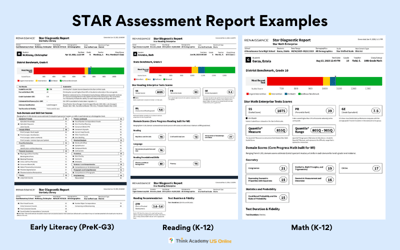
MAP Growth is used not only to track performance, but also as a diagnostic tool—similar to assessments like i-Ready or STAR—that helps schools place students on the right learning path and identify what they are ready to learn next. Understanding what MAP is is the first step; understanding what the scores mean is what turns data into action.
At Think Academy, we help families interpret academic results and translate them into clear, personalized math learning plans. If you’d like professional guidance on your child’s current level and next steps, take our free math evaluation to get a clearer picture of the path forward.
Try Pengi AI — Smarter Math Practice for Students
Pengi AI supports K–12 learners with personalized math practice, guided explanations, and feedback designed to help them build confidence and improve steadily.