
Pengi Editor's Note: This article was originally published by Think Academy. We're sharing it here for educational value. Think Academy is a leading K-12 math education provider.
Enhancing Your STEM Journey: Physics Competitions and Beyond
Physics competitions offer students a powerful way to deepen their scientific understanding, develop problem-solving skills, and stand out in college applications. From national olympiad programs to regional contests, the pathway for aspiring physicists is rich with opportunity.
Why Physics Competitions Matter
Beyond the academic challenge, physics competitions offer:
- Deep conceptual understanding: Competition problems require applying physics principles to unfamiliar situations — far beyond what standard coursework covers.
- College application differentiation: Strong performance in prestigious competitions like USAPhO or IPhO signals exceptional academic ability to admissions officers.
- Community and mentorship: Competitive physics brings together intellectually motivated students and connects them with leading scientists and educators.
- Problem-solving transferability: The analytical and reasoning skills developed in physics competition prep apply broadly to engineering, computer science, and research.
Major Physics Competitions
F = ma Exam (AMC of Physics)
The F = ma Exam is administered by the American Association of Physics Teachers (AAPT) and serves as the qualification exam for the USA Physics Olympiad (USAPhO).
- Format: 25 multiple-choice questions, 75 minutes
- Content: Classical mechanics (Newtonian mechanics, energy, momentum, rotational motion)
- Eligibility: High school students
- Top scorers advance to the USAPhO semifinal exam.
USA Physics Olympiad (USAPhO)
The USAPhO is the national physics olympiad for the United States, selecting the top students to represent the US at the International Physics Olympiad (IPhO).
Structure:
- F = ma Exam: ~400 top scorers advance.
- Semifinal Exam: Tests broader physics including electricity, magnetism, optics, and modern physics.
- Training Camp: Top ~20 students are invited to a 10-day training camp.
- IPhO Team: 5 students are selected to represent the US internationally.
International Physics Olympiad (IPhO)
The IPhO is the premier international physics competition, held annually with ~90 countries participating. It consists of theoretical and experimental examinations testing the full range of undergraduate-level classical physics.
Science Olympiad
Science Olympiad is a team competition covering 23 events across biology, chemistry, physics, engineering, and earth science. Physics-related events include:
- Circuit Lab
- Trajectory
- Sounds of Music
- Air Trajectory
Science Olympiad is excellent for students in middle and early high school who want broad STEM experience.
Physics Bowl
The Physics Bowl, administered by AAPT, is a 40-question multiple-choice exam covering all of physics. It's a good stepping stone before attempting F = ma.
- Division 1: For students who have completed less than one year of physics.
- Division 2: For students who have completed one or more years of physics.
How to Prepare for Physics Competitions
Foundation: Master Mechanics First
Classical mechanics — kinematics, Newton's laws, energy, momentum — forms the backbone of the F = ma exam and much of USAPhO. Build a rock-solid foundation before moving to other areas.
Recommended resources:
- Halliday, Resnick & Krane, Physics (comprehensive undergraduate-level text)
- Irodov, Problems in General Physics (challenging, internationally used)
- Morin, Introduction to Classical Mechanics (excellent for competition prep)
Intermediate: Expand to E&M and Waves
Electricity and magnetism, oscillations, waves, and basic optics appear extensively in USAPhO semifinals.
Recommended resources:
- Griffiths, Introduction to Electrodynamics (college-level, thorough)
- Feynman Lectures on Physics (freely available online — exceptional for intuition)
Advanced: Past Competition Problems
The most effective preparation is working through past F = ma and USAPhO problems systematically.
Physics Competitions vs. Math Competitions: Which to Focus On?
Many students compete in both math and physics competitions. However, for students choosing where to invest limited time:
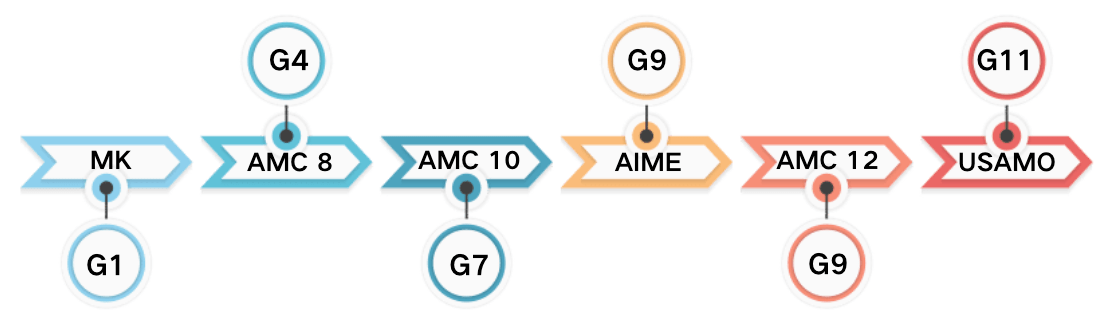
- Math competitions (AMC, AIME, USAMO) emphasize abstract reasoning and are independent of lab science.
- Physics competitions require strong math foundations AND physical intuition — making them more demanding in breadth.
- Students who have already built strong math competition skills often find the transition to physics competitions natural and rewarding.
Beyond Competitions: Research and Enrichment
High-achieving physics students often complement competition prep with:
- Research internships: Programs like RSI (Research Science Institute), PRIMES, and FIRST give students real research experience.
- Online coursework: MIT OpenCourseWare, Stanford Online, and edX offer rigorous physics courses.
- Science fairs: Intel ISEF and regional science fairs reward original experimental work.
Timeline: Building Toward IPhO
| Grade | Focus |
|---|---|
| 9 | Complete Physics I; start F = ma practice |
| 10 | Take F = ma; start USAPhO prep (E&M, optics) |
| 11 | Compete in USAPhO; aim for semifinal |
| 12 | Compete for IPhO selection; pursue research |
Starting competitive physics in 9th grade or earlier gives students the best chance at reaching national and international levels.
Try Pengi AI — Smarter Math Practice for Students
Pengi AI supports K–12 learners with personalized math practice, guided explanations, and feedback designed to help them build confidence and improve steadily.