Pengi Editor's Note: This article was originally published by Think Academy. We're sharing it here for educational value. Think Academy is a leading K-12 math education provider.
What Is a Good ISEE Score — Explanation And Real Cases
This article will help you clearly understand four key questions about the ISEE score report:
- How and when will I receive the ISEE score report?
- What do the different numbers on the score report actually mean?
- How strong is my child’s score — and how much does it help in admissions?
- If the score looks good but we’re unsure — should we send it? Should we retake the test?
New to the ISEE? If you’re still learning what the ISEE is, who uses it, how to register, or how to prepare, check out our guides:
How to Access the ISEE Score Report
When Will Scores Be Released?
After your child completes the ISEE, you’ll receive an email notification when the Score Report is ready. The results will be available in your ISEE Parent Portal , where you can view and download the PDF report.
The official score release timelines are approximately:
- Online tests: within 3–5 days
- Paper tests (Grades 2–4): within 7–14 days
- Paper tests (Grades 5–12): within 5–10 days
Planning tip:
Before scheduling your test, be sure to confirm both the application deadline and the score submission deadline for your target schools. Then work backward at least 2–4 weeks to choose a test date that gives you enough time for score review and submission.
Important Notes About Score Recipients
- If families wish to send score reports to schools, they must add the desired school(s) to their student’s score recipients list. You can select score recipient schools at the time of registration or after you receive your copy of your student’s score report.
- Recipient schools cannot be removed from the list once your student has started the exam.
- Be sure to verify any deadlines for receiving scores with the school(s) to which you are applying.
- You can manage your list of score recipients at iseeonline.erblearn.org or by phone with ISEE Operations.
How to Interpret the ISEE Score Report
Test Profile Overview
For the Lower, Middle, and Upper Levels (applying to Grades 5–12), the ISEE score report includes results for the four main test sections.
- Verbal Reasoning
- Quantitative Reasoning
- Reading Comprehension
- Mathematics Achievement
The Primary Level (for students applying to Grades 2–4) has a simpler score report, which mainly includes:
- Reading
- Mathematics
- (Grade 2 only: Auditory Comprehension)
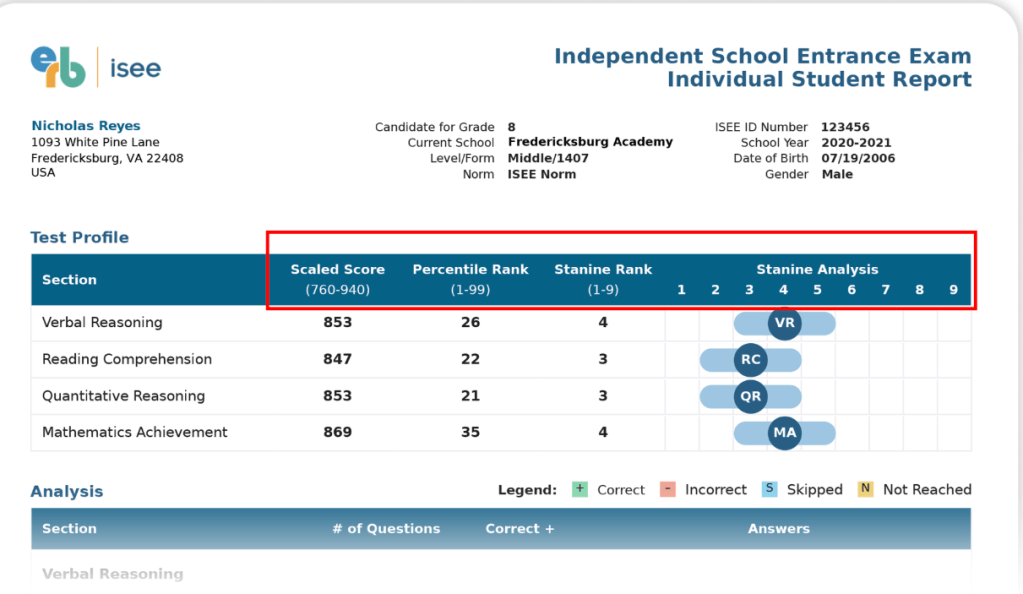
In the score repot, you’ll see several columns of numbers and visual indicators — these represent the four types of scores we’ll explain in the next section.
Four Key Score Types
The ISEE uses four different metrics to show your child’s performance in each subject area:
- Scaled Score(760-940)
- Percentile Rank (1-99)
- Stanine Rank(1–9)
- Stanine Analysis
| Metrics | Meaning |
|---|---|
| Scaled Score (760-940) | Each section’s raw score (number of correct answers) is converted into a scaled score ranging from 760 to 940, adjusted for the difficulty of the test season.The ISEE does not deduct points for incorrect answers — blank or wrong answers simply don’t add points. 📌 Parents don’t need to worry about small differences like 760 vs. 780 vs. 800 — schools pay more attention to the Percentile Rank and Stanine. |
| Percentile Rank (1-99) | This shows the percentage of students (in the same grade level over the past 3 years) who scored lower than or equal to your child. Example: If the Mathematics Achievement Percentile is 70, → it means your child scored better than about 70% of test-takers at the same grade level. |
| Stanine Rank (1-9) | Stanine is the score most commonly used by schools. It divides all student scores into 9 ranges (1 = lowest, 9 = highest).It’s essentially a simplified version of the percentile, designed to help schools read results more quickly. In Part 3, we’ll use the Stanine to explain what your child’s score level means. |
| Stanine Analysis | It shows a possible ±1 Stanine Range, indicating where your child’s performance might realistically vary.For example, if your child’s Verbal Reasoning Stanine is 5, the Stanine Analysis might show a band from 4 to 6, suggesting that their performance in this section likely falls within that range. |
Analysis Section & Essay
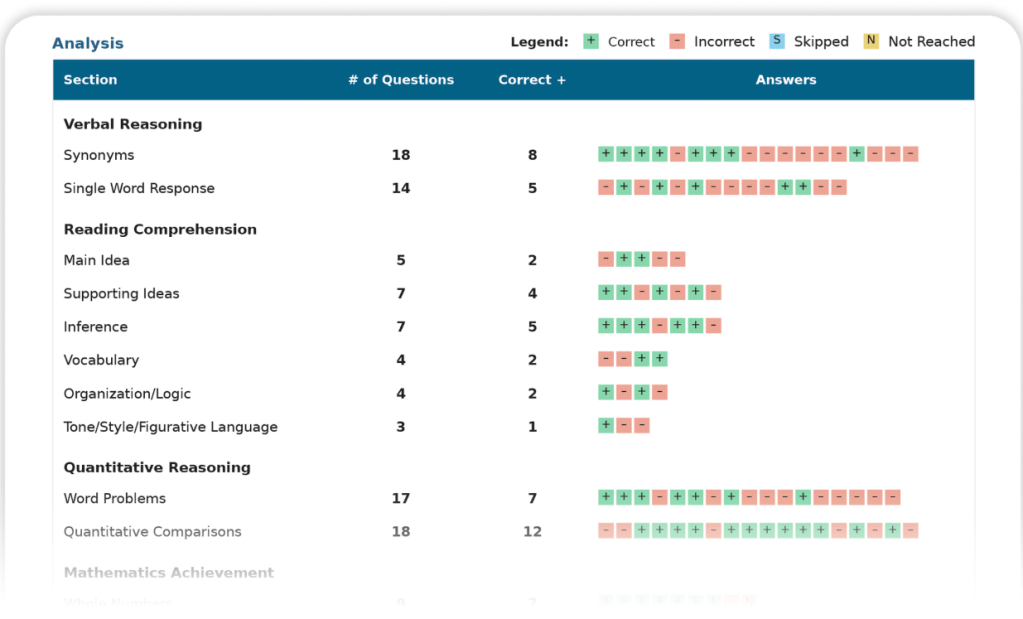
At the end of the Score Report, there is an Analysis section that breaks down:
- The total number of questions in each test section
- How those questions are distributed across different content areas (e.g., Number Operations, Algebra, Geometry, Data Analysis, etc.)
- About the Essay:
For students applying to Grades 5–12, the ISEE Essay is not scored — there is no numerical score shown on the report. However, the student’s original written response is sent directly to schools, and admissions officers often review it to evaluate:
- Clarity of thinking
- Strength of argument and use of examples
- Grade-level appropriate language and structure
So while the essay doesn’t affect the official score, it’s definitely not something to overlook.
How to Understand Your Child’s Academic Level from the ISEE
Must Know
Your student is compared only to other students who tested for the same grade over the past three years.
That means your child is being ranked among peers who have already chosen to apply to private schools or take this type of exam — a group that is already above average in many cases.
Stanines Percentiles
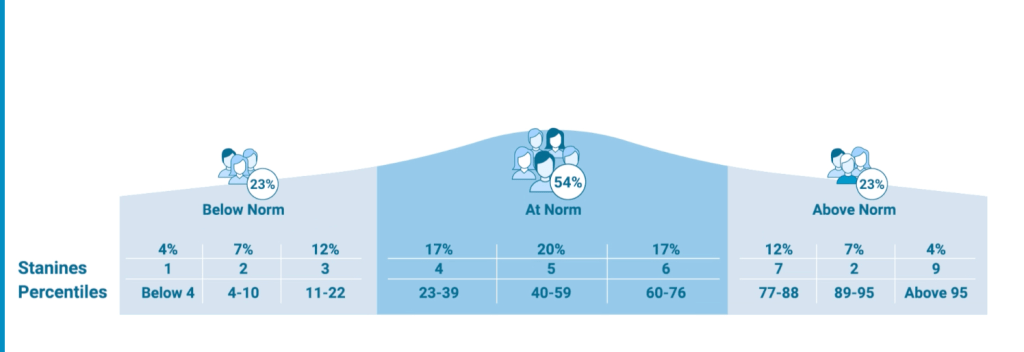
We primarily focus on the Stanine score (1–9) for each section:
- 1–3 range: Below most students in the ISEE testing pool for that grade. → Indicates a relative weakness in this subject — may require explanation or improvement during the application process.
- 4–6 range: Around the middle of all ISEE test-takers (the average range). → A Stanine of 5 or 6 is generally considered slightly above average.
- 7–9 range: Significantly stronger than most students at the same grade level. → 7 = excellent / above average → 8–9 = truly high-performing (Top 10%, Top 5%)
A student with four 9s across all sections = An exceptionally well-rounded test-taker with top-tier skills in reasoning, verbal expression, math, and reading comprehension.
Using ISEE Scores for Application Decisions: Competitiveness & Overall Profile
Three Ways to Evaluate the Score Report
① Where does your child stand among ISEE test-takers nationwide?
Start by identifying whether your child is performing at a slightly above average, clearly top-performing, or still developing level.
② How does the score match the academic rigor of your target schools?
- Highly competitive schools (e.g. top boarding schools in New York/Boston or select top Bay Area day schools): Many successful applicants have several Stanines in the 7–9 range, with strong overall score patterns.
- Strong local schools / exam schools: A profile with mostly 6–7s, combined with a solid GPA and activities, can still be quite competitive.
③ How does the ISEE score fit into your child’s full application profile?
- If your child has a high GPA, challenging coursework, and ISEE scores in the 7–9 range → this is a strong-on-all-fronts profile.
- If school grades are average but the ISEE score is strong → this can serve as a highlight or turning point in the application.
- If GPA is strong but the ISEE score falls in the 4–5 range → you may need to rely on recommendation letters, teacher comments, or interviews to explain why classroom performance is a better reflection of your child’s potential.
“Is my ISEE score strong enough” vs. “Should we submit it?”
Step 1: Understand the School’s ISEE Policy
- Required — Must be submitted
- Optional — Can be submitted if helpful
- Not accepted / Test-free — Will not be reviewed
Step 2: Evaluate Your Child’s Current Scores
- Most sections ≥ 7
- Most sections 5–6
- Most sections ≤ 4
Submission Decision Guide
| School Policy | Score Range | What to Do |
|---|---|---|
| Required | Most ≥ 7 | Submit normally; consider retesting for a higher boost |
| Required | Most 5–6 | Weigh against other materials and timeline; consider retake |
| Optional | Most ≥ 7 | Usually worth submitting — can strengthen the application |
| Optional | Most 5–6 | Depends on school selectivity and rest of the application |
| Optional | Most ≤ 4 | Usually not recommended to submit |
| Not accepted | Any score | Do not submit; focus on other areas (essay, interview, GPA) |
Should We Retake the ISEE?
- Timing: How much time is left before the application deadline? Will there be another testing season available?
Score Gap:
- From 3–4 to 5–6: Big room for improvement, but requires solid content review.
- From 6–7 to 8–9: Much harder to raise; may not be the best use of time. A 7 is already considered excellent.
- Student Well-being: Consider your child’s current workload, stress level, and balance with GPA, school performance, and extracurriculars. → If retesting would negatively affect these, it may not be worth pursuing just for a marginal gain.
Where Does the ISEE Fit in the Overall Application?
The ISEE is an important part of the academic profile, but it is not everything. Admissions teams consider four main areas:
| Category | Includes |
|---|---|
| Academic | GPA, course rigor, standardized tests (ISEE/SSAT/MAP/Others) |
| Personal | Activities, interests, talents, competitions (if any) |
| Contextual | School background, teacher recommendations, family narrative (e.g. reason for transfer) |
| Expression | Essays, writing samples, interviews |
What Parents Should Know
High scores ≠ guaranteed admission
Even top schools reject students with perfect ISEE/SSAT scores every year — because:
- Spots are limited
- They aim to build a balanced, diverse class (interests, gender, background, region)
- Some grades have a high concentration of top scorers, so schools look beyond scores to find the best fit
Above-average scores + strong overall profile ≠ no chance
Many students with Stanines in the 5–6 range improved slightly (to 6–7), combined with:
- Strong school performance
- Genuine teacher recommendations
- A clear and compelling personal story → and successfully gained admission to excellent local private or exam schools.
The real question for families is not “How do we get a 9?” but rather: “Now that we’ve reached this ISEE level — what should we focus on next to build a compelling, well-rounded application?”
Case Examples: How Different ISEE Profiles Play Out in Real Admissions
Case 1
Profile:
- 8th grade girl, public school, straight-A student
- ISEE: All sections 98th percentile
- Strong in STEM + well-rounded: advanced math, music, research, sports, long-term volunteering
- Admitted to: Phillips Exeter Academy
Takeaway: Top scores confirm readiness — but it’s depth of interests and a cohesive, authentic story that truly distinguish the applicant.
Case 2
Profile:
- 8th grade girl, private school, strong GPA
- First ISEE: 9-6-6-6 → Retake: 8-7-7-7
- Active in sports, choir, musicals, and community service, student ambassador
- Admitted to: St. Paul’s School
Takeaway: You don’t need perfect scores. A balanced 7–8 range, plus strong extracurriculars and a thoughtful retake, can create a highly competitive profile.
Case 3
Profile:
- Middle school student applying for 9th grade
- ISEE: Verbal 5, Reading 6, Quantitative 9, Math 8
- Admitted to: Chaminade College Prep
Takeaway: Selective schools may accept profiles with clear strengths. A math-leaning profile like 5–6–9–8 can still succeed with the right school match.
Case 4
Profile:
- 8th grade girl, public school
- ISEE: 7-7-8-7
- Strong interests in dance, school musicals, attended international GI & pediatric conferences
- Admitted to: Phillips Exeter Academy
Takeaway: A profile with 7–8 scores + unique passions and leadership can stand out — even at top-tier schools.
Beyond ISEE: How Think Academy Supports Your Child’s Next Math Step
The ISEE is more than just a test — it’s a window into your child’s academic progress. Whether it highlighted areas of strength or revealed skill gaps, it offers valuable insights into your child’s math and verbal development.
If you’re looking to build on math strengths or close math gaps, Think Academy can help in three key directions:
- Catch up: Fill in gaps and strengthen foundational skills
- Stay ahead: Maintain a competitive edge and accelerate math progress
- Go further: Take on challenge math competitions, Math kangaroo, AMC competitions
How We Help Students Plan
We offer comprehensive K–12 math programs designed to:
1. Math Acceleration Planning
- Honors / Advanced Math / AP courses
- Complete 5–8 AP STEM courses before high school graduation
2. Competition Planning
- Lower Grades: Start with Math Kangaroo → Aim for National Top 20
- Middle School: Progress from AMC 8 / AMC 10 → AIME / AMC 12 → USA(J)MO
📌 Next Step: Take a personalized evaluation to understand your child’s current math progress and get a tailored roadmap for courses, pacing, and goals.
🏆 Our Proud Results
- School Math Power-Up
- 91% scored in the National Top 10%
- 86% admitted to gifted programs / private / selective schools
- School Honors/Placement Test
- 95% passed their school’s placement exams
- Competition Track

ISEE FAQs – Common Parent Questions
Q1: What is a good ISEE score?
There’s no single definition of a “good” ISEE score — it depends on the schools you’re applying to.
For highly selective private schools, competitive applicants typically have scores of 7–9 (stanines) across all sections.
For moderately selective or less competitive schools, scores of 5–6 may be sufficient.
🎯 Our advice: A strong ISEE score is important, but it’s just one part of the overall admissions picture. Schools also look at academic growth, interests, recommendations, interviews, and how well your child fits their school culture.
Q2: When is the best time to take the ISEE? How long does it take to get scores?
A: Work backward from your target school’s application and material submission deadlines to choose a test season.
Paper test: Typically 5–14 business days, depending on level It’s safest to allow at least 2–4 weeks buffer before deadlines for score release, delivery, and a potential retake.
Online test: Scores available in 3–5 business days
Q3: If I send scores to a school, can they see how many times my child took the ISEE or which other schools received scores?
No. Each school only sees the specific score report sent to them. They cannot see how many times your child tested or which other schools received reports.
Q4: How many times can my child take the ISEE?
A: Students can take the ISEE once per testing season — Fall, Winter, and Spring/Summer — for a total of up to three times per admissions cycle.
Q5: Can I choose which score report to send? Does ISEE superscore?
A: Yes — you can choose which test date’s score to send to each school. ISEE does not superscore; schools evaluate each report as a whole.
Q6: Can I add or remove schools after the test?
A: You can add schools before or after the test via the Parent Portal. However, once the test begins, any selected recipients cannot be removed. Be cautious when choosing score recipients.
Q7: How are Percentile and Stanine scores calculated?
A: Your child is compared to other students in the same grade level who took the ISEE over the past three years. This testing pool is often more competitive than the general student population.
Q8: Can students use a calculator?
A: Calculators are not allowed on the ISEE.
Try Pengi AI — Smarter Math Practice for Students
Pengi AI supports K–12 learners with personalized math practice, guided explanations, and feedback designed to help them build confidence and improve steadily.