
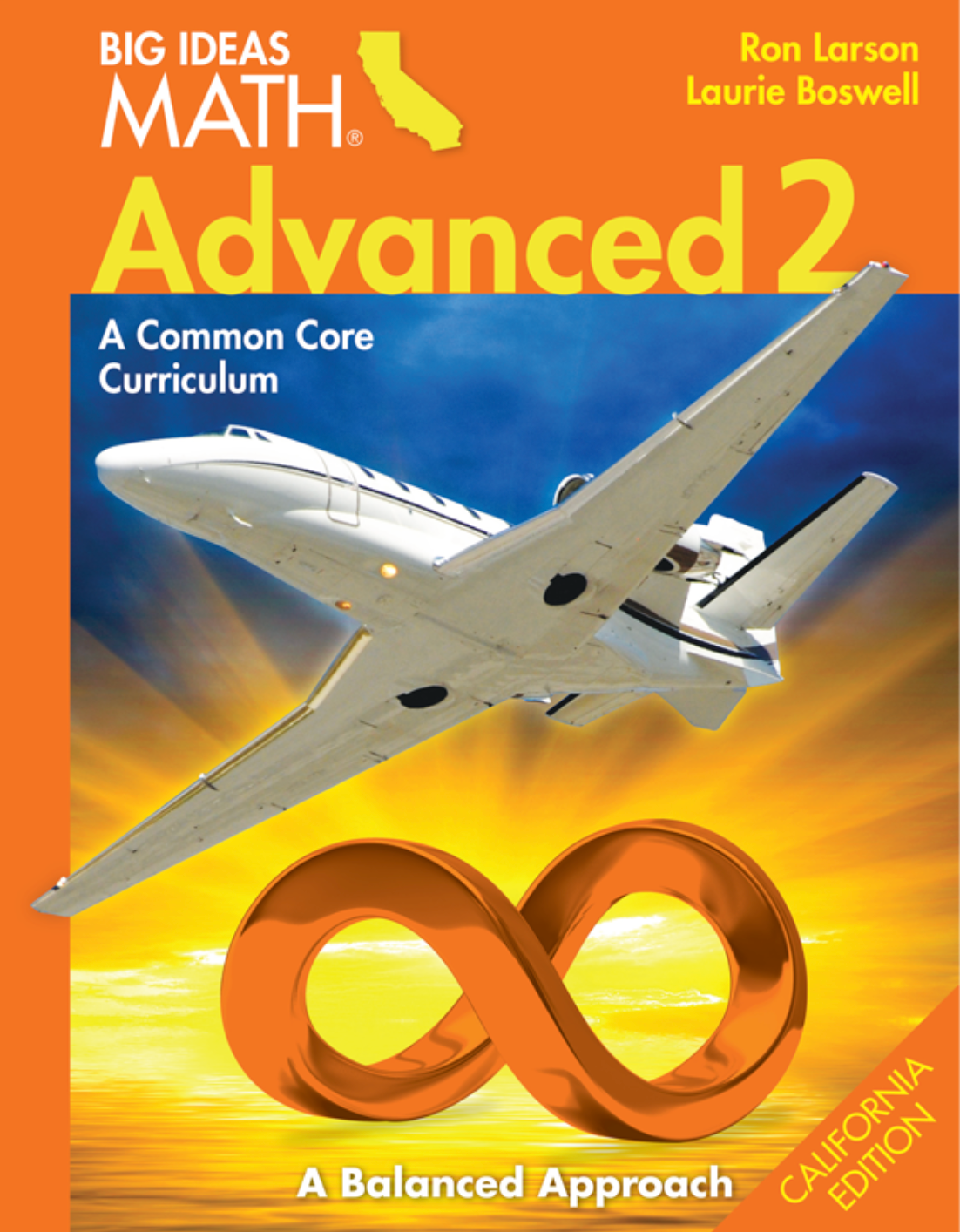
Big Ideas Math, Advanced 2
Big Ideas Math, Advanced 2, published by Big Ideas Learning LLC, is an accelerated Grade 7 mathematics textbook designed for students ready to move beyond standard middle school content. The course covers a wide range of topics including equations and inequalities, systems of linear equations, transformations, graphing and writing linear equations, functions, exponents and scientific notation, real numbers and the Pythagorean theorem, geometry concepts such as angles, triangles, circles, area, surface area, and volume, as well as probability, statistics, and data analysis. With its advanced pacing and rigorous problem-solving approach, this text builds the algebraic and geometric foundations students need to succeed in high school mathematics.
Chapters & Lessons
Chapter 1: Equations
4 lessonsIn this Grade 7 lesson from Big Ideas Math Advanced 2, Chapter 1, students learn to solve simple equations using the Addition, Subtraction, Multiplication, and Division Properties of Equality. The lesson begins with inductive reasoning to discover that the angles of a triangle sum to 180 degrees, then applies that rule to write and solve one-step equations with integers, decimals, fractions, and pi. Students practice using inverse operations to isolate variables and check their solutions for accuracy.
In this Grade 7 lesson from Big Ideas Math Advanced 2, Chapter 1, students learn how to solve multi-step equations using inverse operations, combining like terms, and the Distributive Property. Real-world applications, such as calculating tree growth and weekly running averages, help students set up and solve equations like 2(1 − 5x) + 4 = −8. Students also practice checking the reasonableness of their solutions, reinforcing accuracy and critical thinking throughout the problem-solving process.
In this Grade 7 lesson from Big Ideas Math, Advanced 2 (Chapter 1: Equations), students learn how to solve equations with variables on both sides by collecting variable terms on one side and constant terms on the other. The lesson covers applying the distributive property to multi-step equations and identifying special cases where an equation has no solution or infinitely many solutions. Real-world contexts such as perimeter, area, and surface area are used to build and solve these equations.
In this Grade 7 lesson from Big Ideas Math Advanced 2, Chapter 1, students learn how to rewrite literal equations and geometric formulas by solving for one variable in terms of the other variables. They apply properties of equality to isolate specific variables in formulas for perimeter, area, volume, surface area, and temperature conversion, including the Fahrenheit-to-Celsius formula. By the end of the lesson, students can rearrange multi-variable equations such as the cone surface area formula or a linear equation like 2y + 5x = 6 to express any target variable.
Chapter 2: Transformations
5 lessonsIn this Grade 7 lesson from Big Ideas Math Advanced 2, Chapter 2: Transformations, students learn to identify congruent figures by comparing corresponding angles and corresponding sides. Using geoboard activities and worked examples, students practice naming corresponding parts of congruent polygons and applying the congruence symbol (≅) to determine whether figures such as triangles, squares, and trapezoids are congruent. The lesson also shows how to use congruence to find unknown side lengths and perimeters of congruent figures.
In this Grade 7 lesson from Big Ideas Math Advanced 2, students learn how to identify reflections and reflect figures across the x-axis and y-axis in the coordinate plane using the rules (x, y) → (x, -y) and (x, y) → (-x, y). The lesson covers the concept of a line of reflection and explores how reflected figures are congruent to their originals. Students also apply reflections to analyze frieze patterns, determining whether decorative band designs are reflections of themselves when folded horizontally or vertically.
In this Grade 7 lesson from Big Ideas Math Advanced 2, Chapter 2, students learn how to identify and perform rotations in the coordinate plane, including key vocabulary such as center of rotation and angle of rotation. Students practice rotating figures by specific degree measures — such as 90°, 180°, and 270° clockwise or counterclockwise — about a point or the origin, and determine the coordinates of the resulting image. The lesson also connects rotations to the broader set of rigid transformations, reinforcing that a figure and its rotated image are always congruent.
In this Grade 7 lesson from Big Ideas Math Advanced 2, students explore how changes in the dimensions of similar figures affect perimeter and area, learning that the ratio of perimeters equals the ratio of corresponding side lengths while the ratio of areas equals the square of that ratio. Students practice finding and applying these ratios using similar rectangles and triangles. The lesson is part of Chapter 2 on Transformations and builds geometric reasoning skills through hands-on activities and coordinate graphing.
In this Grade 7 lesson from Big Ideas Math Advanced 2, students learn how to perform dilations in the coordinate plane by multiplying vertex coordinates by a scale factor to enlarge or reduce figures with respect to a center of dilation. Students identify whether a transformation is a dilation and distinguish between enlargements (scale factor greater than 1) and reductions (scale factor between 0 and 1). The lesson also connects dilations to the other transformations studied in Chapter 2, reinforcing the concept of similar figures.
Chapter 3: Angles and Triangles
1 lessonsIn this Grade 7 lesson from Big Ideas Math Advanced 2, students learn that the sum of the interior angle measures of a triangle is 180° and apply the Exterior Angle Theorem, which states that an exterior angle equals the sum of the two nonadjacent interior angles. Students practice finding unknown angle measures by setting up and solving algebraic equations using these relationships. The lesson builds understanding of interior and exterior angles of polygons within the broader study of angles and triangles.
Chapter 4: Graphing and Writing Linear Equations
3 lessonsIn this Grade 7 lesson from Big Ideas Math Advanced 2, Chapter 4, students learn to graph proportional relationships using the direct variation equation y = mx, where m represents the constant of proportionality, the slope, and the unit rate. Students practice identifying whether x and y are proportional, deriving the equation y = mx from similar triangles, and interpreting slope in real-world contexts such as data costs and planetary weights. The lesson also covers writing direct variation equations from given points and comparing proportional relationships represented in different forms.
In this Grade 7 lesson from Big Ideas Math Advanced 2, students learn how to write equations of lines in slope-intercept form by identifying the slope and y-intercept from a graph. The lesson covers calculating slope using the slope formula, recognizing the y-intercept as the point where a line crosses the y-axis, and applying these skills to real-world contexts such as modeling distance over time. Students also explore special cases including horizontal lines and use the slope-intercept equation y = mx + b to solve practical problems.
In this Grade 7 lesson from Big Ideas Math Advanced 2, students learn to write linear equations in point-slope form, y − y₁ = m(x − x₁), using a given slope and a point on the line. The lesson covers how to apply point-slope form when working with two points by first calculating slope using the slope formula, then converting to slope-intercept form. Part of Chapter 4 on Graphing and Writing Linear Equations, the lesson builds students' ability to represent real-world situations as linear equations.
Chapter 5: Systems of Linear Equations
2 lessonsIn this Grade 7 lesson from Big Ideas Math Advanced 2, students learn how to solve systems of linear equations by elimination, a method that involves adding or subtracting equations to cancel out one variable. The lesson covers both simple cases where coefficients are already opposites and more complex cases requiring multiplication by a constant to match coefficients before eliminating a variable. Students practice the four-step elimination process and apply it to real-life problems.
Chapter 6: Functions
5 lessonsIn this Grade 7 lesson from Big Ideas Math Advanced 2, students learn to define relations and functions, represent them using ordered pairs and mapping diagrams, and determine whether a relation qualifies as a function by checking that each input is paired with exactly one output. Through activities involving area, perimeter, circumference, and volume, students practice constructing and interpreting mapping diagrams to describe relationships between two data sets.
In this Grade 7 lesson from Big Ideas Math Advanced 2, students learn that a linear function can be written in the form y = mx + b, where m is the slope and b is the y-intercept. Students practice identifying linear functions by writing equations from graphs and tables, calculating slope using changes in x and y values. The lesson also applies linear functions to real-world contexts, such as modeling a UAV descent, and connects the concept to geometric formulas like circumference and perimeter.
In this Grade 7 lesson from Big Ideas Math Advanced 2, students learn to identify linear and nonlinear functions by analyzing whether the rate of change is constant across tables, graphs, and equations. The lesson covers key skills such as recognizing nonlinear functions like y = 4/x that cannot be written in slope-intercept form, and distinguishing them from linear functions using equal intervals. Real-life applications, including comparing simple and compound interest and falling objects, reinforce how linear and nonlinear patterns appear in everyday contexts.
In this Grade 7 lesson from Big Ideas Math Advanced 2, Chapter 6, students learn to analyze and sketch graphs that show relationships between two quantities without relying on specific numerical values on the axes. Using real-world contexts like changing water levels, bike speeds, and city temperatures, students practice interpreting features such as steepness, increases, decreases, and plateaus to describe how one quantity changes relative to another. The lesson builds skills in matching situations to graphs and comparing graphs of scenarios like rocket launches and car speeds approaching traffic signs.
Chapter 7: Real Numbers and the Pythagorean Theorem
4 lessonsIn this Grade 7 lesson from Big Ideas Math Advanced 2, students learn how to find square roots of perfect squares, interpret radical signs and radicands, and evaluate expressions involving square roots. The lesson covers both positive and negative square roots using the radical sign and plus-or-minus notation. Students also apply square roots to solve real-world problems, such as finding the side length of a square or the radius of a circle when the area is known.
In this Grade 7 lesson from Big Ideas Math Advanced 2, students learn to find cube roots of perfect cubes, including negative numbers and fractions, using the cube root symbol and prime factorization. The lesson covers evaluating expressions involving cube roots, solving equations with cubed variables, and applying cube roots to real-life geometry problems such as finding the edge length of a cube from its volume.
In this Grade 7 lesson from Big Ideas Math Advanced 2, students learn the Pythagorean Theorem (a² + b² = c²) and apply it to find missing side lengths of right triangles, including both legs and the hypotenuse. The lesson introduces key vocabulary such as legs and hypotenuse and guides students through geometric proof using area models. Real-world applications, such as calculating the length of a guy wire or distances on a coordinate plane, are also covered.
Chapter 8: Volume and Similar Solids
3 lessonsIn this Grade 7 lesson from Big Ideas Math Advanced 2, students learn how to calculate the volume of a cylinder using the formula V = πr²h, as well as how to work backwards to find an unknown height when the volume is given. The lesson connects the cylinder volume formula to the general prism volume formula (V = Bh) and applies these concepts to real-life problems involving containers and unit conversion.
In this Grade 7 lesson from Big Ideas Math Advanced 2, students learn to calculate the volume of a cone using the formula V = ⅓Bh (equivalently V = ⅓πr²h), discovering through hands-on exploration that a cone holds exactly one-third the volume of a cylinder with the same base and height. Students practice finding cone volumes and working backwards to find unknown heights when volume is given. The lesson also extends the formula to oblique cones and applies volume concepts to real-life problems.
In this Grade 7 lesson from Big Ideas Math Advanced 2, students learn how to calculate the volume of a sphere using the formula V = (4/3)πr³, derived by comparing a sphere's volume to that of a cylinder and through a pyramids approach. Students practice applying the formula to find both the volume and the radius of spheres, then extend their skills to composite solids involving hemispheres. The lesson builds on prior work with cylinders and pyramids in Chapter 8's exploration of volume and similar solids.
Chapter 9: Data Analysis and Displays
2 lessonsIn this Grade 7 lesson from Big Ideas Math Advanced 2, students learn how to construct and interpret scatter plots by graphing two data sets as ordered pairs in a coordinate plane. They explore concepts such as positive and negative relationships, linear and nonlinear patterns, and how to use scatter plot data to make predictions. The lesson uses real-world examples — including sports ball weights and circumferences, and student absences versus final grades — to help students identify trends and describe the relationship between two variables.
In this Grade 7 lesson from Big Ideas Math Advanced 2, Chapter 9, students learn how to read and make two-way tables to display and analyze two categories of data collected from the same source. Students work with joint frequencies, which are the individual entries in the table, and marginal frequencies, which are the row and column sums that reveal totals across each category. The lesson builds data analysis skills by having students interpret real-world surveys and draw conclusions from the organized data.
Chapter 10: Exponents and Scientific Notation
3 lessonsIn this Grade 7 lesson from Big Ideas Math Advanced 2, students learn three key exponent properties: the Product of Powers Property (adding exponents when multiplying powers with the same base), the Power of a Power Property (multiplying exponents), and the Power of a Product Property (distributing an exponent across a product). Using inductive reasoning, students explore patterns in tables and expressions to derive the general rules a^m · a^n = a^(m+n), (a^m)^n = a^(mn), and (ab)^m = a^m · b^m. The lesson applies these properties to numerical and algebraic expressions as part of Chapter 10 on Exponents and Scientific Notation.
In this Grade 7 lesson from Big Ideas Math Advanced 2, students learn how to evaluate expressions with zero exponents using the rule a⁰ = 1 and with negative integer exponents using the definition a⁻ⁿ = 1/aⁿ. Through guided activities applying the Quotient of Powers and Product of Powers properties, students practice simplifying numerical and algebraic expressions by rewriting negative exponents as positive reciprocals.
In Section 10.7 of Big Ideas Math Advanced 2, Grade 7 students learn how to add, subtract, and multiply numbers written in scientific notation by applying the Distributive Property, Commutative and Associative Properties of Multiplication, and the Product of Powers Property. The lesson covers both cases where numbers share the same power of 10 and where powers differ, requiring students to rewrite one number before combining. These skills are practiced through partner activities and worked examples using both positive and negative exponents.
Chapter 11: Inequalities
3 lessonsIn this Grade 7 lesson from Big Ideas Math Advanced 2, students learn to solve one-variable inequalities using the Addition and Subtraction Properties of Inequality, applying inverse operations to isolate the variable. Students practice solving and graphing solutions on a number line using both whole numbers and decimals or fractions. Real-life contexts, such as age eligibility and temperature comparisons, help students interpret what inequality solutions represent.
Grade 7 students in Big Ideas Math Advanced 2 learn to solve two-step inequalities by applying inverse operations in sequence, including cases that require reversing the inequality symbol when multiplying or dividing by a negative number. The lesson covers solving inequalities such as 5x − 4 ≥ 11 and b/−3 + 4 < 13, graphing solutions on a number line, and applying two-step inequalities to real-life contexts like area, perimeter, volume, and averaging problems.
Chapter 12: Constructions and Scale Drawings
4 lessonsIn Section 12.4 of Big Ideas Math Advanced 2, Grade 7 students learn to classify quadrilaterals — including trapezoids, parallelograms, kites, rectangles, rhombuses, and squares — by analyzing properties of their sides and angles. Students explore the hierarchy of quadrilateral types and apply the rule that the sum of interior angle measures of any quadrilateral is 360 degrees. The lesson also covers constructing quadrilaterals using geoboards and geometry software.
Chapter 13: Circles and Area
3 lessonsIn this Grade 7 lesson from Big Ideas Math Advanced 2, students learn to identify the parts of a circle — including radius, diameter, and circumference — and explore the concept of pi as the constant ratio of circumference to diameter. Using inscribed and circumscribed polygons, students approximate the value of pi and apply the circumference formula C = πd to solve problems involving circles and semicircles.
In this Grade 7 lesson from Big Ideas Math, Advanced 2 (Chapter 13: Circles and Area), students learn how to calculate the area of a circle using the formula A = πr². The lesson covers applying the formula with both 3.14 and 22/7 as approximations for π, finding areas when given either the radius or diameter, and extending the concept to find the area of semicircles. Students also explore how the formula is derived by rearranging circle sectors into a parallelogram shape.
In this Grade 7 lesson from Big Ideas Math Advanced 2, students learn how to find the area of composite figures by decomposing them into familiar shapes such as rectangles, triangles, semicircles, and parallelograms. Students apply area formulas for each component and sum the results to find the total area. The lesson is part of Chapter 13: Circles and Area and includes real-life applications such as calculating the area of a basketball court section.
Chapter 14: Surface Area and Volume
5 lessonsIn this Grade 7 lesson from Big Ideas Math Advanced 2, students learn how to find the surface area of rectangular prisms, triangular prisms, and cubes using the formulas S = 2ℓw + 2ℓh + 2wh and S = 6s², as well as the general method of summing base areas and lateral face areas. Students use two-dimensional nets to visualize and calculate surface area for three-dimensional solids. The lesson is part of Chapter 14: Surface Area and Volume.
In this Grade 7 lesson from Big Ideas Math Advanced 2, students learn how to find the surface area of regular pyramids by calculating the area of the base plus the areas of the lateral faces using slant height. The lesson covers square and triangular pyramids, with students drawing nets to visualize the formula S = area of base + areas of lateral faces. Real-life applications include calculating lateral surface area for structures like the Cheops Pyramid and determining how many shingles are needed to cover a pyramid-shaped roof.
In this Grade 7 lesson from Big Ideas Math Advanced 2, Chapter 14, students learn how to find the surface area of a cylinder using the formula S = 2πr² + 2πrh, which accounts for both the two circular bases and the lateral surface. Students also practice finding lateral surface area alone, as when calculating the area of a label on a can. Real-world applications include estimating surface areas of everyday cylindrical containers and using proportional reasoning to solve problems.
In this Grade 7 lesson from Big Ideas Math Advanced 2, students learn to calculate the volume of prisms using the formula V = Bh, where B is the area of the base and h is the height. The lesson covers both rectangular and triangular prisms, including real-life applications such as finding unknown dimensions when volume is known. Students also practice connecting volume calculations to surface area in practical problem-solving contexts.
In this Grade 7 lesson from Big Ideas Math Advanced 2, students learn how to find the volume of a pyramid using the formula V = (1/3)Bh, where B is the area of the base and h is the perpendicular height. Through hands-on activities and worked examples, students apply the formula to rectangular and triangular pyramids, including real-world contexts like comparing the volumes of ancient pyramids in Mexico and Egypt.
Chapter 15: Probability and Statistics
5 lessonsIn this Grade 7 lesson from Big Ideas Math Advanced 2, students learn to identify outcomes, favorable outcomes, and events in probability experiments. Using activities like flipping coins, spinning spinners, and playing Rock Paper Scissors, students practice counting all possible results of an experiment and determining the number of favorable outcomes for a given event. This section lays the foundational vocabulary and concepts for the probability and statistics unit in Chapter 15.
In this Grade 7 lesson from Big Ideas Math Advanced 2, students learn to distinguish between experimental probability and theoretical probability by conducting hands-on trials and calculating relative frequencies. Students practice finding experimental probability using the formula P(event) = number of times the event occurs ÷ total number of trials, and explore how increasing the number of trials produces results closer to theoretical probability. The lesson also introduces uniform probability models and builds skills in using experimental data to make real-world predictions.
In this Grade 7 lesson from Big Ideas Math Advanced 2, students learn to distinguish between independent and dependent events and apply the multiplication formula P(A and B) = P(A) · P(B) to calculate the probability of compound events. Using hands-on marble-drawing activities with and without replacement, students explore how replacing or not replacing an item affects whether outcomes influence each other. The lesson builds a foundation for solving real-world probability problems involving spinners, coins, and other multi-step scenarios.
In this Grade 7 lesson from Big Ideas Math Advanced 2, students learn how to compare two populations by analyzing measures of center (mean and median) and measures of variation (MAD and IQR) using data displays such as double dot plots, double box-and-whisker plots, and back-to-back stem-and-leaf plots. Students practice selecting the appropriate measure based on whether a distribution is symmetric or skewed, then express the difference between populations as a multiple of the measure of variation. The lesson builds statistical reasoning skills through real-world comparisons like shoe sizes, sleep hours, and debate response times.
Frequently Asked Questions
- Is Big Ideas Math Advanced 2 the right choice for my 7th grader?
- Big Ideas Math Advanced 2 is designed for 7th graders who are ready to move at an accelerated pace beyond standard middle school math. It covers pre-algebra topics like multi-step equations and systems of linear equations alongside geometry topics like transformations, the Pythagorean theorem, and volume — content that non-accelerated peers typically see in 8th grade. If your child finished a standard 6th-grade math course and demonstrated strong number sense, this textbook is a solid fit and will put them on track for Algebra 1 in 8th grade.
- Which topics are most challenging in Big Ideas Math Advanced 2?
- Chapter 1 on equations with variables on both sides (Section 1.3) and literal equations (Section 1.4) catch many students off guard because both skills require multi-step algebraic thinking in the same lesson. Chapter 4 on slope-intercept form and writing linear equations is another common stumbling block, especially Sections 4.4 and 4.5. The geometry chapters on the Pythagorean theorem and real numbers also trip up students who are not yet comfortable with square roots and irrational numbers.
- My child is struggling with graphing and linear equations — where should they start?
- Start at Section 4.1 (Graphing Linear Equations) and work through Sections 4.2 and 4.3 to build slope and proportional relationships before tackling slope-intercept form in Section 4.4. If your child cannot yet solve multi-step equations comfortably, back up to Sections 1.2 and 1.3 first — graphing breaks down when the algebra is shaky. Working through concrete examples with tables of values before moving to abstract slope-intercept form makes a big difference.
- What should my child study after Big Ideas Math Advanced 2?
- The natural next step is Algebra 1, which builds directly on the linear equations, systems, and functions introduced in this textbook. Many students who complete Advanced 2 in 7th grade take full Algebra 1 in 8th grade, followed by Geometry in 9th and Algebra 2 in 10th — reaching Calculus by senior year. Some school districts offer Advanced 2 as the direct predecessor to Big Ideas Math Algebra 1.
- How can Pengi help my child with Big Ideas Math Advanced 2?
- Pengi can support your child lesson-by-lesson through the entire Big Ideas Math Advanced 2 curriculum. If Section 1.3 equations with variables on both sides is confusing, or if the transformation rules in Chapter 2 are not clicking, Pengi will work through examples step-by-step and ask questions to check understanding rather than just showing answers. It is like having a patient tutor available every evening who knows exactly which lesson your child is working on.
Ready to start learning?
Jump into your first lesson for Big Ideas Math, Advanced 2. Free, no account required.
Start Learning