Pengi Editor's Note: This article was originally published by Think Academy. We're sharing it here for educational value. Think Academy is a leading K-12 math education provider.
2025 Digital SAT Prep: Scores, Study Plans & Practice
The SAT went fully digital in 2024, and the 2025 edition continues the adaptive testing format. If your child is preparing for the Digital SAT, understanding the new structure, scoring system, and how to build an effective study plan is essential.
What's New in the Digital SAT?
The Digital SAT (DSAT) differs from the paper SAT in several important ways:
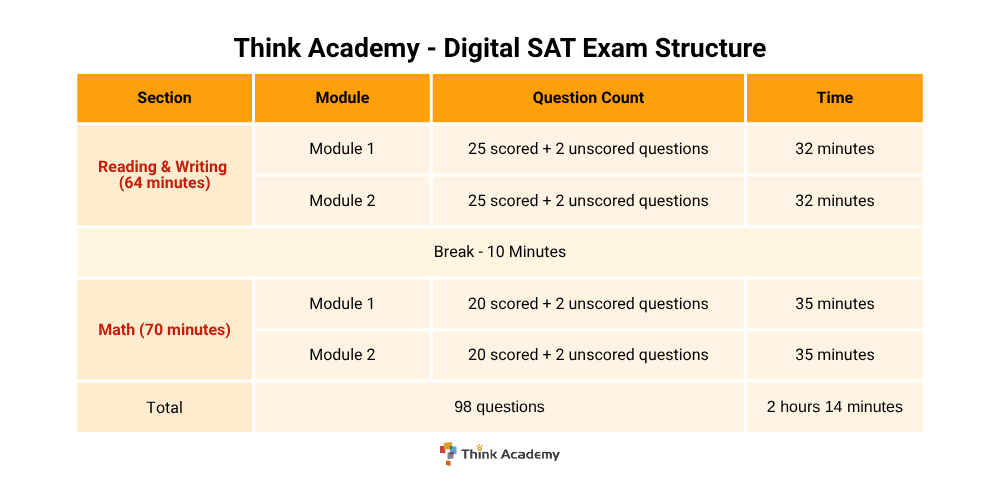
- Shorter test: ~2 hours 14 minutes (down from ~3 hours)
- Adaptive format: Two sections per subject — the second module's difficulty adjusts based on your performance in the first.
- All digital: Taken on a laptop or tablet using the Bluebook app.
- Built-in calculator: Available for the entire Math section.
- No passage-based reading: Reading & Writing questions are shorter, paired with a single passage.
Digital SAT Score Structure
| Section | Score Range | # of Questions | Time |
|---|---|---|---|
| Reading & Writing | 200–800 | 54 questions | 64 minutes |
| Math | 200–800 | 44 questions | 70 minutes |
| Total | 400–1600 | 98 questions | ~134 min |
Each section is divided into two adaptive modules. Module 1 contains standard difficulty questions. Module 2 is either standard or harder depending on Module 1 performance.
Score Benchmarks
| Score | Interpretation |
|---|---|
| 1400+ | Competitive for selective universities |
| 1200–1399 | Average to above average |
| 1000–1199 | Below average; room for improvement |
| Under 1000 | Significant gaps to address |
SAT Benchmarks (College Board):
- Reading & Writing: 480 (college readiness threshold)
- Math: 530 (college readiness threshold)
How the Adaptive Scoring Works
The Digital SAT uses a multistage adaptive testing model:
- Module 1 (both sections): Everyone gets the same difficulty level.
- Module 2: If you perform well on Module 1, you receive harder questions with higher scoring potential. If you perform poorly, you receive easier questions with a lower scoring ceiling.
This means strong performance in Module 1 is critical — it determines your access to the higher-difficulty module where top scores are earned.
Study Plan: 3-Month Digital SAT Prep
Month 1: Diagnostic and Foundation Building
- Take a full practice test (College Board's official Bluebook app has free practice tests).
- Identify your baseline score and the sections where you lose the most points.
- Review content gaps: for Math, focus on algebra, advanced math, problem-solving and data analysis; for Reading & Writing, focus on grammar rules and inference questions.
- Study 45–60 minutes per day, 5 days per week.
Month 2: Targeted Practice
- Focus on your two weakest content areas.
- Complete 20–30 practice questions per session with full review of errors.
- Begin taking timed module-by-module practice sessions.
- Use Khan Academy (official SAT prep partner) for personalized recommendations.
Month 3: Full Test Simulation and Review
- Take 2–3 full-length practice tests under timed conditions.
- After each test: review every wrong answer, categorize errors (conceptual, careless, time pressure).
- Fine-tune pacing strategy — especially the transition between Module 1 and Module 2.
- Last 1–2 weeks: review only your error log; no new content.
Key SAT Math Topics to Master
- Algebra: Linear equations, systems of equations, inequalities
- Advanced Math: Quadratics, polynomial expressions, exponential functions
- Problem-Solving & Data Analysis: Ratios, percentages, statistics, data interpretation
- Geometry & Trigonometry: Area, volume, right triangles, basic trig ratios
Key Reading & Writing Strategies
- Craft and Structure questions: Vocabulary in context, text structure, author's purpose
- Information and Ideas: Central idea, evidence-based analysis, cross-text connections
- Standard English Conventions: Punctuation, sentence structure, subject-verb agreement
- Expression of Ideas: Transitions, rhetorical synthesis
Official Practice Resources
- College Board Bluebook App — Free full-length practice tests
- Khan Academy SAT Prep — Personalized practice linked to PSAT/SAT scores
- College Board SAT Question Bank — Browse official questions by skill
Try Pengi AI — Smarter Math Practice for Students
Pengi AI supports K–12 learners with personalized math practice, guided explanations, and feedback designed to help them build confidence and improve steadily.