Pengi Editor's Note: This article was originally published by Think Academy. We're sharing it here for educational value. Think Academy is a leading K-12 math education provider.
What Is Number Theory? Unlock the Magic of Math
Welcome to the elegant world of number theory.
“Mathematics is the queen of the sciences, and number theory is the queen of mathematics.” — Carl Friedrich Gauss
In this guide, we will transition from foundational concepts to competition-level techniques, helping you and your child discover the structural beauty of mathematics. Let’s dive in.
What Is Number Theory?
Simply put, number theory is the study of the hidden rules and patterns inside whole numbers—the integers like 1, 2, 3, 4, and so on.
Unlike math that measures speed, area or continuous change, number theory focuses on the fundamental behavior of discrete numbers: how they divide, multiply, and relate to one another.
Have you ever wondered:
- Why are all multiples of 2 even numbers?
- Why does 12 have so many factors (1, 2, 3, 4, 6, 12), while 13 has almost none?
- Why do some numbers only divide by 1 and themselves?
Number theory turns these casual questions into a systematic way of thinking:spotting patterns → proving why they work → applying them to solve bigger problems.
Studying number theory is one of the most effective ways to build a student’s logical reasoning, abstract thinking, and proof skills—core abilities that are essential for advanced high school math and future success in STEM.
Foundational Number Theory Concepts
To master the basics, a student must first understand how integers are classified. Recognizing these properties allows students to see math as a highly logical system.
The Logic of Odd and Even Numbers
While 1, 3, and 5 are odd, and 2, 4, and 6 are even, in formal mathematics, this property is known asparity. Understanding parity is not just about counting; it is a fundamental tool for logical deduction.
Even numbers are integers divisible by 2 with no remainder.
Odd numbers are integers not divisible by 2.
A simple set of rules governs how they interact:
- Odd + Odd = Even (e.g., 3 + 5 = 8)
- Odd × Even = Even (e.g., 3 × 6 = 18)
By applying these parity rules, students can instantly verify complex algebraic equations or eliminate incorrect multiple-choice answers without performing the full calculation.
Prime and Composite Numbers
- Prime Numbers: Think of these as the fundamental, unbreakable atoms of mathematics. A prime number is an integer strictly greater than 1 that can only be divided evenly by 1 and itself (e.g., 2, 3, 5, 7, 11).
- Composite Numbers: These are numbers composed of prime building blocks. They have more than two distinct divisors (e.g., 4, 6, 8, 9).
Fun Math Fact: The number 2 is the only even prime number in existence. Furthermore, the number 1 is mathematically considered neither prime nor composite!
Factors and Multiples
- Factors: Think of these as the building blocks that divide a number exactly with no remainder. A factor of an integer is a number that divides it evenly, without leaving a remainder (e.g., factors of 12: 1, 2, 3, 4, 6, 12).
- Multiples: A multiple of an integer is the product obtained by multiplying that integer by another whole number. Multiples are always divisible by the original number (e.g., multiples of 5: 5, 10, 15, 20, 25).
Fun Math Fact: Every number is both a factor and a multiple of itself. Also, 1 is a factor of every whole number in existence!
Higher Level Number Theory Theorem & Tricks
Many parents and students assume math competitions require grueling computational speed. In reality, they test a student’s ability to recognize patterns and apply theorems. A student trained in number theory can solve a 5-minute brute-force calculation in 10 seconds.
Divisibility Rules
Knowing these rapid-fire rules allows students to factorize massive integers instantly:
- Rule for 2: The number ends in an even digit (0, 2, 4, 6, 8). Example: 1,02 4.
- Rule for 3: Add up all the digits; if the sum is a multiple of 3, the whole number is too. Example: 123 (1 + 2 + 3 = 6, which is divisible by 3).
- Rule for 4: The last two digits form a number divisible by 4. Example: 5,0 24 (24 is divisible by 4).
- Rule for 9: Add up all the digits; if the sum is a multiple of 9, the number is too. Example: 8,199 (8 + 1 + 9 + 9 = 27, which is divisible by 9).
- Rule for 25: The last two digits form a number divisible by 25. Example: 1,3 75(75 is divisible by 25).
Counting Factors (Prime Factorization)
Competition Application: “How many distinct positive factors does 360 have?”
Instead of manually listing them, a trained student uses prime factorization:

By taking the exponents, adding 1 to each, and multiplying them together, the solution becomes an elegant calculation: (3+1)×(2+1)×(1+1)=4×3×2=24.
There are exactly 24 factors.
Modular Arithmetic (Congruence)
Often introduced as “Clock Math,” modular arithmetic is the mathematical system of dealing with remainders.
Competition Application: A classic contest question is: “What is the last digit of 2 to the power of 100?”
A student without number theory training might give up, thinking it’s impossible to calculate. But a trained child knows to look for the repeating pattern of the last digits of powers of 2: (2, 4, 8, 6, 2, 4, 8, 6…). Since the pattern repeats every 4 numbers, and 100 is perfectly divisible by 4, the last digit must be 6! No calculator needed.
The Fibonacci Sequence
This is where arithmetic elegance meets the natural world. The sequence begins like this: 1, 1, 2, 3, 5, 8, 13…
Do you see the recursive pattern? Every number is the exact sum of the two preceding numbers (e.g., 5 + 8 = 13). From the precise geometric arrangement of sunflower seeds to the spiral of a pinecone, the Fibonacci sequence proves that mathematical rules quietly govern the architecture of nature.
Competition Application: “You are climbing a staircase with 5 steps. You can choose to take either 1 step or 2 steps at a time. How many different ways can you climb to the top?”
Instead of drawing out every single messy combination, students learn that the answers perfectly follow the Fibonacci sequence: 1 step = 1 way, 2 steps = 2 ways, 3 steps = 3 ways, 4 steps = 5 ways, and 5 steps = 8 ways.
When Numbers Meet Geometry
When number theory collides with geometry, numbers suddenly transform into tangible, visual shapes! This is a fantastic way for visual learners to physically see the magic of mathematics.
Triangular Numbers
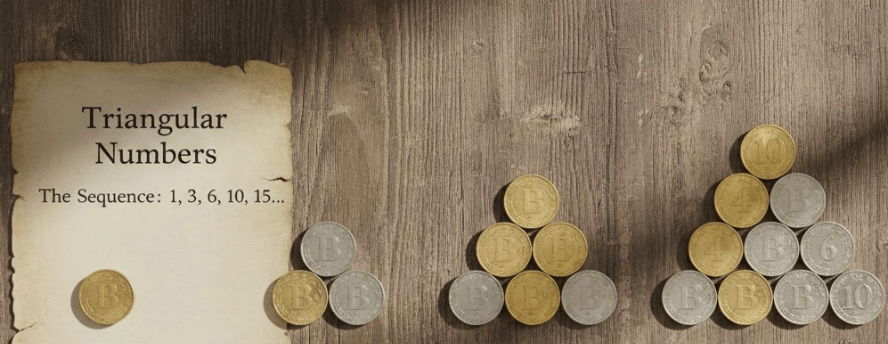
The Sequence: 1, 3, 6, 10, 15…
Why are they called triangular? Because in discrete mathematics, these specific numbers physically build perfect triangles!
If you grab a handful of coins and arrange them on a table, each new bottom layer adds exactly one more coin than the layer above it.
- Layer 1 needs 1 coin.
- Layer 2 needs 2 coins (Total: 3).
- Layer 3 needs 3 coins (Total: 6).
- Layer 4 needs 4 coins (Total: 10).
Suddenly, adding numbers becomes a fun, hands-on building game.
Triangular Numbers
Perfect Squares (Square Numbers)
The Sequence: 1, 4, 9, 16…
In English, these are formally called Perfect Squares or Square Numbers. Have you ever wondered why we use the word “square” for multiplying a number by itself? Because if you have 9 pennies or 16 Lego bricks, you can arrange them to form a mathematically flawless, perfectly symmetrical square grid (like a 3×3 or 4×4 layout). This visual representation makes the concept of algebraic exponents instantly intuitive.
Pythagorean Triples: Integers Hiding in Right Triangles
We often think of the famous Pythagorean Theorem strictly as a geometry rule. But finding whole integers that perfectly fit this equation is a classic puzzle in number theory!
These magical sets of whole numbers are known as Pythagorean Triples. The most famous ones are (3, 4, 5) and (5, 12, 13). They prove that beautiful, clean integer relationships are secretly hiding inside the sharp angles of right triangles.
Number Theory Real-World Application
If your child loves video games, robots, or coding, number theory is their golden ticket. It is the absolute foundation of algorithms and computer science. Computers process everything in discrete, whole numbers (zeros and ones). By mastering number theory concepts now, your child is building the exact logical framework they will need for a highly successful future in any STEM (Science, Technology, Engineering, and Mathematics) field.
Number Theory Cheat Sheet & Practice
Quick Number Theory Cheat Sheet
To help your child easily remember these awesome concepts, we have put together a quick vocabulary cheat sheet. Feel free to download!
Free Download Number Theory Cheat Sheet
Number Theory Practice
At Think Academy, we periodically release rigorous, highly targeted practice sets designed by our expert coaches to challenge and inspire students.
To get your child started right away, we have compiled a special bundle of our classic number theory competition-level practice problems from previous training sessions. Feel free to download!
Free Download Number Theory Practice
Join the Think Academy Community
Want to ensure your child never misses out on high-quality math resources?
Subscribe to our blog and join the Think Academy Newsletter! By subscribing, you will receive our latest, carefully crafted math practice sets, exclusive competition updates, and professional math education insights delivered straight to your inbox.
Try Pengi AI — Smarter Math Practice for Students
Pengi AI supports K–12 learners with personalized math practice, guided explanations, and feedback designed to help them build confidence and improve steadily.